Costochondritis: Causes, Symptoms, Diagnosis, and Treatment
What is costochondritis?
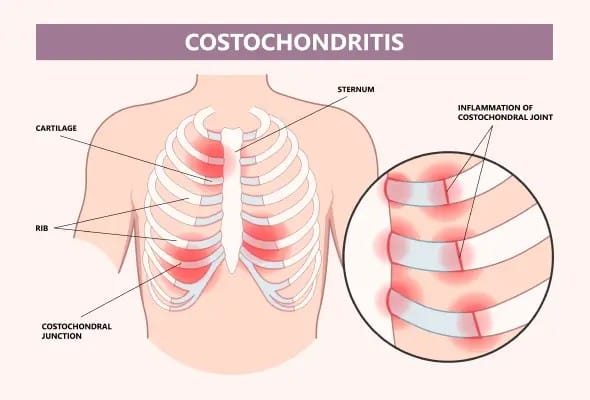
There are 12 pairs of ribs that encase the heart and lungs. Of the 12 rib pairs, the first 7 are true ribs, articulating directly with the sternum via their costal cartilages. The rest are false rib pairs, with pairs 8 to 10 attaching indirectly to the sternum via cartilage connections to the ribs above them. Pairs 11 and 12 are "floating ribs," having no sternal attachment.
Costochondral junctions, where the costal cartilages articulate with the sternum, are crucial in costochondritis pathophysiology. These junctions are composed of hyaline cartilage, which is susceptible to inflammation. Costochondritis is painful inflammation in the cartilage that connects your ribs to the breastbone in front. [1]
How common is costochondritis?
Costochondritis is one of the most common causes of chest pain. Experts estimate that around one-third of people who visit a healthcare provider with chest pain or rib pain have costochondritis.
What are the symptoms of costochondritis?
Pain in the chest that feels like a low ache is the most common symptom of costochondritis. The pain might feel suddenly sharp or stabbing when you move your chest or torso. Some movements that can make costochondritis pain worse include:
- Breathing, especially taking deep breaths or breathing heavily.
- Coughing, sneezing, or vomiting.
- Twisting your torso.
- Reaching overhead (like grabbing something off a high shelf).
- Hugging someone.
- Exercising.
- Lying down on your affected side.
- Tenderness when you press the area where the rib joins the breastbone. [2]
What are the causes of costochondritis?
- Chest injury
- Hard exercise or heavy lifting
- Viral infections, such as respiratory infections
- Strain from coughing
- Infections after surgery or from intravenous (IV) drug use
- Some types of arthritis [3]
How is costochondritis diagnosed?
Costochondritis can mimic acute coronary syndrome, pulmonary embolism, aortic dissection, pneumonia, oesophageal injury, pneumothorax, and trauma, which must all be ruled out. Factors that provoke or improve pain should also be elicited. A comprehensive history and physical exam helps exclude chest pain etiologies before making a costochondritis diagnosis.
Chest wall pain due to costochondritis is usually reproducible by mild-to-moderate palpation at the upper costochondral junctions. Often, point tenderness is elicited where 1 or 2 ribs meet the sternum. However, a pitfall of the typical costochondritis physical findings is that pain due to acute coronary syndrome is occasionally described as reproducible. Patients with costochondritis present with normal vital signs. Tachycardia or hypotension should raise suspicion of an alternative diagnosis as the cause of the patient's chest pain
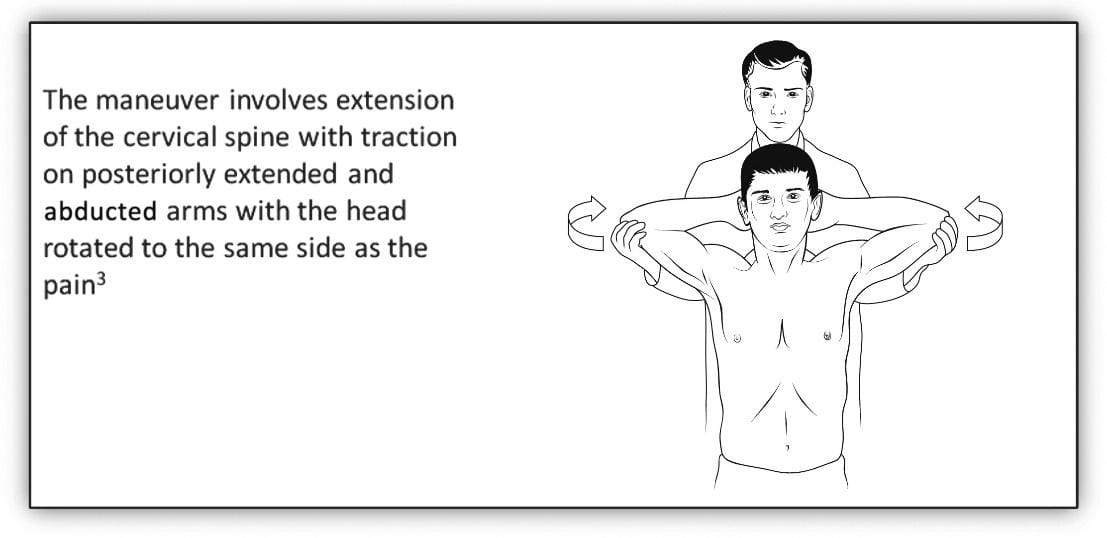
The "crowing rooster" and "horizontal arm flexion" tests are performed to elicit costochondritis pain. [1]
There’s no imaging test that can diagnose costochondritis. But your provider may use some imaging tests to rule out other causes of rib pain. The most common tests include:
- Chest X-ray
- Computed tomography scan
- Magnetic resonance imaging
- Ultrasound
- Electrocardiogram [2]
How is costochondritis treated?
Treatment for costochondritis aims primarily to relieve symptoms. Topical modalities include heat and topical medications such as capsaicin, diclofenac gel, and lidocaine patches. Oral NSAIDs or acetaminophen may also be considered.
Localized corticosteroid injections at the costochondral junction have insufficient evidence and thus should only be considered for people unresponsive to more conservative treatments.
There is minimal evidence supporting physical therapy involving a stretching program in reducing pain compared to other treatment methods. [1]