
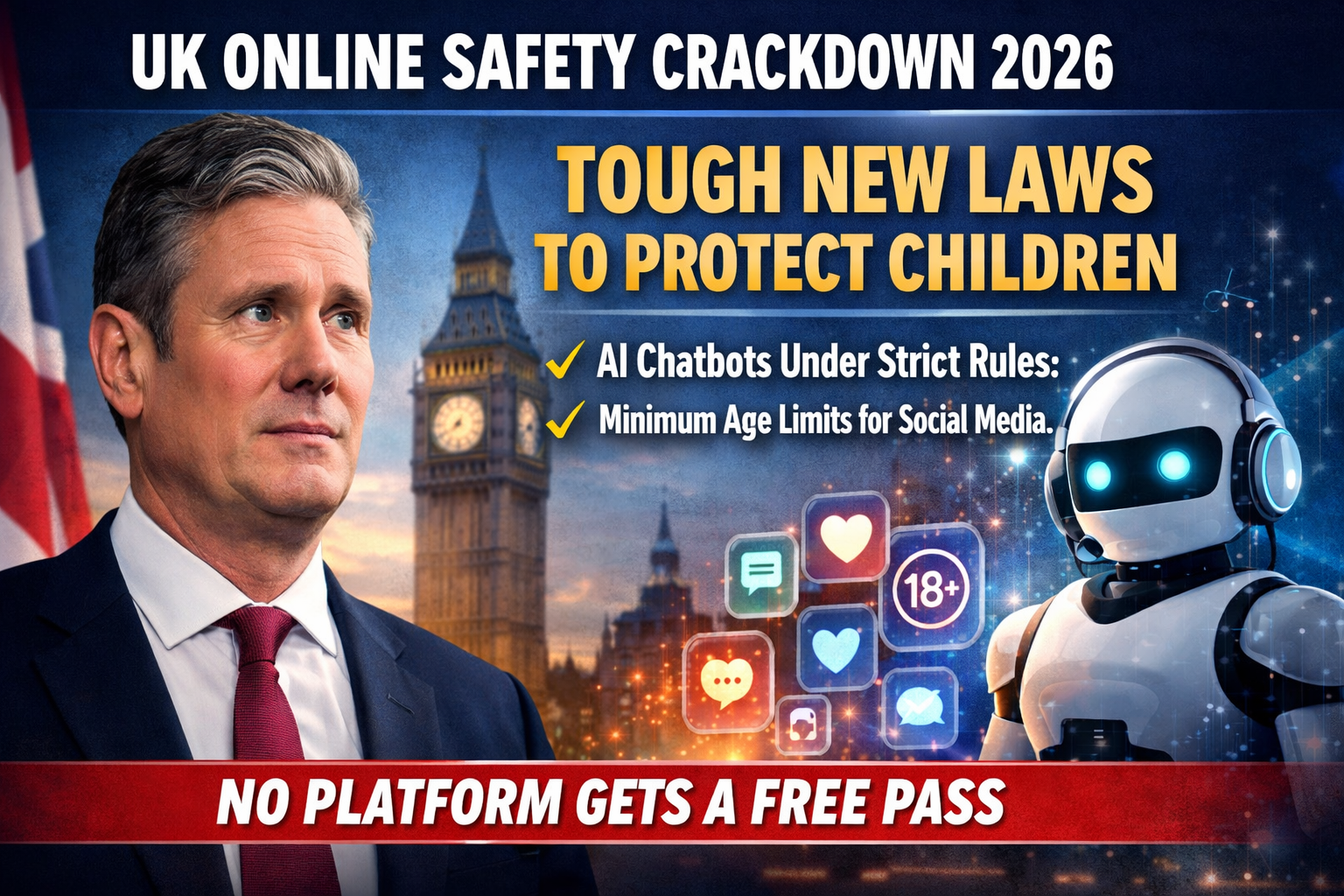
AI Chatbots and Social Media Face Stricter UK Laws in Major Child Online Safety Reform
The UK Government has announced sweeping new measures to protect children online, declaring that no digital platform will be exempt from responsibility. In a major press release from the Prime Minister's Office and the Department for Science, Innovation and Technology, Prime Minister Keir Starmer outlined immediate steps to close legal loopholes, strengthen enforcement under the Online Safety Act, and crack down on harmful AI chatbot content.
This decisive shift in online safety policy signals a new era for digital regulation in the United Kingdom, particularly when it comes to protecting children from illegal and harmful online content.
Why Online Safety Reform Is Urgent in 2026
The digital world has transformed dramatically over the past decade. Social media platforms, AI chatbots, encrypted messaging apps, and addictive design features such as infinite scrolling have reshaped how children interact, learn, and socialise.
However, these innovations have also introduced serious risks:
- Exposure to illegal content
- Non-consensual intimate image sharing
- Online grooming and exploitation
- Misogynistic and ragebait content
- AI-generated harmful material
- Circumvention of safeguards via VPNs
As technology evolves rapidly, the Government argues that regulation must evolve just as quickly. The Prime Minister stated that Britain must be a leader, not a follower, in online child protection.
Closing Loopholes in the Online Safety Act
A key announcement involves tightening the scope of the UK’s Online Safety Act to ensure that all AI chatbot providers comply with illegal content duties.
Currently, some AI-driven services have operated in legal grey areas. The Government will now table amendments to ensure that chatbot providers cannot avoid responsibilities under the law.
Under the new approach:
- AI chatbots must prevent illegal content distribution
- Providers face legal consequences if they fail
- The law will adapt to emerging AI risks
- Enforcement can occur within months rather than years
This move comes after government intervention concerning content shared via Grok, an AI tool linked to Elon Musk. Following scrutiny, certain harmful functions were removed.
The message is clear: technological innovation does not exempt platforms from UK law.
New Legal Powers for Faster Action
In addition to closing loopholes, the Government will introduce new powers through amendments to the Children’s Wellbeing and Schools Bill and the Crime and Policing Bill.
These powers aim to:
- Enable rapid implementation of consultation outcomes
- Avoid delays caused by new primary legislation
- Provide Parliament with affirmative voting oversight
- Preserve child social media data following a child’s death
One particularly significant proposal would ensure that critical online data is preserved after a child’s death, unless it is clearly unrelated. This responds to concerns raised by families seeking answers about online activity linked to tragic circumstances.
Minimum Age Limits and Social Media Restrictions
The Government’s upcoming children’s digital wellbeing consultation will examine stronger safeguards, including:
- Setting a minimum age for social media use
- Restricting harmful design features such as infinite scrolling
- Changing the age of digital consent
- Limiting children’s VPN use when it undermines safety protections
- Considering restrictions on AI chatbot use by minors
While some campaigners have pushed for a blanket under-16 social media ban, ministers suggest that targeted regulation and robust enforcement may offer stronger, evidence-based protection.
The distribution of nude images of children is already illegal under UK law. However, the Government will consult on preventative mechanisms to stop children from sending or receiving such content in the first place.
Parents at the Centre of the Strategy
A recurring theme in the announcement is parental support. Prime Minister Starmer, speaking as a father of two teenagers, emphasised the real-world anxieties families face.
To provide immediate assistance, the Department for Science, Innovation and Technology has launched the You Won’t Know Until You Ask campaign. The initiative includes:
- Guidance on parental safety settings
- Conversation prompts for discussing online safety
- Age-appropriate advice
- Resources for dealing with misogynistic and harmful content
The Government states that policy will be shaped directly by consultation with parents and young people, ensuring reforms reflect lived experiences rather than theoretical assumptions.
Support from Child Protection Organisations
Leading charities have cautiously welcomed the announcement.
NSPCC Response
NSPCC CEO Chris Sherwood praised the Government’s commitment to urgent action. The NSPCC has long advocated:
- Stronger age-limit enforcement
- An end to addictive design
- Greater platform accountability
- Child-centred policy development
The organisation warned that without meaningful change, calls for stricter bans will intensify.
Molly Rose Foundation Reaction
The Molly Rose Foundation, led by Chief Executive Andy Burrows, also supported swift reforms. The Foundation has campaigned extensively on online harm prevention and the regulation of harmful content that can affect vulnerable young people.
However, it urged the Prime Minister to go further and strengthen regulation to ensure that product safety and children’s wellbeing become non-negotiable costs of doing business in the UK.
AI Chatbots Under Scrutiny
Artificial intelligence presents both promise and peril. AI chatbots can assist with homework, creativity, and communication, but they can also:
- Generate inappropriate content
- Share harmful advice
- Enable grooming or manipulation
- Circumvent traditional moderation
By explicitly bringing chatbot providers under the Online Safety Act’s illegal content duties, the Government is attempting to future-proof regulation.
This move reflects a broader global debate about AI governance and ethical technology development. The UK aims to balance innovation with responsibility, ensuring that children are not experimental subjects in a rapidly evolving digital landscape.
Data Preservation After Child Death
One of the more sensitive but crucial proposals concerns preserving digital evidence after a child’s death. Families often struggle to access social media records that may shed light on harmful interactions.
The proposed amendment would require platforms to preserve relevant data before deletion. This measure seeks to support bereaved families and ensure accountability where online harm may have played a role.
A Shift in UK Online Safety Leadership
The Prime Minister framed these reforms as part of a broader shift in how Britain approaches digital regulation.
The UK intends to:
- Lead globally on child online protection
- Act proactively rather than reactively
- Strengthen enforcement against powerful tech companies
- Ensure rapid response mechanisms for emerging technologies
Rather than waiting years for legislative updates, ministers argue that flexible legal powers will allow quicker adaptation to technological change.
What Happens Next?
The children’s digital wellbeing consultation launches next month. Its findings will inform targeted measures that could take effect within months, subject to parliamentary approval.
Key milestones include:
- Public consultation period
- Evidence gathering from parents and children
- Legislative amendments tabled
- House of Commons vote
- Implementation of enforcement powers
If approved, the measures will significantly expand regulatory oversight of social media platforms, AI providers, and digital services accessed by minors.
Why This Matters for Parents and Tech Companies
For parents, this announcement represents:
- Greater clarity about platform responsibilities
- Faster government response to new risks
- Stronger legal backing for child protection
For tech companies, the message is unequivocal:
Compliance with UK online safety law is mandatory. No platform gets a free pass.
Companies operating AI tools, social media services, or communication platforms will need to ensure that:
- Age verification systems are robust
- Illegal content is proactively removed
- Design features do not exploit young users
- Safeguards prevent harmful image sharing
Failure to comply may lead to enforcement action under strengthened legal powers.
Final Thoughts
The UK Government’s 2026 online safety crackdown marks a pivotal moment in digital regulation. By tightening rules on AI chatbots, closing loopholes in the Online Safety Act, and accelerating child protection measures, ministers aim to keep pace with a rapidly changing technological environment.
As the consultation unfolds, parents, children, charities, and technology providers will shape the next phase of reform. Whether these measures deliver meaningful protection will depend on effective enforcement, transparent implementation, and sustained political commitment.
What is clear is that the Government has drawn a line in the sand. In the digital age, protecting children is no longer optional for platforms operating in the United Kingdom.
Source
UK Government Press Release: “PM: ‘No platform gets a free pass’: Government takes action to keep children safe online” Published 15 February 2026.
Disclaimer
This blog post is for informational and commentary purposes only. It summarises and analyses publicly available government information and does not constitute legal advice. For official policy details, legislative updates, or guidance, please refer directly to GOV.UK or consult a qualified legal professional.