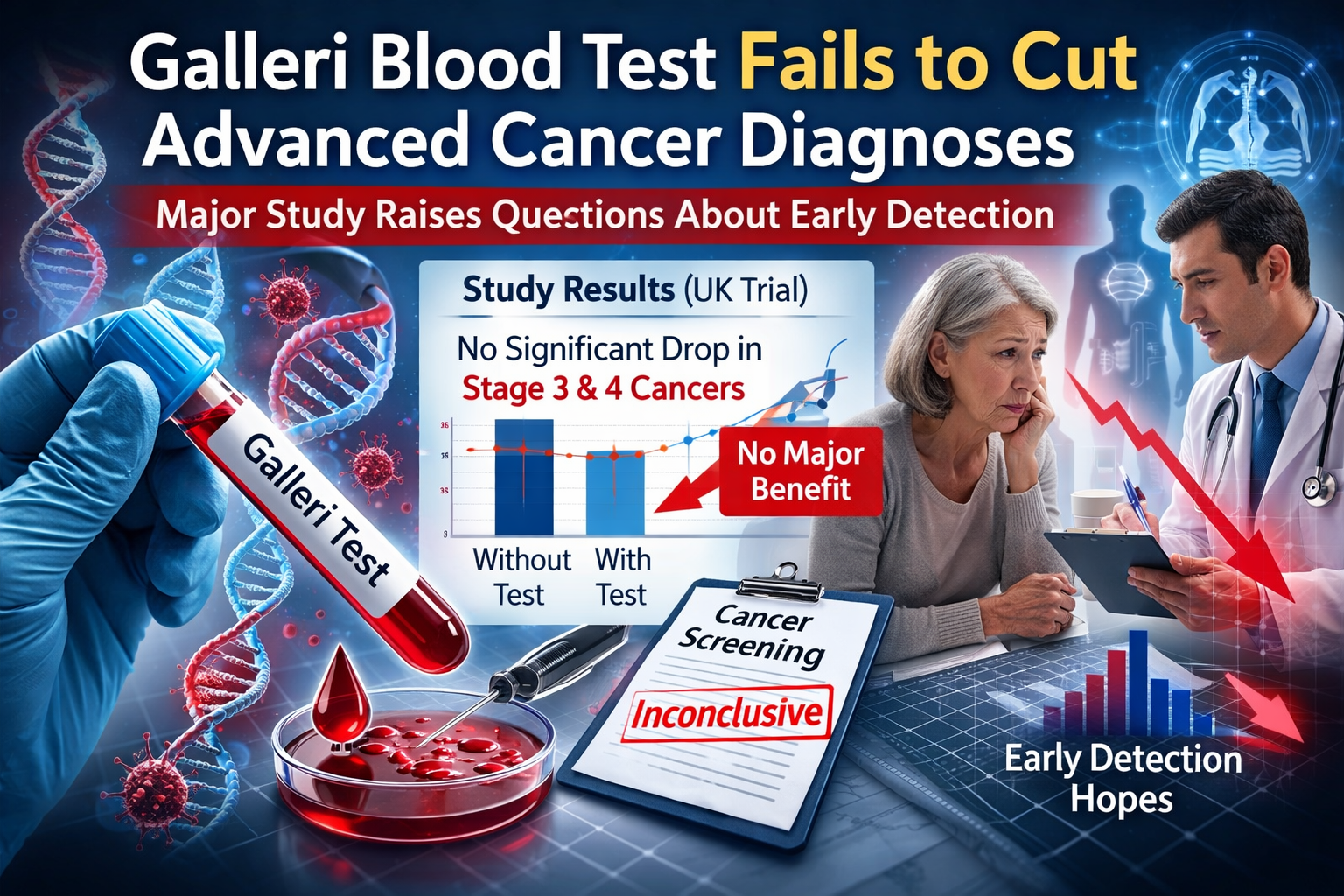
A major new study has revealed that the Galleri blood test, designed to detect more than 50 types of cancer at early stages, did not lead to a meaningful drop in the number of advanced stage cancers diagnosed among participants. The findings have sparked debate in the medical community and have major implications for the future of blood‑based cancer screening tests. This article explains the study results in clear terms and explores what they mean for patients, doctors, public health officials and anyone interested in the latest advances in cancer detection.
What Is the Galleri Blood Test
The Galleri blood test is a product developed by the biotechnology company Grail. It examines small fragments of DNA in the blood that are shed by tumors. The idea is that certain patterns in this circulating tumor DNA can signal the presence of cancer before symptoms develop. Because many dangerous cancers do not have reliable screening tests, Galleri has been marketed as a next generation tool for early detection. It is not currently approved by the U.S. Food and Drug Administration (FDA), and individuals typically pay about $949 for the test out of pocket.
The Major New Study Explained
A large trial in the United Kingdom enrolled about 142,000 healthy adults between the ages of 50 and 77. The study was conducted in collaboration with the U.K. National Health Service. Participants were randomly divided into two groups. One group received the Galleri blood test, while the other group followed standard care with no additional testing.
Researchers followed both groups for three years. Their goal was to see whether offering the Galleri test would lead to fewer diagnoses of late stage cancers. Late stage cancers are defined as stage 3 or stage 4 cancers. These more advanced cases are typically harder to treat and have worse outcomes than early stage cancers.
The main objective of the study was ambitious. Researchers hoped to show a 20 percent reduction in the number of advanced stage cancers diagnosed in the group offered the Galleri test compared to the group that did not receive it.
Key Result: The Primary Goal Was Not Met
The study found no statistically significant difference in the number of stage 3 and stage 4 cancers diagnosed between the group that received the Galleri test and the group that did not. This means that, on average, offering the test did not reduce the number of cancers only found at advanced stages.
Grail acknowledged missing the primary target for the study. Dr. Harpal Kumar, Grail’s chief scientific officer, said the test did deliver some promising findings but emphasized that the primary goal was not met according to the defined study results.
Secondary Findings and Company Perspective
Grail has noted some secondary patterns in the data that it views as encouraging. For example, they reported a slight reduction in the number of stage 4 cancers and a possible relative increase in stage 3 diagnoses. They argue this suggests the test may be detecting cancers slightly earlier before the disease has fully progressed.
Company representatives characterized these outcomes as showing potential clinical benefit. However, these secondary or exploratory findings are not definitive proof that the test meaningfully improves cancer outcomes in the general population.
Medical Community Reaction
Many experts outside of Grail have been blunt in their interpretation of the study results. Some say the failure to reach the primary endpoint means the test should not be widely adopted into health care systems. One academic expert said if there had been a clear and strong benefit, it would be obvious from the data.
Critics point out that finding cancers earlier does not automatically translate into people living longer or having better quality of life. They also highlight issues that can occur with blood screening tests such as false positives where the test indicates cancer but follow up imaging shows no tumor or where the test misses a real cancer.
Another concern is that finding early disease could subject patients to anxiety and invasive testing without improving survival outcomes. As one oncologist put it, people may feel they have a danger hanging over them without clear guidance on how to respond.
Comparison With Other Cancer Screening Methods
It is important to note that existing screening tools for some cancers already show clear benefits. Mammograms for breast cancer and colonoscopies for colorectal cancer have long histories of helping detect disease early and reducing mortality. These tests are backed by decades of research and well defined screening protocols.
In contrast, the Galleri test was designed to screen for many types of cancer all at once. This is a much more complex challenge than screening for a single cancer type. Because each cancer behaves differently biologically the sensitivity and specificity for each vary widely.
This difference may explain why the test has proven promising in concept and still disappointing in aggregate outcomes measured in this large study.
Impact on FDA Approval and Health Insurance Coverage
Grail has applied for FDA approval of the Galleri blood test. The new trial results could affect how regulators view the test. Successful FDA approval typically requires clear evidence that a test improves health outcomes or provides meaningful benefit over current care.
Some blood cancer tests have been granted coverage under Medicare through a new law allowing payment for certain types of early detection testing. Offering reimbursement is seen as an important step toward broader adoption. The Galleri test may qualify for coverage under Medicare rules but it is not automatically covered simply because of the new legislation.
Regulators and payers will likely consider the study findings closely as they evaluate the clinical utility and value of the test.
The Promise and Challenges of Multi‑Cancer Blood Tests
The idea of a simple blood test that can detect many cancers early is highly appealing. Scientists and medical companies have invested heavily in this concept because of its potential to catch cancers that lack current screening options.
Despite the disappointing results of this trial, researchers continue to explore better ways to interpret circulating tumor DNA and to refine the technology. Some experts describe this field as still in early days despite the high expectations.
Other researchers emphasize that moving from promising laboratory results to real world benefits for people is extremely difficult. Cancer is not a single disease but a collection of many separate diseases with unique characteristics.
Implications for Patients and Public Health
For patients, the study reinforces the idea that no screening test is perfect. When considering any screening tool, individuals must weigh the potential benefits against possible harms including anxiety, false positives, unnecessary procedures and limitations of the test itself.
People who are concerned about cancer risk should continue to follow established screening guidelines for cancers where evidence supports benefit. They should also have open conversations with their health care providers about the risks and benefits of any newer testing option such as Galleri.
From a public health perspective, evidence that a test changes the total number of advanced cancers diagnosed is essential before it can be recommended widely. Reducing late stage diagnoses can lead to better survival and lower overall costs. Without clear evidence this is happening, large scale implementation is hard to justify.
What Comes Next for Galleri and Research
Grail and other companies working on similar technologies are likely to conduct further analyses and possibly additional studies. Researchers may explore refined algorithms, different populations, or combine blood tests with other tools to see if outcomes improve.
Scientists continue to study circulating tumor DNA in hopes of identifying patterns that reliably predict cancer presence before symptoms occur. There is ongoing investment in bioinformatics, machine learning and larger datasets to improve the ability to pick up true signals and avoid false alarms.
Success in this area could still revolutionize cancer care but the path appears more complicated and longer than early enthusiasm might have suggested.
Final Thoughts
The large UK study testing the Galleri blood test’s impact on advanced cancer detection produced sobering results. The test did not reduce the number of late stage cancers diagnosed compared to standard care. This challenges the notion that the test can deliver on its promise as a general screening tool. Scientists praised the size and quality of the study but noted that finding earlier disease does not always translate into improved patient outcomes.
While secondary analyses offered some hopeful signals, experts emphasize the importance of rigorous evidence before adopting widespread screening strategies. The Galleri test remains under review by regulators and insurers will consider these results when making coverage decisions.
Anyone interested in cancer screening should carefully review available evidence and discuss options with trusted medical professionals. Established screening guidelines remain important tools for reducing cancer morbidity and mortality.
Source: New York Times article dated February 20, 2026
Disclaimer: This article is for educational and informational purposes only. It is not medical advice and does not replace consultation with a qualified health care provider. Information about medical studies and diagnostic tests can change over time and outcomes vary based on individual health conditions. Always seek personalized advice from a licensed medical professional before making decisions about medical tests or treatments.

Most Accurate Healthcare AI designed for everything from admin workflows to clinical decision support.