
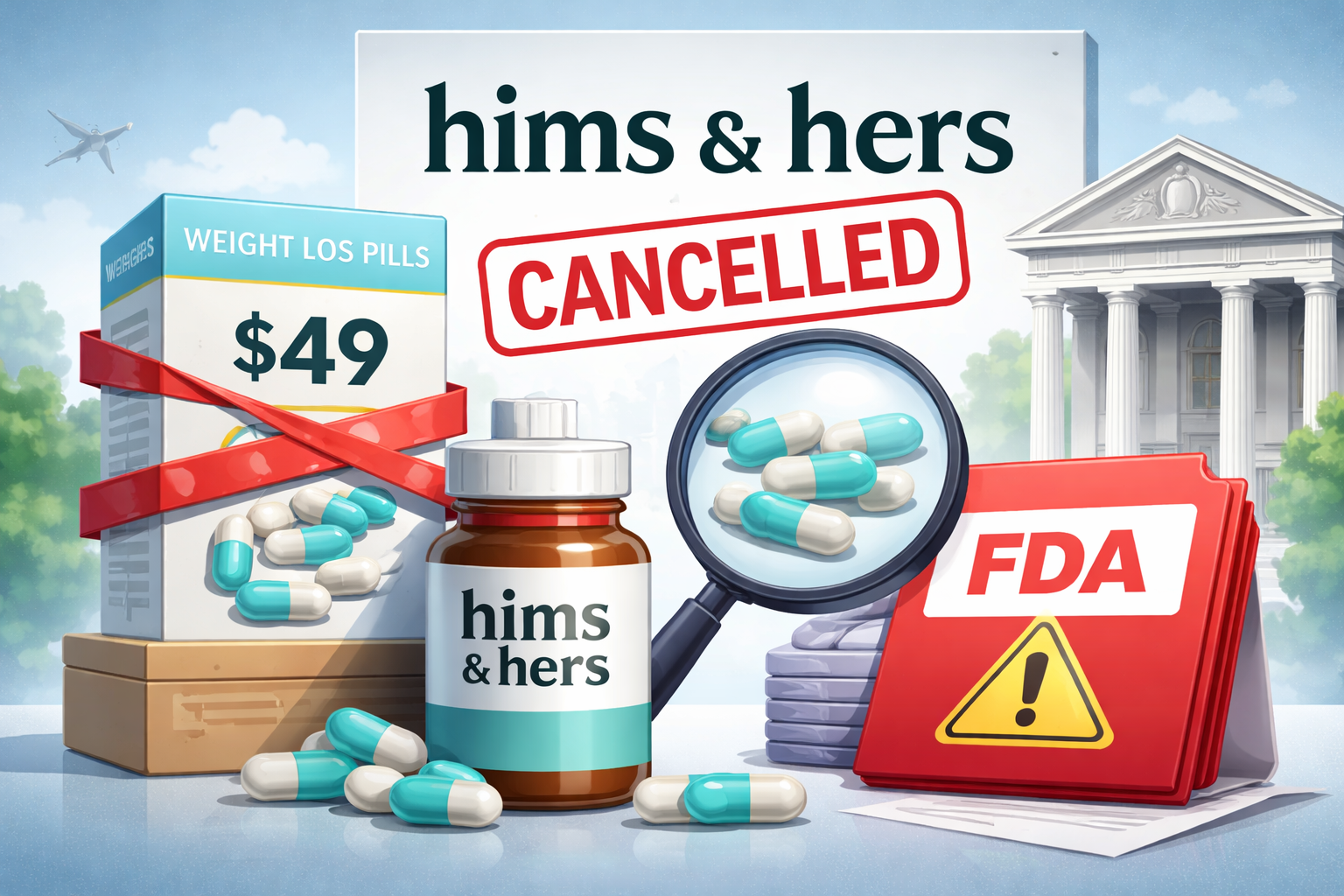
Why Hims & Hers Pulled Its Cheaper Wegovy-Style Weight-Loss Pill: FDA Scrutiny and Legal Challenges Explained
In early February 2026, the telehealth company Hims & Hers Health abruptly halted sales of its low‑cost weight‑loss pill that was positioned as a copycat version of Novo Nordisk’s Wegovy. The move came shortly after federal health regulators and the pharmaceutical giant raised serious concerns about the legality, safety, and marketing of the product. This development has generated widespread discussion across health, regulatory, consumer, and investor communities. In this blog post, we break down the story, unpack the implications for patients and the industry, and explore what this means for the future of compounded weight‑loss drugs in the United States.
A Quick Summary of the Issue
In early January 2026, Hims & Hers introduced a compounded semaglutide pill to the U.S. market priced significantly below the FDA‑approved Wegovy pill. Wegovy, manufactured by Novo Nordisk, is a GLP‑1 class weight‑loss medication that had been previously available mainly as an injection and more recently in pill form. Hims’s version was priced at approximately $49 for the first month and $99 for each month after, compared with roughly $149 per month for the branded Wegovy pill.
However, within just two days of the product’s launch, Hims & Hers announced it would stop offering the pill after scrutiny from the U.S. Food and Drug Administration (FDA) and threats of legal action by Novo Nordisk. Federal regulators flagged concerns that the product might violate drug laws and that the marketing around it could mislead consumers about its safety and efficacy.
Why Hims & Hers Launched the Pill
Hims & Hers built a large part of its business around online telehealth services and compounded medications, including GLP‑1 weight‑loss treatments. Compounded drugs are tailor‑made formulations created by pharmacists, often used when commercially available drugs are in shortage or when individual customizations are required. Historically, compounded medications have enjoyed legal exceptions that allow them to be made without full clinical review by the FDA under certain conditions.
With the weight‑loss drug market exploding in recent years, demand for GLP‑1 medications like Ozempic and Wegovy surged. Compounded alternatives became popular because they were often sold at lower prices. Before 2025, these compounded versions coexisted alongside branded treatments, partly because there were shortages of some GLP‑1 products.
However, by late 2025, the FDA declared that GLP‑1 drugs were no longer in shortage, which should have signaled an end to mass compounding based on shortage exemptions alone. Even so, companies like Hims & Hers continued to compound and sell semaglutide products, asserting that their offerings met patient needs and represented personalized medicine options, despite not being FDA‑approved medications.
Federal Regulators and Legal Pressure
The turning point came in early February 2026 when federal officials, including the FDA and the Department of Health and Human Services (HHS), intensified scrutiny of compounded GLP‑1 drugs. The FDA publicly stated its intention to take action against companies mass‑marketing unapproved analogues of FDA‑approved weight‑loss medications, emphasizing that the agency could not verify the quality, safety, or effectiveness of these knockoff compounds.
HHS issued a referral to the U.S. Department of Justice (DOJ) to investigate potential violations of the Federal Food, Drug, and Cosmetic Act by Hims & Hers and other compounders. In response, Hims & Hers said it was discontinuing access to its compounded semaglutide pill after “constructive conversations with stakeholders across the industry.”
In addition to regulatory pressure, Novo Nordisk filed a lawsuit against Hims & Hers, alleging that the telehealth company’s compounded pills infringed on patents for the original Wegovy product. The suit sought to permanently bar Hims & Hers from selling unapproved, compounded semaglutide drugs and to recover damages for the pharmaceutical company.
What Regulators and Experts Are Saying
Federal regulators and health experts have voiced multiple concerns about compounded versions of GLP‑1 weight‑loss drugs:
Quality and Safety Concerns:
Compounded drugs are not approved by the FDA through large‑scale clinical trials. This means that their safety, purity, and effectiveness are not verified to the same standard as FDA‑approved products. The FDA and other medical organizations emphasize that compounded versions can vary significantly in dose, efficacy, and purity.
Misleading Marketing:
The FDA has warned that companies cannot advertise compounded products as being equivalent to FDA‑approved drugs. Misleading claims that a compounded product contains the “same active ingredient” or is “clinically proven” can violate the Federal Food, Drug, and Cosmetic Act. Previous FDA warning letters to Hims & Hers reinforced that such language misbrands these products.
Patent and Regulatory Compliance:
Pharmaceutical companies like Novo Nordisk protect their intellectual property through patents, and competing products that mimic patented formulations without approval or licensing can face legal challenges. Novo argues that Hims’s pill infringed on Wegovy’s patents and undermined the regulatory framework that ensures drug safety and innovation.
Industry and Market Impact
The rapid rise and fall of Hims’s compounded semaglutide pill had ripple effects across both the telehealth and pharmaceutical industries.
Investor Response:
After Hims & Hers announced it would discontinue the pill, its stock price plunged, reflecting investor concern over regulatory risk and future revenue prospects from GLP‑1 products. At the same time, shares of Novo Nordisk rose as the legal and regulatory actions were seen as protecting its patented treatments.
Corporate Strategy Shifts:
Hims & Hers may need to reassess its strategy in the weight‑loss drug space. With compounded GLP‑1 products facing tighter scrutiny, the company could pivot to selling FDA‑approved branded medications or develop its own proprietary treatments. Analysts believe a regulatory crackdown could reshape how telehealth companies operate in the drug distribution market.
Broader Regulatory Implications:
The FDA’s actions signal a broader regulatory push to enforce consistent standards across all products marketed as weight‑loss treatments. This could affect other compounders and telehealth providers who have sold similar knockoff versions of GLP‑1 therapies. It may also prompt more rigorous enforcement of miscellaneous claims in advertising across the pharmaceutical and telehealth sectors.
What It Means for Patients
For consumers considering weight‑loss medications, this episode highlights important points about safety and regulation:
Choose FDA‑Approved Treatments:
FDA‑approved drugs undergo rigorous testing for safety and effectiveness. When a product is not approved, patients may face unknown risks from unverified manufacturing and formulation.
Talk to Healthcare Providers:
Before starting or stopping any medication, especially for weight loss, individuals should consult a qualified healthcare professional. Medical decisions should be based on personalized clinical advice rather than marketing claims.
Understand the Risks of Compounded Medications:
While compounded drugs can address specific clinical needs, especially when approved medications are not suitable or available, they may carry uncertainty in dosage and quality. This is particularly important in complex drug classes like GLP‑1 therapies.
Looking Ahead
The Hims & Hers situation underscores the dynamic tension between patient demand for affordable weight‑loss solutions and the need to ensure drug safety and regulatory compliance. As federal regulators continue to clarify the legal framework for compounded drugs, industry participants, healthcare providers, and patients will be watching closely.
In the months ahead, we may see additional legal challenges, updated FDA guidance, and perhaps new business models emerging from companies that once relied on compounded therapies. The balance between innovation, accessibility, and safety remains at the heart of the debate.
Sources
- The New York Times, February 7, 2026
- Reuters, February 7, 2026
- Forbes, February 9, 2026
- FDA public statements and warning letters, 2025–2026
- GlobeNewswire, February 9, 2026
- Barron’s and Becker’s Hospital Review coverage, 2026
Disclaimer
This article is provided for informational and educational purposes only. It reflects developments reported by reputable news organizations and public statements from companies and regulators. It does not constitute medical advice, diagnosis, or treatment. For individual health decisions, always consult a qualified healthcare professional. None of the content here should be construed as endorsement of any product or company.