
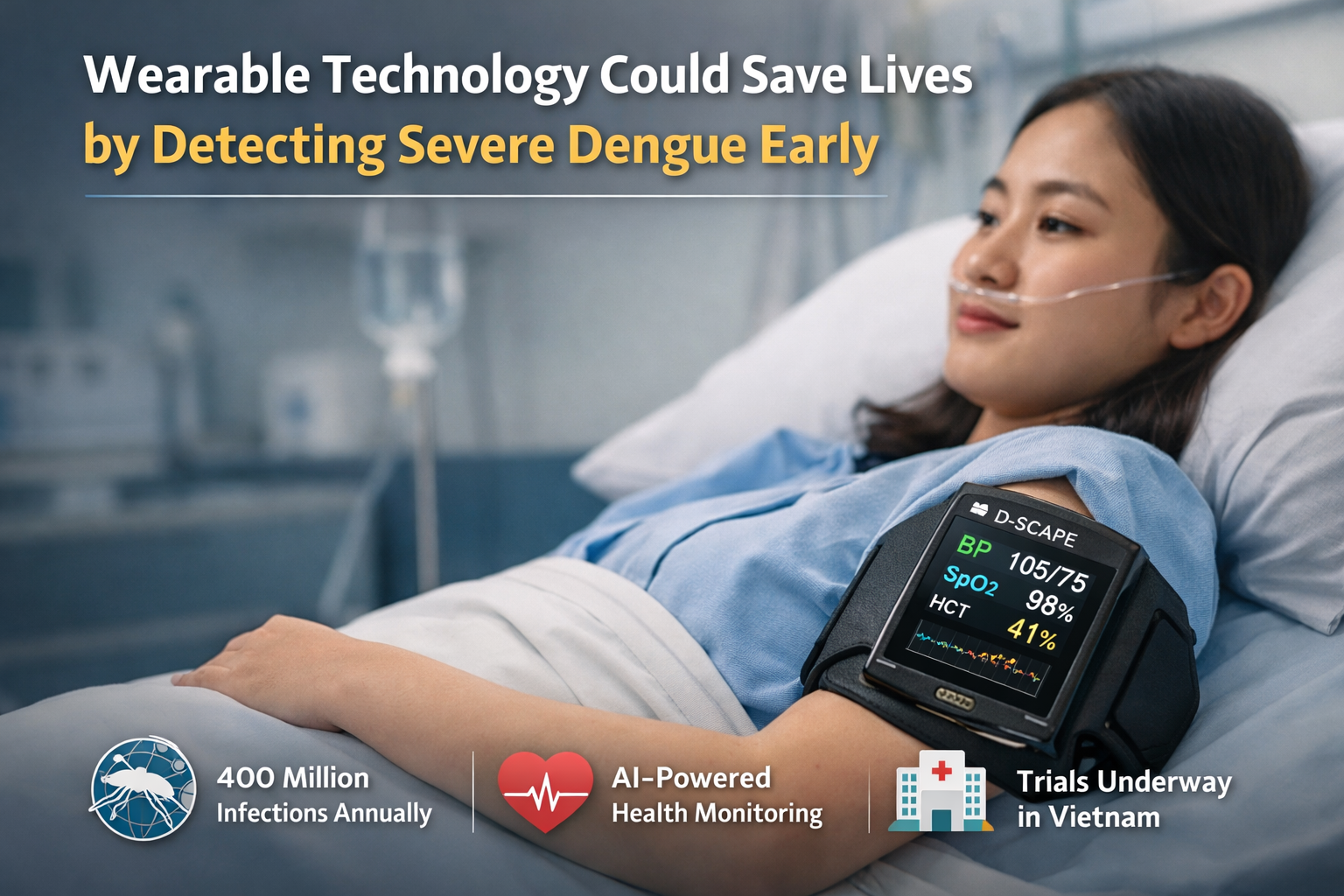
Wearable Technology Could Save Lives by Detecting Severe Dengue Early
Dengue fever is one of the fastest-growing infectious diseases in the world, placing billions of people at risk every year. While most dengue infections are mild, a small but significant percentage can rapidly progress into severe dengue, a life-threatening condition that requires urgent medical intervention. The biggest challenge clinicians face is identifying which patients will deteriorate before it is too late.
A new wearable device developed by researchers at Imperial College London may offer a breakthrough solution. Known as D-SCAPE, this low-cost, AI-powered wearable technology is designed to continuously monitor vital signs and detect early warning signals of severe dengue. Currently undergoing clinical trials in Vietnam, the device could transform dengue care, particularly in low-resource and high-burden settings.
This article explores how wearable technology like D-SCAPE works, why early detection of severe dengue is so critical, and how innovations in artificial intelligence and biosensors could help save thousands of lives each year.
Understanding Dengue and Why Early Detection Matters
Dengue is a viral infection transmitted to humans through the bite of infected Aedes mosquitoes. There are no specific antiviral treatments available, and patient care relies almost entirely on careful monitoring and supportive treatment. According to global estimates, around four billion people are at risk of dengue infection, with up to 400 million infections occurring annually.
Most dengue cases resolve with rest and hydration, but approximately five percent develop into severe dengue. This form of the disease can cause plasma leakage, internal bleeding, organ failure, and shock. Without timely medical care, severe dengue can be fatal.
The difficulty lies in the disease’s unpredictability. Patients may appear stable one day and deteriorate rapidly the next. Current clinical practice relies heavily on repeated blood tests to monitor key indicators such as haematocrit levels and blood pressure. During outbreaks or peak seasons, this approach becomes impractical due to overwhelmed healthcare systems, limited laboratory capacity, and the discomfort and risks associated with frequent blood draws.
This is where wearable medical technology offers a compelling alternative.
What Is the D-SCAPE Wearable Device?
D-SCAPE stands for Dengue Shock and Classification Prediction Wearable. It is a patented medical device developed at Imperial College London that combines advanced sensors with artificial intelligence to monitor critical physiological markers associated with severe dengue.
The wearable is worn on the arm and continuously tracks vital signs including blood pressure, blood oxygen levels, and haematocrit. Haematocrit is particularly important in dengue management, as rising levels can indicate plasma leakage, a hallmark of severe disease.
Unlike traditional blood tests, D-SCAPE provides non-invasive, continuous monitoring. This allows clinicians to detect subtle trends and early warning signs that might otherwise be missed between intermittent laboratory tests.
Clinical Trials in Vietnam
Vietnam was selected as the trial location due to its high dengue burden and strong research infrastructure. The device is currently being evaluated in collaboration with the Oxford University Clinical Research Unit in Vietnam and the Hospital for Tropical Diseases in Ho Chi Minh City.
The clinical trial is being conducted in phases. The initial phase involves monitoring 25 dengue patients to gather high-quality physiological data and assess the device’s usability in real clinical environments. Patient feedback and clinician input from this phase will inform improvements to the design and software.
A subsequent phase is expected to expand testing to 100 dengue patients in intensive care units and other hospital settings. This larger trial will assess the accuracy of the device in predicting severe dengue and its potential impact on clinical decision-making.
Why Non-Invasive Monitoring Is a Game Changer
Traditional dengue monitoring relies on repeated blood sampling, which poses several challenges. Blood tests are invasive, uncomfortable, and increase the risk of infection, particularly when performed frequently. They also require trained staff, laboratory infrastructure, and time, all of which may be limited during outbreaks.
Non-invasive wearable technology addresses these issues directly. By providing continuous data without the need for needles, devices like D-SCAPE reduce patient discomfort and free up healthcare resources. Clinicians can monitor trends in real time rather than relying on snapshot measurements taken hours apart.
According to clinical researchers involved in the trial, this approach could be especially valuable during dengue outbreaks, when hospitals are overcrowded and staff are stretched thin.
The Role of Artificial Intelligence in Dengue Care
Artificial intelligence is central to how D-SCAPE works. The device does not simply collect raw data. It uses AI algorithms to analyse patterns in vital signs and identify combinations of changes associated with worsening disease.
AI can detect subtle shifts that may not be obvious to clinicians until the patient becomes critically ill. By flagging patients at higher risk of severe dengue earlier, the technology supports timely interventions such as fluid management and closer observation.
This decision-support capability does not replace clinicians. Instead, it augments their ability to prioritise care and allocate resources effectively.
Global Impact and the Growing Dengue Threat
Dengue is endemic across large parts of Asia, Africa, the Americas, and the Pacific Islands. Vietnam experienced a major dengue outbreak in 2025, with a sharp increase in severe cases. However, dengue is no longer confined to tropical regions.
Climate change, increased international travel, and global trade have expanded the habitat of dengue-carrying mosquitoes. Local outbreaks have already been reported in countries such as France, Italy, and Spain. Public health experts warn that these mosquitoes could eventually establish themselves in the United Kingdom.
As dengue spreads to new regions, healthcare systems unfamiliar with the disease may struggle with diagnosis and management. Affordable, easy-to-use wearable devices could play a critical role in strengthening preparedness and response worldwide.
Making the Technology Accessible and Affordable
One of the most promising aspects of D-SCAPE is its affordability. The final commercial version of the device is expected to cost under 500 US dollars, significantly less than comparable monitoring technologies that can cost several thousand dollars.
The device is designed to be reusable, making it suitable for hospitals in low- and middle-income countries where dengue burden is highest. Funding from the not-for-profit medical research organisation LifeArc is supporting the development of second- and third-generation prototypes, further clinical testing, and health economic studies.
These studies will help demonstrate the cost-effectiveness of the technology and support its adoption in real-world healthcare settings.
Beyond Dengue: Broader Applications of Wearable Health Tech
While D-SCAPE is currently focused on dengue, the underlying technology has broader potential applications. Continuous, non-invasive monitoring of haematocrit and blood pressure could be useful in detecting other life-threatening conditions, including antenatal sepsis and shock from other infectious diseases.
This highlights a wider trend in healthcare toward wearable diagnostics and remote monitoring. As sensor technology improves and AI models become more sophisticated, wearable devices are increasingly capable of delivering clinical-grade insights outside traditional laboratory environments.
The Future of Dengue Management
There are still no effective antiviral treatments for dengue, and vaccine coverage remains limited. As a result, early detection and supportive care remain the cornerstone of saving lives.
Wearable technology like D-SCAPE represents a shift from reactive to proactive dengue care. By identifying patients at risk before severe symptoms develop, clinicians can intervene earlier and improve outcomes.
If clinical trials continue to show positive results, this technology could become a standard tool in dengue-endemic regions and beyond. It also sets a precedent for how engineering, artificial intelligence, and global health collaboration can address some of the world’s most pressing medical challenges.
Conclusion
Dengue remains a major global health threat, and severe cases can escalate rapidly with devastating consequences. The development of the D-SCAPE wearable device offers hope for a safer, more efficient way to monitor patients and detect danger signs early.
Through non-invasive sensors, continuous monitoring, and AI-driven analysis, this innovation has the potential to save thousands of lives each year. As dengue spreads to new regions due to climate change and globalisation, scalable and affordable solutions like D-SCAPE will be more important than ever.
Wearable technology is no longer just about fitness tracking. It is becoming a vital part of modern medicine, especially in the fight against infectious diseases that disproportionately affect vulnerable communities.
Sources
Imperial College London News
Oxford University Clinical Research Unit Vietnam
LifeArc Global Health Research
World Health Organization Dengue Fact Sheets
Disclaimer
This article is for informational and educational purposes only. It does not constitute medical advice, diagnosis, or treatment. Always seek the guidance of qualified healthcare professionals regarding medical conditions or treatment decisions. The information presented is based on publicly available research and press materials as of February 2026 and may be subject to change as further clinical evidence emerges.