
Vitamin B3 Metabolism Might Play a Role in Recurring Miscarriages, Researchers Say
Recurrent miscarriage is one of the most painful experiences a woman and her family can go through. It refers to the loss of two or more pregnancies in a row, usually in the early stages of pregnancy. For many women the cause of these losses remains unknown, and this uncertainty can make the experience even more distressing. Recent research suggests that there may be a biological factor involved that has not been fully appreciated until now. New findings suggest that the way the body metabolises vitamin B3, also known as niacin, might play a role in recurrent miscarriage. If confirmed, this could change how we understand some cases of pregnancy loss and open new avenues for prevention and treatment.
What Is Recurrent Miscarriage?
Miscarriage itself is the most common complication in early pregnancy. Many women experience a single miscarriage, and in most cases it does not predict future reproductive problems. However, when miscarriages occur repeatedly, defined clinically as two or more losses, it becomes classified as recurrent miscarriage. Estimates suggest that about one in every 50 couples trying to conceive experience this pattern of loss.
Recurrent miscarriage can be devastating emotionally and physically. Many women search for answers, seeking genetic testing, hormonal evaluations, immune assessments, clotting profiles, and lifestyle changes. Medical research has identified multiple causes of recurrent miscarriage, including chromosomal issues, uterine structural problems, hormonal imbalance, immune dysfunction, and genetic or environmental factors. Yet in a large proportion of cases, doctors still cannot identify a clear explanation. This leaves patients and families in a difficult position. The search for previously unrecognised biological contributors has therefore been a strong priority for researchers.
Vitamin B3 and NAD: A Basic Overview
Vitamin B3, or niacin, is a water‑soluble nutrient that the body cannot produce in sufficient amounts on its own. It must therefore come from the diet or supplements. Foods rich in niacin include poultry, fish, peanuts, mushrooms, and fortified cereals. Once inside the body, niacin is used to make a coenzyme called nicotinamide adenine dinucleotide, commonly referred to as NAD. NAD is a molecule required for hundreds of cellular processes, including energy production, DNA repair, cell signalling, and responses to stress. These functions are especially important during early stages of pregnancy, when cells are dividing rapidly and energy demand is high.
Early work in animal models has shown that extremely low levels of NAD can lead to birth defects and miscarriage. For example, when mice were fed diets deficient in the precursors needed to make NAD, or when genes required for NAD production were disrupted, the result was frequent embryo loss and developmental abnormalities. In those models, supplementing with vitamin B3 prevented many of those defects. These findings suggested that proper NAD metabolism is crucial for normal embryo development. (PMC)
However, the story in humans may be more complex. Humans have multiple pathways for making NAD, and how these are regulated during pregnancy is only beginning to be understood. This makes the role of vitamin B3 not just about deficiency, but also about how the body processes and uses it.
The New Pilot Study: Clues From Metabolites
Recently, scientists from the Victor Chang Cardiac Research Institute, University of Sydney, and the Royal Hospital for Women in Australia published a pilot study that offers fresh insight into how vitamin B3 metabolism could relate to recurrent miscarriage. Rather than focusing only on dietary intake or overall NAD levels, this research looked at specific molecules involved in the metabolic pathways of NAD. These molecules are known as NAD‑related metabolites.
The study included 88 women aged between 20 and 40. Thirty‑seven of these women had a history of recurrent miscarriage, meaning they had experienced two or more pregnancy losses in a row. Their blood, plasma, and urine samples were analysed and compared with samples from women who had not had recurrent losses.
What the researchers found was intriguing. Instead of simply showing lower overall NAD levels, the women with recurrent miscarriage had distinct changes in the levels of three specific NAD‑related metabolites. These metabolites are produced as part of the body’s normal metabolic processing of niacin and NAD, and they were consistently elevated in the women who had experienced repeated losses. Importantly, these differences were present regardless of whether the women were taking vitamin B3 supplements. This suggests that the problem is not merely one of vitamin B3 deficiency in the diet, but potentially a deeper metabolic imbalance in how the body uses the nutrient.
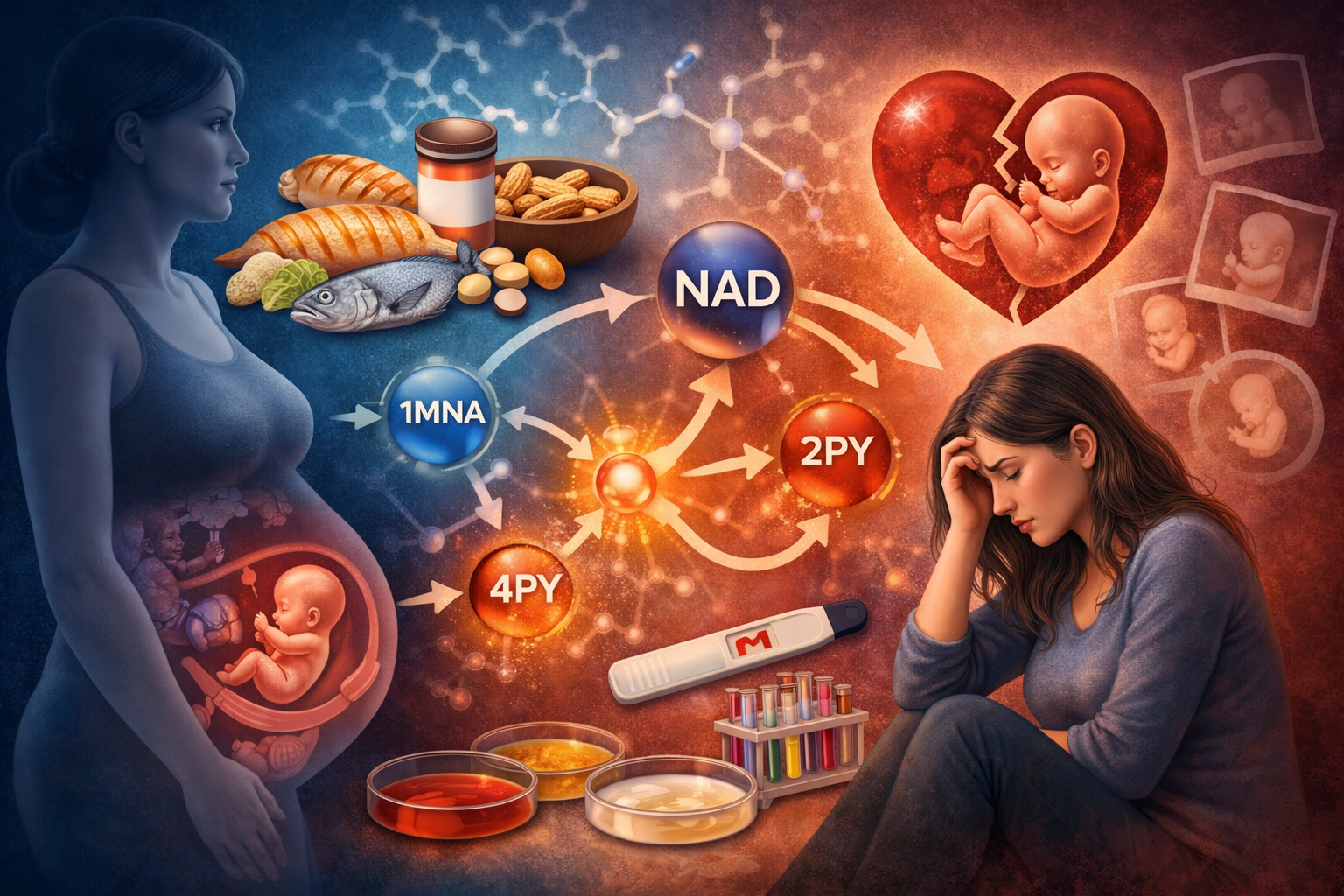
The metabolites identified included 1‑methyl‑nicotinamide and its downstream products, known clinically as 1MNA, 2PY, and 4PY. These are molecules formed when the body breaks down niacin and recycles nicotinamide, a form of vitamin B3. Their elevation in women with recurrent pregnancy loss suggests that these metabolic pathways may be altered in ways that could impact pregnancy success.
Why Metabolism Matters More Than Simple Levels
This pilot study challenges the simple assumption that low vitamin B3 or low NAD alone explains miscarriage risk. Instead, the findings point to the idea that how the body processes B3 and maintains NAD balance might matter more than absolute levels. Vitamin B3 can be converted to NAD through several biochemical steps, and each step is influenced by enzymes and other factors that can vary between individuals. If certain metabolites are elevated, it may indicate that the system is stressed, overloaded, or inefficient. This could reflect differences in enzyme activity, inflammatory processes, or other cellular stresses that affect how NAD is produced and used. (PMC)
For example, some of the elevated metabolites in the study are associated with increased activity of NAD‑consuming enzymes. These are proteins involved in cellular responses to stress and inflammation. If these enzymes are more active, they convert NAD into other forms more rapidly, potentially reducing the pool of NAD available for essential cellular functions. Chronic inflammation and stress are known to influence pregnancy outcomes, and these findings may connect those physiological processes with biochemical pathways at the cellular level. (PMC)
It is too soon to say exactly how these metabolic changes contribute to miscarriage risk, and it is important to be cautious. The study is small and exploratory. But it opens up a new way of thinking about recurrent miscarriage. Instead of asking only whether women have enough vitamin B3, researchers are now asking whether their metabolic processing of B3 and NAD might differ. If so, this could help explain why some women experience repeated losses even when they are taking supplements or eating a nutritionally adequate diet.
Potential Implications for Diagnosis and Treatment
The most immediate potential implication of this research is the possibility of identifying biomarkers that could help identify women at higher risk of recurrent miscarriage. If the altered metabolites observed in this study are validated in larger groups, they could serve as early warning signals long before clinical pregnancy loss occurs. This could give physicians a tool for early risk assessment and allow tailored interventions before or early in pregnancy.
Beyond diagnosis, understanding the metabolic pathways at play may help researchers develop new treatments. For example, if certain enzymes or steps in the NAD production pathway are less efficient in some women, targeted therapies could be developed to support those pathways. This could involve specific forms of vitamin B3 that bypass metabolic bottlenecks, or therapies that modulate enzyme activity. Researchers are already planning additional studies to explore these possibilities more fully.
Crucially, these findings also reinforce the idea that nutritional supplementation is not a one‑size‑fits‑all solution. Simply taking more of a vitamin does not necessarily correct underlying metabolic differences. A deeper understanding of individual metabolism and genetic factors may ultimately lead to more personalised approaches to support reproductive health.
Looking Ahead
The research into vitamin B3 metabolism and miscarriage is still in its early stages. A new larger project beginning in 2026 aims to investigate NAD and related metabolites more thoroughly, track how these levels change over time, and examine how diet, supplements, and other health factors interact with metabolic pathways. This longer project will recruit women with a history of recurrent miscarriage, women experiencing miscarriage currently, and those without a history of miscarriage. The goal is to build a comprehensive picture of how NAD metabolism relates to pregnancy outcomes.
Scientists hope that this work will lead to better risk assessment, improved understanding of underlying biological mechanisms, and eventually preventative strategies that reduce the number of families affected by recurrent miscarriage. While much work remains, these early findings are an important step forward.
Final Thoughts
Recurrent miscarriage is a complex and deeply personal challenge for many women and families. For decades the focus has been on identifying external causes and risk factors. Now, emerging research points to more subtle biochemical mechanisms that could help explain why some women experience repeated pregnancy loss even when traditional risk factors are absent.
The idea that vitamin B3 metabolism could underlie some cases of recurrent miscarriage is both hopeful and humbling. Hopeful because it suggests new ways to detect risk and intervene early. Humbling because it reminds us just how intricate the biology of human reproduction really is. What we eat, how our cells process nutrients, and how those nutrients interact with genetic and environmental factors all contribute to the delicate balance required for a healthy pregnancy.
As research continues, women and their healthcare providers will hopefully gain new tools and insights that make the road to parenthood clearer and more supported. For now, these findings underscore the importance of ongoing scientific inquiry into even the most fundamental aspects of human biology.