
They Sat for Hours With Flu Patients and Never Got Sick. What This Experiment Reveals About How Influenza Spreads
Every winter, influenza feels unavoidable. Offices empty out, classrooms echo with coughs, and pharmacies run low on cold and flu remedies. The idea of sitting for hours in a small room with people actively infected with the flu sounds like a guaranteed way to get sick. Common sense suggests that close contact equals transmission.
A recent real world experiment challenges that assumption in a surprising way.
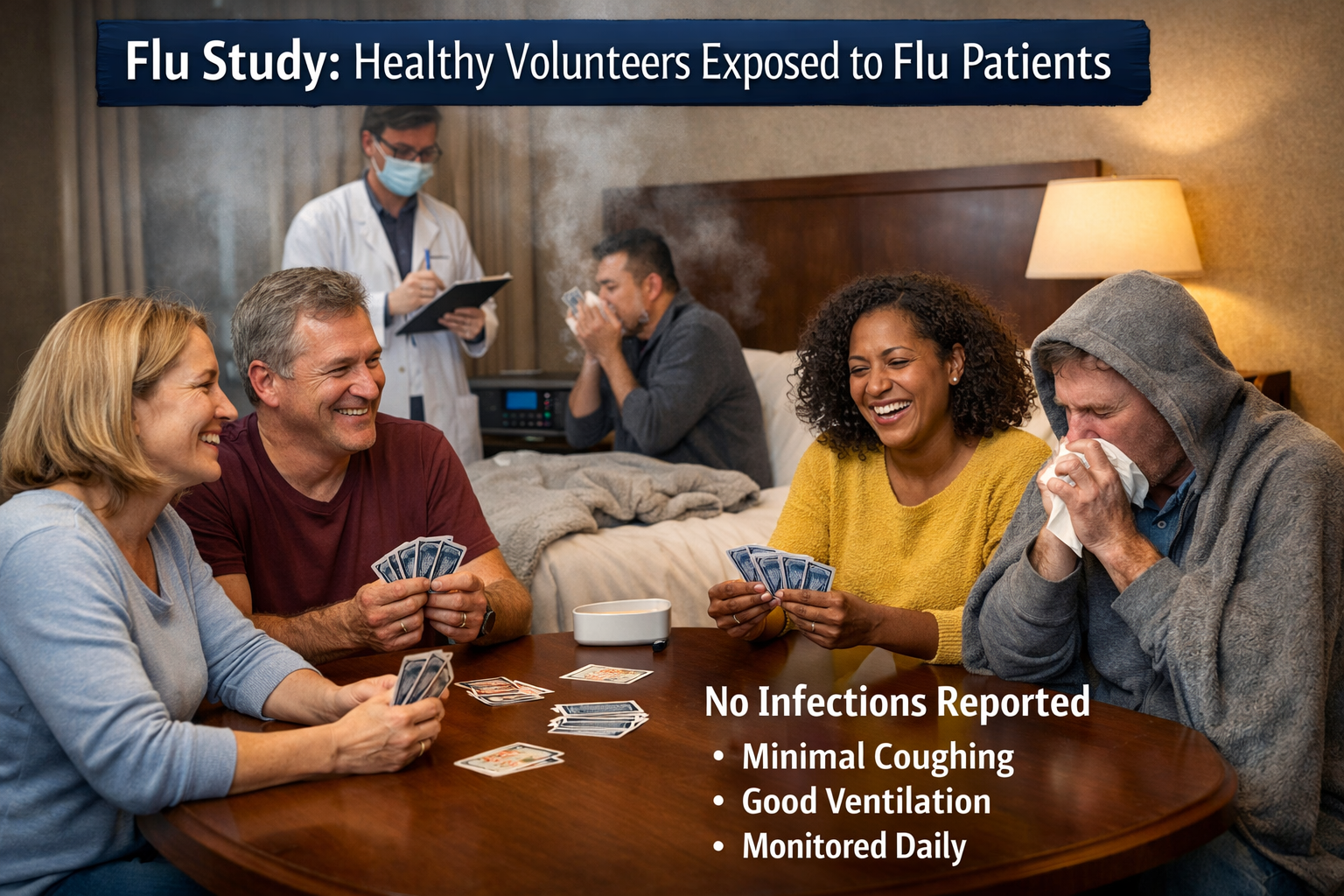
In a carefully monitored study published in January 2026, researchers placed healthy volunteers in close indoor contact with people who had confirmed influenza infections. The groups talked, played games, shared objects, and even exercised together. The exposure lasted for dozens of hours across multiple days. And yet, not a single healthy participant caught the flu.
The findings raise important questions about how influenza actually spreads and what factors truly increase risk. At a time when flu seasons are growing more intense and unpredictable, these insights may help reshape how we think about prevention.
A Bold and Unusual Study Design
The experiment was conducted by researchers from the University of Maryland and took place on a quarantined floor of a hotel in the Baltimore area. The goal was simple but ambitious: observe influenza transmission in conditions that closely resemble real life rather than a laboratory.
Two separate groups participated during 2024. Each group stayed in the hotel for two weeks under close medical supervision.
In the first group, one person who had the flu spent time with eight healthy volunteers. They participated in six structured social sessions, referred to as exposure events by the researchers.
In the second group, four flu infected participants interacted with three healthy volunteers. This group took part in seventeen exposure events.
Each exposure session lasted between 111 and 250 minutes. Altogether, the first group accumulated nearly 20 hours of close contact, while the second group spent close to 63 hours together.
This was not passive exposure. Participants were encouraged to interact naturally. They talked using icebreaker questions, played card games and tablet based games, shared microphones, and passed around common objects like markers and electronic devices. Some sessions included light physical activity such as yoga or dancing.
If influenza were easily transmitted through casual indoor contact alone, this setup should have resulted in multiple infections.
It did not.
Zero Transmission Despite High Viral Levels
Throughout the study, researchers collected daily nasal swabs, saliva samples, and blood samples from all participants. They also monitored symptoms closely and measured virus levels in the air and in participants’ exhaled breath.
The infected individuals showed high levels of influenza virus in their nasal passages. By traditional standards, they were clearly contagious.
Despite this, none of the healthy volunteers developed symptoms or tested positive for influenza during or after the study period.
This result surprised even the researchers.
Dr. Donald Milton, a professor of global, environmental, and occupational health at the University of Maryland and a senior investigator on the study, noted how unusual the outcome was given the time of year. Influenza was widespread in the community, yet controlled exposure under close conditions resulted in no transmission.
Coughing May Be the Key Factor
One of the most important observations was how little the infected participants coughed.
While they carried high viral loads in their noses, they rarely produced forceful coughs. According to lead investigator Jianyu Lai, coughing appears to be one of the strongest drivers of influenza transmission.
When people cough, they release large numbers of respiratory droplets and fine aerosols that can carry virus particles into the air. Without frequent coughing, far fewer viruses become airborne.
The researchers found that only small amounts of virus were detected in the room air and in exhaled breath samples. This suggests that viral presence alone is not enough. The mechanism by which virus leaves the body and enters the shared environment matters greatly.
In other words, someone can technically have the flu without effectively spreading it if they are not coughing or forcefully expelling respiratory particles.
Ventilation Played a Major Role
Another critical factor was air circulation.
The study room was equipped with a heater and a dehumidifier that continuously mixed the air. This constant movement diluted any virus particles that entered the air, reducing the concentration that healthy participants might inhale.
Rather than allowing virus laden aerosols to linger in stagnant air, the ventilation setup prevented buildup.
This finding supports growing evidence that indoor air quality plays a major role in respiratory virus transmission. Poorly ventilated spaces allow virus particles to accumulate, while well ventilated environments reduce risk even when infected individuals are present.
Portable air purifiers, fans, and systems that promote air mixing may offer more protection than previously recognized, especially in shared indoor settings.
Vaccination Was Not the Explanation
One might assume that the healthy participants were protected by vaccination. That was not the case.
Only a small number of the healthy volunteers had received a flu shot. Vaccination status did not explain the absence of transmission.
This does not mean vaccination is unimportant. Flu vaccines remain one of the most effective tools for reducing severe illness, hospitalizations, and deaths. However, in this particular experiment, other factors such as coughing frequency and ventilation appeared to have a greater impact on immediate transmission.
Age and Susceptibility May Have Helped
The healthy volunteers were mostly middle aged adults. According to the researchers, this may have contributed to their resistance.
Middle aged adults tend to have stronger immune responses to influenza compared to young children or older adults. Many have been exposed to multiple flu strains over their lifetime, which may offer partial immunity even to new variants.
This does not mean that middle aged individuals are immune to the flu, but it suggests that susceptibility varies significantly by age and immune history.
Context Matters in Flu Spread
The study highlights a critical takeaway: not all close contact is equally risky.
Being indoors with someone who has the flu does not automatically mean you will get sick. The risk depends on several interacting factors, including:
- Whether the infected person is coughing frequently
- How well ventilated the space is
- How long exposure lasts
- How close people are to one another
- The immune status of those involved
Face to face interactions in stagnant air where someone is actively coughing remain the highest risk scenario. Simply sharing a room, especially one with good airflow, may be far less dangerous than commonly assumed.
Lessons for Public Health and Daily Life
The findings arrive during a particularly severe flu season in the United States. According to estimates from the U.S. Centers for Disease Control and Prevention, at least 15 million Americans fell ill with influenza during the current season, with approximately 7,400 deaths.
A new influenza variant known as subclade K has been especially aggressive, contributing to widespread transmission.
Understanding how flu spreads in real world conditions can inform better prevention strategies that go beyond blanket assumptions.
Dr. Milton emphasized that environments where air does not move much pose greater risks. He also noted that portable air purifiers that both clean and circulate air could be valuable tools in homes, schools, and workplaces.
When close contact is unavoidable and someone is coughing, masks remain an effective layer of protection. High filtration masks such as N95 respirators offer the greatest defense in those situations.
Rethinking Fear Versus Evidence
This study does not suggest that influenza is harmless or that precautions are unnecessary. Rather, it challenges oversimplified ideas about how transmission works.
Fear based responses often focus on proximity alone, while ignoring factors like airflow, behavior, and symptom severity. Evidence based approaches allow for more nuanced decisions that balance safety with practicality.
For individuals, this may mean prioritizing ventilation, staying home when actively coughing, and using masks strategically rather than universally.
For institutions, it reinforces the importance of improving indoor air quality and designing spaces that reduce airborne buildup of pathogens.
What This Does Not Mean
It is important to clarify what conclusions should not be drawn from this study.
It does not mean that people with the flu are safe to socialize freely. It does not mean that vaccination is unnecessary. It does not mean that everyone will respond the same way to exposure.
Instead, it shows that influenza transmission is more complex than simply being near someone who is sick. The virus requires certain conditions to spread efficiently.
Understanding those conditions can help reduce panic while improving targeted prevention.
Looking Ahead
As researchers continue to study respiratory viruses, including influenza and other emerging threats, experiments like this provide valuable real world insight. They help bridge the gap between laboratory models and everyday human behavior.
Future studies may explore how different variants behave, how humidity and temperature affect transmission, and how these findings apply to other respiratory viruses.
For now, the message is cautiously reassuring. Even in a room full of flu patients, illness is not inevitable when the right factors are in place.
Sources
- University of Maryland, News Release, January 11, 2026
- PLOS Pathology, January 7, 2026
Medical Disclaimer
This article is for informational and educational purposes only. It does not provide medical advice, diagnosis, or treatment. Statistical findings describe general trends and may not apply to individual circumstances. Individual health risks vary based on age, medical history, and other factors. Always consult a qualified healthcare professional for personalized medical guidance.