For years, one idea has felt inevitable: healthcare will become AI-powered. What once sounded like a bold prediction is now becoming reality at remarkable speed. Over the past few months, the world’s largest technology companies have made decisive moves into healthcare. They are not experimenting on the edges anymore. They are launching products, signing partnerships, building platforms, and competing for control of what could become the next major digital infrastructure layer.
Healthcare is entering a new era where artificial intelligence could shape how people manage their wellbeing, how doctors diagnose disease, how hospitals operate, and how new medicines are discovered. This is no small market shift. It is the start of a strategic battle for the future of health technology.
Healthcare has always been rich in data but poor in usability. Medical records are fragmented. Scheduling systems are outdated. Administrative tasks consume enormous time. Patients struggle to navigate care journeys. Clinicians face burnout from documentation and operational overload. AI promises to solve many of these long-standing inefficiencies.
With advances in large language models, predictive analytics, medical imaging, voice interfaces, and automation, companies can now create tools that help patients and healthcare professionals at scale. That is why the recent wave of launches matters so much. It shows that healthcare AI is no longer theoretical. It is becoming commercialized.
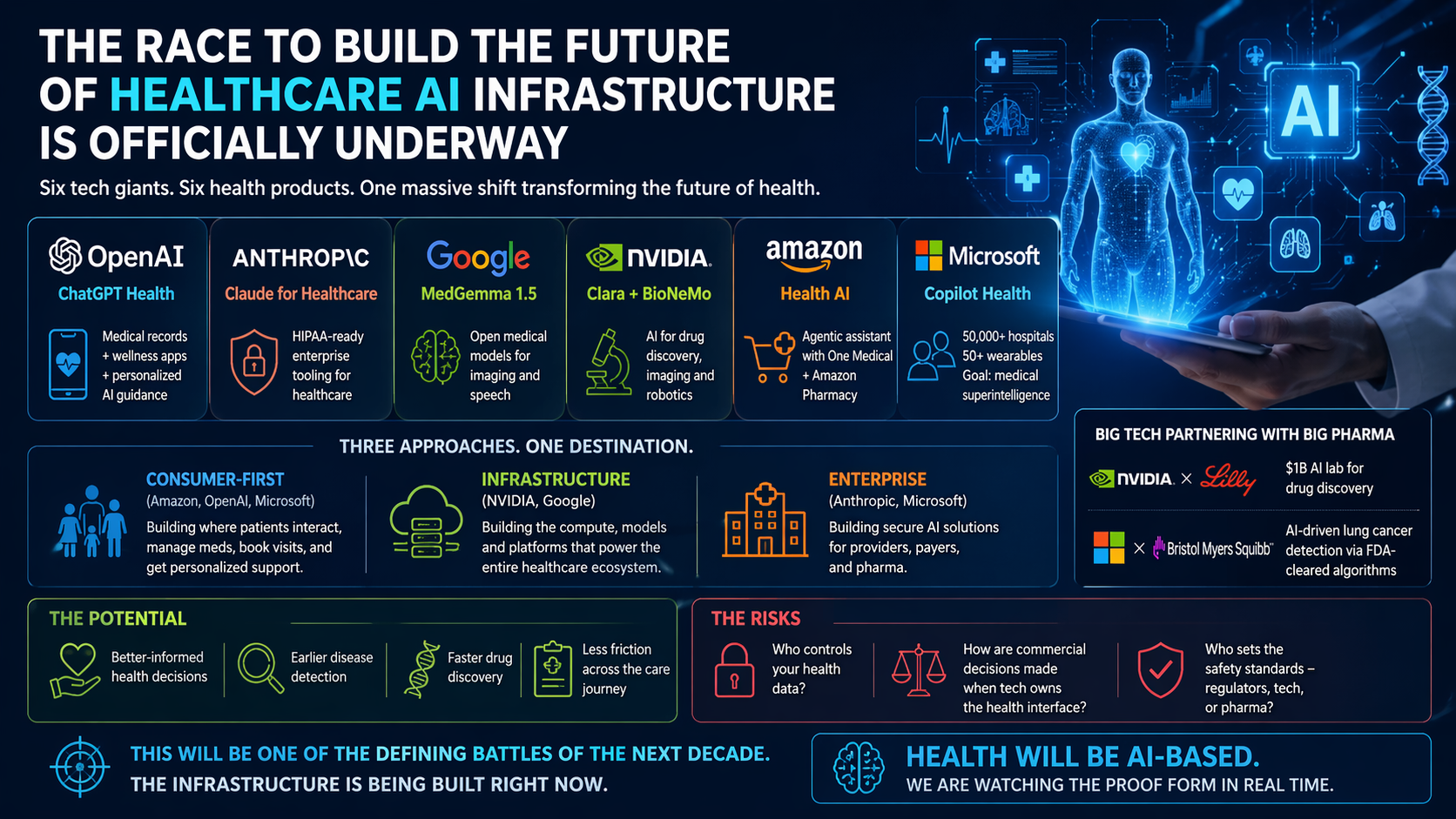
In a short period of time, six major players have introduced healthcare-focused products or expanded their AI health strategies.
OpenAI entered the space with ChatGPT Health, focused on connecting medical records, wellness apps, and individualized AI support.
This signals a consumer-first strategy. If users already trust AI assistants for productivity, learning, and daily decisions, health may be the next category where they seek guidance.
The opportunity is clear: one intelligent interface that helps people understand symptoms, manage conditions, interpret reports, and make better decisions.
Anthropic launched Claude for Healthcare, designed with enterprise-grade privacy and compliance readiness.
This approach targets hospitals, insurers, and regulated healthcare organizations that need secure AI systems rather than public consumer tools.
Healthcare institutions want productivity gains, but they also need governance, auditability, and privacy controls. Anthropic is positioning itself as the trusted AI provider for that environment.
Google released MedGemma 1.5, offering open medical AI models for imaging, speech, and clinical use cases.
Google’s strength has always been infrastructure, data science, and developer ecosystems. By offering powerful healthcare models, it can become a foundational layer for startups, hospitals, and researchers building their own solutions.
This strategy mirrors what happened in cloud computing. Rather than owning every end-user product, Google can power thousands of them.
NVIDIA expanded Clara and BioNeMo, platforms focused on medical imaging, robotics, simulation, and drug discovery.
NVIDIA may be the most important company in this race because every AI company depends on compute. In healthcare, that means training imaging models, simulating molecules, accelerating diagnostics, and enabling autonomous systems.
If AI becomes central to healthcare, NVIDIA could become the picks-and-shovels provider of the entire ecosystem.
Amazon introduced Health AI tied to One Medical and Amazon Pharmacy.
This gives Amazon something many competitors lack: direct access to healthcare transactions and patient interactions. It can combine AI assistance with appointment booking, medication fulfillment, primary care access, and home delivery.
That creates a powerful convenience model centered around consumers.
Microsoft launched Copilot Health, connecting with tens of thousands of hospitals and dozens of wearable devices, while pursuing a vision of medical superintelligence.
Microsoft already has deep relationships across enterprise software, cloud infrastructure, cybersecurity, and productivity tools. That gives it a natural route into healthcare systems globally.
If healthcare organizations adopt Microsoft AI inside existing workflows, the company could gain enormous influence quickly.
Although these companies are competing in the same market, they are taking different routes.
Amazon, OpenAI, and Microsoft are building where patients directly engage.
This includes:
The company that owns the patient interface may own long-term loyalty, data relationships, and recurring engagement.
Google and NVIDIA are focused on powering the ecosystem.
This includes:
These companies may not always be visible to end users, but they could control the engines behind modern healthcare applications.
Anthropic and Microsoft are targeting providers, insurers, pharmaceutical companies, and large institutions.
This includes:
Healthcare enterprises spend heavily and move cautiously. Winning trust here can create durable market positions.
The next stage of healthcare AI is not just software. It is biology.
Major technology firms are increasingly partnering with pharmaceutical leaders to accelerate discovery, diagnostics, and precision medicine.
Examples include:
These partnerships matter because pharma has domain expertise, clinical pathways, and commercialization channels. Tech companies bring compute, models, automation, and scale.
Together, they can shorten timelines that traditionally took years.
If implemented responsibly, AI could transform multiple layers of the health system.
Many patients struggle to interpret test results, understand treatment options, or know when to seek care.
AI assistants can translate complex medical language into understandable guidance and help users prepare better questions for clinicians.
AI models already show promise in imaging, pathology, screening, and risk prediction.
Earlier detection often means lower treatment cost and better outcomes.
Traditional drug development is expensive, slow, and high risk.
AI can help identify promising compounds, model biological interactions, optimize trials, and reduce wasted time.
Healthcare is full of forms, delays, repeated data entry, and disconnected systems.
AI can streamline scheduling, paperwork, follow-up communication, and care coordination.
While the upside is significant, the risks are equally serious.
Health data is among the most sensitive forms of personal information.
If AI platforms become the gateway to care, users must know:
Trust will be essential.
If a tech company controls the health interface, how are recommendations made?
Could business incentives shape pharmacy choices, provider referrals, or product suggestions?
Healthcare decisions must prioritize patient outcomes, not platform monetization.
Who defines acceptable AI performance in medicine?
Will standards come from regulators, technology companies, healthcare systems, or pharmaceutical partners?
When mistakes happen, accountability must be clear.
Healthcare is one of the largest industries in the world. It is data-heavy, operationally complex, and expensive. That makes it an ideal target for AI transformation.
But unlike entertainment, advertising, or ecommerce, healthcare touches human lives directly. Errors carry serious consequences. Trust takes years to earn and moments to lose.
That is why this race matters so much.
The winners may shape:
Expect the next few years to bring rapid movement in five areas:
We will also likely see stronger regulation, more acquisitions, and growing competition between open and closed AI ecosystems.
The battle to build the next healthcare infrastructure platform has already started. Some companies want to own the patient relationship. Others want to power the models, compute, and systems underneath. Others aim to become the trusted enterprise layer for hospitals, insurers, and pharma.
No matter who wins, one conclusion is increasingly clear: Healthcare is moving toward an AI-based future. The infrastructure is being built now. The products are launching now. The partnerships are forming now. We are not waiting for the future of healthcare anymore.We are watching it take shape in real time.

Most Accurate Healthcare AI designed for everything from admin workflows to clinical decision support.