
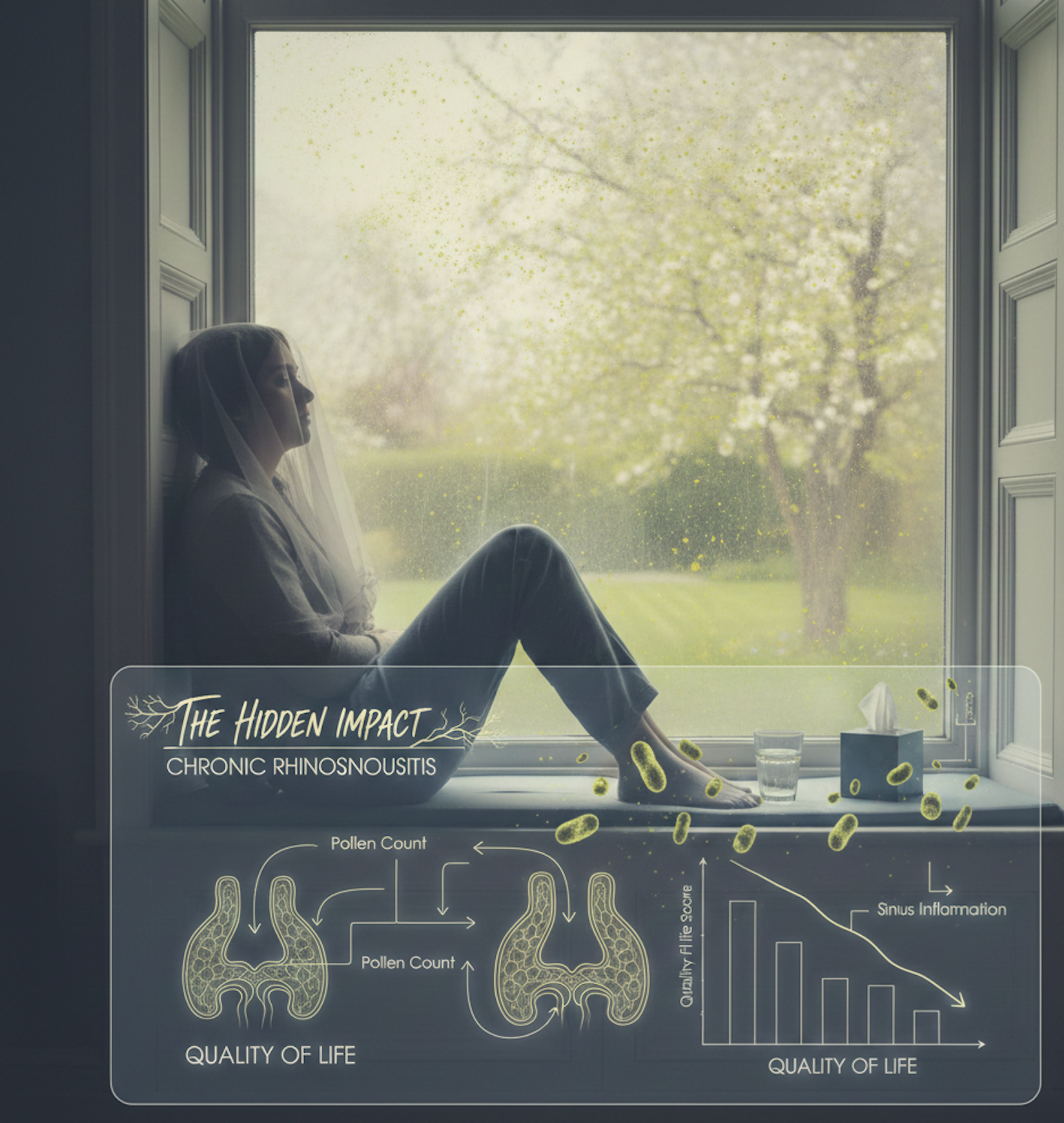
The Hidden Impact of Pollen on Chronic Rhinosinusitis Quality of Life
Chronic rhinosinusitis (CRS) is a common and often debilitating condition affecting millions worldwide. Characterized by persistent inflammation of the nasal and sinus mucosa, CRS manifests with symptoms such as nasal congestion, facial pressure, postnasal drip, and reduced sense of smell. While many factors contribute to CRS development and progression, environmental triggers play a significant role. Among these, airborne pollen has emerged as a potential contributor to disease severity and the quality of life for patients, yet it has been understudied. Recent research published in Laryngoscope Investigative Otolaryngology has begun to shed light on this relationship, examining how long-term pollen exposure correlates with patient-reported outcomes and overall health utility.
This blog explores the findings of this multi-institutional study, how pollen may influence CRS, and what the results mean for patients and healthcare providers.
Understanding Chronic Rhinosinusitis
CRS is defined by the American Academy of Otolaryngology-Head and Neck Surgery as inflammation of the sinus and nasal mucosa persisting for more than twelve weeks despite medical management. The condition can be classified with or without nasal polyps, with symptoms ranging from mild to severe. Beyond the physical manifestations, CRS significantly impacts quality of life, interfering with daily activities, sleep, and productivity. Traditional management strategies include pharmacologic treatments such as corticosteroids, antibiotics when infections are present, and surgical intervention in refractory cases.
While genetic predisposition, infection, and structural abnormalities contribute to CRS, environmental factors such as air pollutants, dust, and pollen are increasingly recognized as modifiers of disease severity. This recognition underscores the need for research exploring how chronic exposure to specific environmental triggers affects patient outcomes.
The Role of Pollen as an Aeroallergen
Pollen is a naturally occurring airborne allergen produced by plants, grasses, and weeds. In sensitized individuals, pollen exposure triggers immune responses mediated by Immunoglobulin E (IgE) and T-helper type 2 cells. This cascade results in the activation of mast cells and basophils, releasing histamine and other inflammatory mediators. Clinically, this response manifests as allergic rhinitis, conjunctivitis, nasal obstruction, and fatigue.
Because pollen is ubiquitous in the environment and seasonal in nature, it has long been studied in the context of allergic diseases. The American Academy of Allergy, Asthma and Immunology established the National Allergy Bureau to monitor pollen levels across the United States, providing valuable data for research and public health. However, despite these resources, there has been limited investigation into the role of long-term pollen exposure in CRS, a condition often overlapping with allergic rhinitis.
Study Overview: Pollen Exposure and CRS Outcomes
A recent pilot study investigated the relationship between pollen exposure and CRS-related quality of life. The research enrolled 103 adult patients diagnosed with CRS across four academic medical centers: Oregon Health & Science University, the Medical University of South Carolina, the University of Colorado, and the University of Utah. The study excluded patients with conditions such as cystic fibrosis, primary ciliary dyskinesia, sinonasal tumors, and immunodeficiencies to maintain a homogeneous sample.
Participants completed two validated surveys upon enrollment: the 22-item SinoNasal Outcome Test (SNOT-22), which measures CRS-specific quality of life, and the Short-Form 6-D (SF-6D) survey, which quantifies general health utility values. Lower scores in these surveys indicate worse quality of life and health perception.
To quantify environmental exposure, researchers obtained five-year mean pollen data from the National Allergy Bureau based on participants' zip codes. Pollen types were categorized into ragweed, weed, and grass pollen. Statistical analyses, including Spearman's correlation coefficients, examined associations between pollen exposure and survey scores.
Key Findings
The study revealed several important correlations between long-term pollen exposure and CRS outcomes. First, higher mean exposure to ragweed pollen over a five-year period correlated with worse SNOT-22 scores, suggesting that these patients experienced more severe CRS-specific symptoms. Additionally, ragweed pollen exposure was associated with lower SF-6D scores, indicating an overall reduction in perceived health utility.
Weed pollen exposure was also linked to higher SNOT-22 scores, although it did not show a significant correlation with SF-6D scores. Grass pollen exposure, in contrast, did not demonstrate significant correlations with either SNOT-22 or SF-6D scores. These findings suggest that certain types of pollen, particularly ragweed and weed pollen, may play a more prominent role in exacerbating CRS symptoms than others.
The study did not find significant associations between pollen exposure and other patient characteristics such as age, sex, or history of prior sinus surgery. While multivariate modeling was not conducted due to the limited sample size, the univariate analysis highlights a noteworthy trend linking environmental exposure to disease severity.
Mechanisms Behind Pollen-Induced CRS Exacerbation
The study’s findings align with what is known about allergic inflammation. In sensitized individuals, pollen penetrates the nasal mucosa, activating T cells and subsequently B cells. B cells produce IgE antibodies that trigger mast cell and basophil degranulation upon re-exposure to pollen. This repeated inflammatory stimulation can compromise the epithelial barrier, promoting mucosal hypertrophy, chronic inflammation, and hypersensitivity. Over time, these changes may exacerbate CRS symptoms, increasing nasal obstruction, discharge, facial discomfort, and fatigue.
It is important to note that CRS exhibits heterogeneous pathophysiology. Different CRS endotypes may respond variably to environmental triggers, complicating attempts to draw definitive conclusions regarding the role of pollen. Nevertheless, the study provides evidence that chronic exposure to specific pollens, particularly ragweed and weed varieties, can worsen disease-specific and general quality-of-life measures.
Clinical Implications
The results of this study have practical implications for both patients and clinicians. For patients, awareness of pollen seasons and exposure levels may inform strategies to mitigate symptoms. This could include minimizing outdoor activities during peak pollen periods, using air filtration systems indoors, or adhering to preventive pharmacologic regimens prescribed by physicians.
For clinicians, the study underscores the need to consider environmental exposure when evaluating CRS severity and treatment response. Incorporating pollen exposure history into patient assessments may help identify individuals at risk for more severe disease and guide more personalized management strategies. Additionally, targeted interventions aimed at reducing exposure to high-risk pollen types could complement standard CRS therapies, potentially improving quality of life outcomes.
Limitations and Future Directions
While the study offers valuable insights, several limitations must be acknowledged. First, the sample size of 103 participants is relatively small, which may affect the generalizability of the findings. Only patients treated at academic medical centers were included, which may introduce selection bias. Additionally, pollen exposure was estimated based on county-level data and zip codes, and continuous residence in the same location over five years could not be confirmed for all participants.
Moreover, SNOT-22 and SF-6D scores were collected at a single time point upon enrollment. Repeated measurements over multiple seasons would provide a more comprehensive view of the temporal relationship between pollen exposure and CRS severity. Future studies with larger cohorts, longitudinal designs, and diverse geographic representation are needed to confirm and expand upon these findings.
Finally, the study did not include multivariate modeling to adjust for potential confounders such as concurrent allergic rhinitis, medication use, or other environmental exposures. Incorporating these variables in future research would strengthen the evidence regarding pollen’s independent role in CRS pathophysiology.
Conclusion
This pilot study is among the first to investigate the association between long-term pollen exposure and quality-of-life measures in patients with chronic rhinosinusitis. The findings suggest that exposure to ragweed and weed pollen over several years is associated with worse disease-specific and general health outcomes. These results highlight the potential for environmental allergens to exacerbate CRS and suggest that pollen monitoring and exposure mitigation may play a role in disease management.
Despite limitations, the research provides a foundation for further investigation. Larger, multi-center studies with longitudinal designs are needed to better understand the clinical relevance of pollen exposure in CRS and to explore potential interventions. Ultimately, recognizing the impact of environmental triggers such as pollen may improve patient care, enhance symptom management, and lead to more effective personalized treatment approaches.
References
- Tullis B, Mace JC, Massey C, et al. Pollen Exposure and Chronic Rhinosinusitis Quality of Life Disease Severity. Laryngoscope Investigative Otolaryngology. 2025;DOI: 10.1002/lio2.70309
- American Academy of Allergy, Asthma & Immunology. National Allergy Bureau Pollen Counts. Accessed January 2026.
- Bernstein JA, Schwartz LB. Mechanisms of allergic inflammation. J Allergy Clin Immunol. 2016;137:385–396
- Fokkens WJ, Lund VJ, Hopkins C, et al. European Position Paper on Rhinosinusitis and Nasal Polyps 2020. Rhinology. 2020;58(S29):1–464
- Smith TL, Kern RC, Palmer JN, et al. Quality-of-life outcomes after sinus surgery. Otolaryngol Head Neck Surg. 2010;142:584–590
Disclaimer
This blog is intended for informational purposes only. It is based on research published in Laryngoscope Investigative Otolaryngology (Wiley Online Library) and accessed through Imperial College London Library. It does not constitute medical advice, diagnosis, or treatment. Patients should consult a qualified healthcare provider for guidance regarding CRS or allergy management.