
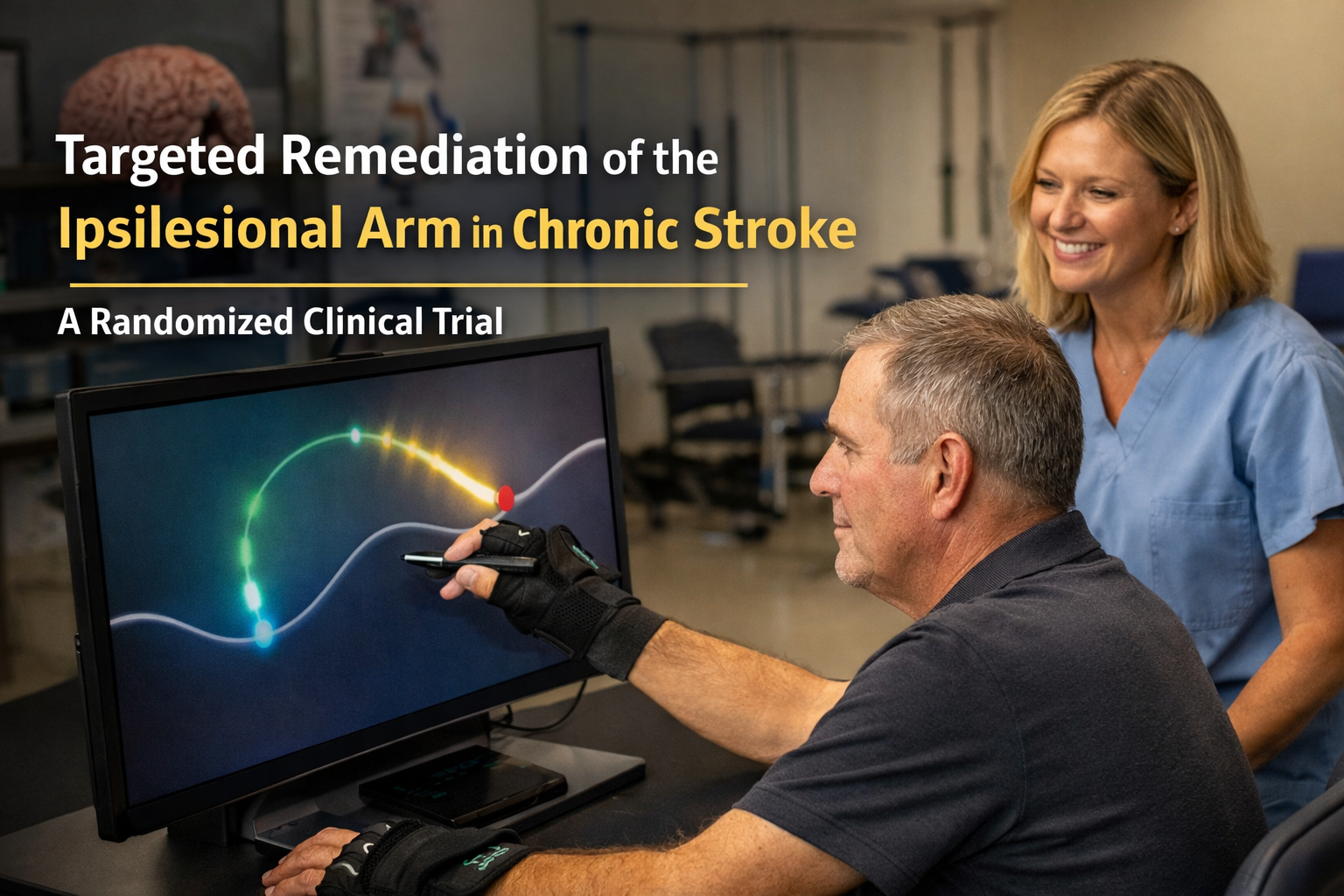
Targeting the “Good” Arm After Stroke: New Research Challenges Conventional Rehabilitation
Stroke rehabilitation has long focused on restoring function to the most visibly affected limb. For patients with severe hemiparesis, that usually means intensive therapy for the contralesional arm, the arm opposite the brain injury. However, a new randomized clinical trial published in JAMA Neurology suggests that this long-standing approach may overlook a critical opportunity for recovery.
The study, titled “Targeted Remediation of the Ipsilesional Arm in Chronic Stroke”, provides compelling evidence that training the less impaired arm, known as the ipsilesional arm, can lead to meaningful and lasting improvements in motor performance. Importantly, these gains were observed even years after stroke, challenging the assumption that functional recovery plateaus in the chronic phase.
This research has significant implications for stroke survivors, caregivers, and rehabilitation professionals who aim to maximize independence and quality of life.
Understanding Ipsilesional Arm Deficits After Stroke
After a unilateral stroke, most people expect weakness and poor coordination on the side of the body opposite the brain lesion. This contralesional impairment is obvious, measurable, and widely treated in clinical practice.
What is less well recognized is that the ipsilesional arm, the arm on the same side as the brain injury, often shows subtle but functionally important motor deficits. These deficits include slowed movements, reduced coordination, and impaired accuracy. While less dramatic than contralesional paralysis, these limitations can have a major impact on daily living.
For individuals with severe contralesional paresis, the ipsilesional arm becomes the primary limb for self-care, feeding, dressing, and household tasks. When that arm is compromised, even slightly, independence is significantly reduced.
Despite this reality, traditional stroke rehabilitation rarely targets the ipsilesional arm in a structured or intensive way.
The Research Question That Sparked a Shift
The JAMA Neurology trial sought to answer a straightforward but overlooked question:
Does targeted training of the ipsilesional arm improve motor performance in people with chronic stroke who have severe contralesional arm impairment?
To address this, researchers conducted a two-site randomized clinical trial involving adults with chronic stroke, defined as six months or more after the initial event. All participants had severe impairment of the contralesional upper limb and measurable motor deficits in the ipsilesional arm.
Study Design and Participants
The trial enrolled 53 participants who completed baseline and post-treatment assessments. Participants were, on average, 59 years old and were between several months and many years post-stroke. All had confirmed unilateral middle cerebral artery stroke and significant functional limitations.
Participants were randomly assigned to one of two intervention groups:
- Ipsilesional arm training group
- Contralesional arm therapy group, representing current best practice
Both groups received the same therapy dose: fifteen supervised sessions over five weeks, each lasting approximately one hour.
Outcome assessors were blinded to group assignment to reduce bias.
What Did Ipsilesional Arm Training Involve?
Participants in the ipsilesional group trained only their less impaired arm. Therapy included:
- Virtual reality-based motor training using real-time visual feedback
- Tasks designed to address hemisphere-specific motor control deficits
- Speed, accuracy, and coordination-focused exercises
- Real-world functional tasks, such as object manipulation
Training was intentionally designed to improve motor control rather than compensate for deficits.
Importantly, no therapy was provided to the contralesional arm in this group.
What Did the Comparison Group Receive?
The contralesional therapy group received dose-matched therapy focused exclusively on the more impaired arm. This intervention followed evidence-informed best practice guidelines and included:
- Passive and active assisted range of motion
- Strengthening exercises
- Motor imagery or mirror therapy
- Task-specific reaching and grasping activities
This design ensured that any observed differences were not due to unequal therapy intensity or therapist attention.
Key Outcome Measures Explained
The primary outcome of interest was motor performance of the ipsilesional arm, measured by the Jebsen Taylor Hand Function Test. This widely used test assesses hand dexterity through timed functional tasks such as picking up objects, stacking items, and simulated feeding.
Other outcomes included:
- Barthel Index, measuring overall independence in daily activities
- Fugl Meyer Assessment Upper Extremity, assessing contralesional impairment
- ABILHAND Stroke, a patient-reported measure of perceived manual ability
The Main Findings: Faster, Lasting Improvement
The results were striking.
Participants who received ipsilesional arm training completed the Jebsen Taylor Hand Function Test an average of 5.87 seconds faster than those receiving contralesional therapy. This represented a 12 percent improvement in performance.
Even more notable, these gains were:
- Statistically significant
- Sustained at three week and six month follow-up
- Observed only in the ipsilesional training group
No comparable improvements were seen in the contralesional therapy group for ipsilesional arm performance.
Why This Improvement Matters
There are no universally accepted benchmarks for clinically meaningful change on the Jebsen Taylor test in severe stroke populations. To address this, researchers compared results with normative differences between dominant and nondominant hands in healthy adults.
The improvement seen in this study exceeded typical dominant versus nondominant differences by up to twofold. This suggests that the gains were not only statistically significant but also functionally meaningful.
In practical terms, this could translate to faster, more coordinated movements during everyday tasks like eating, grooming, and handling objects.
What Did Not Change and Why That Still Matters
The study did not find significant between-group differences in:
- Barthel Index scores
- Fugl Meyer scores for the contralesional arm
- ABILHAND Stroke scores
This does not mean the intervention failed to improve function overall. Instead, it highlights limitations of these measures in severely impaired populations.
For example:
- The Barthel Index is broad and may not capture subtle changes in hand dexterity.
- ABILHAND Stroke showed floor effects, meaning many participants already reported extreme difficulty with bimanual tasks.
Crucially, ipsilesional training did not worsen contralesional arm impairment, addressing a common concern that focusing on the less impaired limb could reduce recovery potential in the paretic arm.
Why This Study Challenges Rehabilitation Norms
This trial directly challenges the long-standing belief that rehabilitation resources should focus almost exclusively on the paretic limb.
For individuals with severe hemiparesis, functional independence often depends far more on the ipsilesional arm. Ignoring deficits in that limb may limit real-world recovery, even if contralesional impairment remains unchanged.
The findings suggest that ipsilesional motor deficits are not fixed and can be improved through targeted, task-specific training even many years after stroke.
Study Limitations to Keep in Mind
As with all clinical research, this study has limitations:
- The sample size was smaller than originally planned due to COVID-related disruptions.
- Functional improvements were measured in laboratory settings rather than in home environments.
- The intervention combined multiple training components, making it difficult to isolate which elements drove improvement.
Despite these limitations, the consistency and durability of the motor performance gains strengthen the validity of the findings.
Implications for Stroke Survivors and Clinicians
This research opens the door to a more balanced approach to upper limb rehabilitation after stroke.
For clinicians, it suggests that:
- Ipsilesional arm assessment should be routine
- Therapy goals should reflect real-world limb use
- Chronic stroke does not mean recovery potential is exhausted
For stroke survivors and caregivers, it reinforces the idea that meaningful improvement is still possible long after formal rehabilitation has ended.
Conclusion
The JAMA Neurology randomized clinical trial provides strong evidence that targeted ipsilesional arm training improves motor performance in individuals with chronic stroke and severe hemiparesis. These improvements are durable, clinically meaningful, and achieved without compromising contralesional arm function.
By shifting attention to the arm that many stroke survivors rely on most, this research highlights an underrecognized but promising pathway to greater independence and quality of life.
Source
Maenza C, Winstein CJ, Murphy TE, et al. Targeted Remediation of the Ipsilesional Arm in Chronic Stroke: A Randomized Clinical Trial.
JAMA Neurology. Published online February 2, 2026. DOI: 10.1001/jamaneurol.2025.5496
Disclaimer
This article is for informational and educational purposes only and does not constitute medical advice. Always consult a qualified healthcare professional before making decisions about medical care, rehabilitation, or therapy following a stroke.