
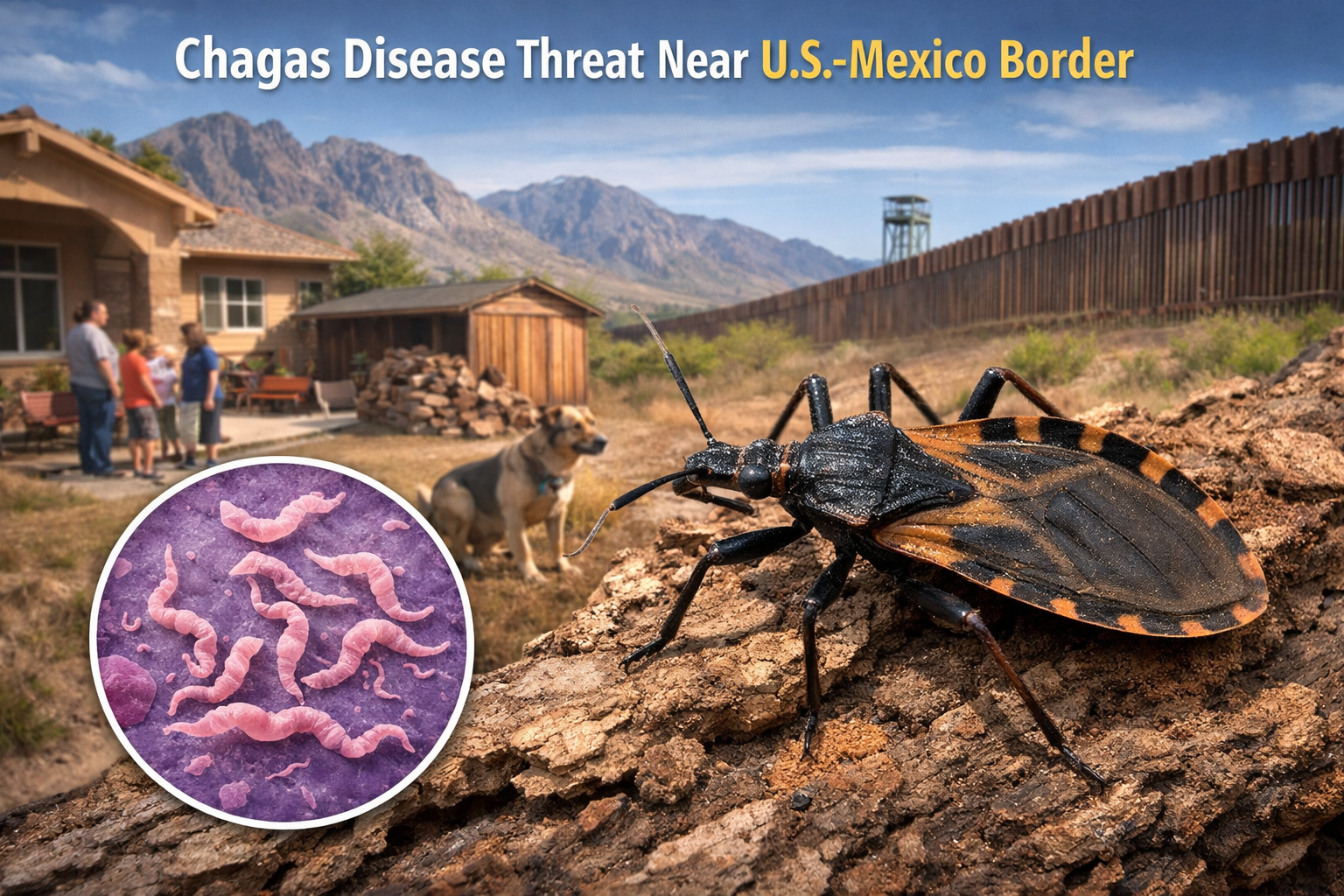
Rising Presence of Chagas-Carrying Kissing Bugs Raises Health Concerns Along the U.S. Mexico Border
Chagas disease, once considered a health issue limited mostly to Latin America, is gaining renewed attention in the United States. New research from the Southwestern U.S. shows a sharp increase in infection rates among kissing bugs, the insects responsible for spreading the disease. The findings suggest that Chagas disease may be an emerging public health concern in parts of Texas and New Mexico, particularly along the U.S. Mexico border.
Scientists from the University of Texas at El Paso recently discovered that a very high percentage of kissing bugs collected near homes and public areas were infected with the parasite Trypanosoma cruzi. This parasite causes Chagas disease, a condition that can remain silent for years before leading to serious and sometimes life threatening complications.
As infection rates in insects continue to rise, experts are urging greater awareness, preventive measures, and additional research to understand how this trend could affect human health in the region.
What Is Chagas Disease?
Chagas disease is a parasitic infection caused by Trypanosoma cruzi. It is primarily transmitted to humans through contact with the feces of infected kissing bugs, also known as triatomine bugs. These insects typically bite humans while they sleep, often around the face or mouth. When a person accidentally rubs the bug’s feces into the bite wound, eyes, or mouth, the parasite can enter the body.
Worldwide, an estimated six million people are currently infected with T. cruzi. Many people experience no symptoms at first, which makes the disease difficult to detect in its early stages. However, over time, Chagas disease can lead to severe health problems, including heart disease, heart rhythm abnormalities, heart failure, and digestive system damage.
New Study Shows Alarming Increase in Infected Kissing Bugs
The recent study conducted by researchers at the University of Texas at El Paso focused on kissing bug populations in El Paso County, Texas, and southern New Mexico. The team collected 26 insects from areas close to human activity, including residential yards, under patio furniture, near woodpiles, and in public spaces such as parks and schools.
Of the 26 kissing bugs collected, 22 tested positive for Trypanosoma cruzi. This means nearly 90 percent of the insects were carrying the parasite.
What makes these findings particularly concerning is the comparison to earlier data. A similar study conducted by the same research team in 2021 found that about 63 percent of kissing bugs in the region were infected. The jump to nearly 88.5 percent represents a significant upward trend.
According to Rosa Maldonado, a biology professor at UTEP who led the study, the increase suggests that T. cruzi infections among kissing bugs are becoming more common in the region. This raises questions about whether the risk to humans and animals is also increasing.
Why This Matters for Public Health in the United States
Historically, Chagas disease has been most prevalent in Latin America, where millions of people have been infected. However, growing evidence shows that the disease is not confined to those regions anymore.
In the United States, kissing bugs are already present in many southern states, including Texas, Arizona, New Mexico, and parts of California. While human infections have been relatively rare compared to Latin America, increased infection rates in insect populations could change that over time.
The concern is not just about new infections but also about undiagnosed cases. Because Chagas disease can remain asymptomatic for years or even decades, people may not realize they are infected until serious heart or digestive complications develop later in life.
Where Kissing Bugs Are Being Found
One of the more unsettling findings from the study is where the insects were discovered. Researchers found kissing bugs in places that bring them into close contact with people and pets, including:
- Residential yards
- Under garden and patio furniture
- Near firewood piles
- Public parks
- School grounds
These locations suggest that the insects are adapting well to environments shaped by human activity. Outdoor lighting, clutter, and shelter near homes may make it easier for kissing bugs to survive and multiply.
How Chagas Disease Affects the Body
Chagas disease typically progresses through two phases: the acute phase and the chronic phase.
Acute Phase
The acute phase occurs shortly after infection and may last for weeks or months. Symptoms are often mild or nonexistent but can include:
- Fever
- Fatigue
- Swelling at the site of infection
- Headache
- Muscle aches
Because these symptoms are nonspecific, many cases go unnoticed or are misdiagnosed.
Chronic Phase
After the acute phase, the disease enters a long chronic stage. Most people remain symptom free for years. However, about 20 to 30 percent of infected individuals eventually develop serious complications, including:
- Enlarged heart or cardiomyopathy
- Heart rhythm disturbances
- Heart failure
- Enlarged esophagus or colon
- Digestive problems
These complications can be severe and may be life threatening if not properly managed.
Pets and Chagas Disease Risk
Humans are not the only ones at risk. Kissing bugs can also infect dogs and other animals. Infected pets may serve as reservoirs for the parasite, increasing the chances of human exposure.
Dogs infected with Chagas disease may develop heart problems similar to those seen in humans. Keeping pets indoors when possible and preventing contact with kissing bugs can reduce this risk.
Simple Steps to Reduce Exposure to Kissing Bugs
While the study findings are concerning, there are practical steps people can take to lower their risk of exposure. Researchers recommend several preventive measures, especially for those living in affected regions.
Seal Entry Points
Cracks and gaps in walls, windows, and doors provide easy access for insects. Sealing these openings can significantly reduce the chances of kissing bugs entering the home.
Remove Outdoor Clutter
Woodpiles, debris, and stacked materials near the house can serve as hiding places for insects. Keeping these items away from living areas can help limit bug populations.
Install Window Screens
Screens on windows and doors act as a barrier between indoor spaces and insects attracted to light.
Turn Off Outdoor Lights at Night
Kissing bugs are drawn to light sources. Reducing outdoor lighting at night can make homes less attractive to them.
Protect Pets
Keeping pets indoors, especially at night, reduces their exposure and lowers the risk of bringing infected insects closer to people.
What Comes Next in Research
The UTEP research team plans to expand their work to determine whether people living in the El Paso area may already be carrying Trypanosoma cruzi without knowing it. This would involve testing human populations for signs of infection, even in the absence of symptoms.
Such research could help public health officials better understand the true scope of Chagas disease risk in the United States and guide future prevention and screening efforts.
Growing Awareness Is Key
The rise in infection rates among kissing bugs does not mean that widespread outbreaks are inevitable. However, it does highlight the importance of awareness, surveillance, and early intervention.
By understanding where kissing bugs live, how Chagas disease is transmitted, and what steps can reduce exposure, individuals and communities can take proactive measures to protect themselves.
As climate patterns change and human development continues to expand into natural habitats, close monitoring of vector borne diseases like Chagas will remain an essential part of public health planning.
Source
University of Texas at El Paso, news release, January 6, 2026.
Disclaimer
This article is for informational and educational purposes only and does not constitute medical advice, diagnosis, or treatment. Health conditions and risks vary by individual. Always consult a qualified healthcare professional for personalized medical guidance or concerns related to Chagas disease or any other health condition.