
One in Four: The Silent Crisis of Missed Maternal Stroke
Maternal health has moved to the center of public health conversations in recent years, and for good reason. Stroke during pregnancy and the postpartum period remains a leading cause of maternal morbidity and mortality, yet it is still frequently underrecognized. As part of the Go Red movement, which highlights cardiovascular risks in women, understanding how and why maternal strokes are missed is critical.
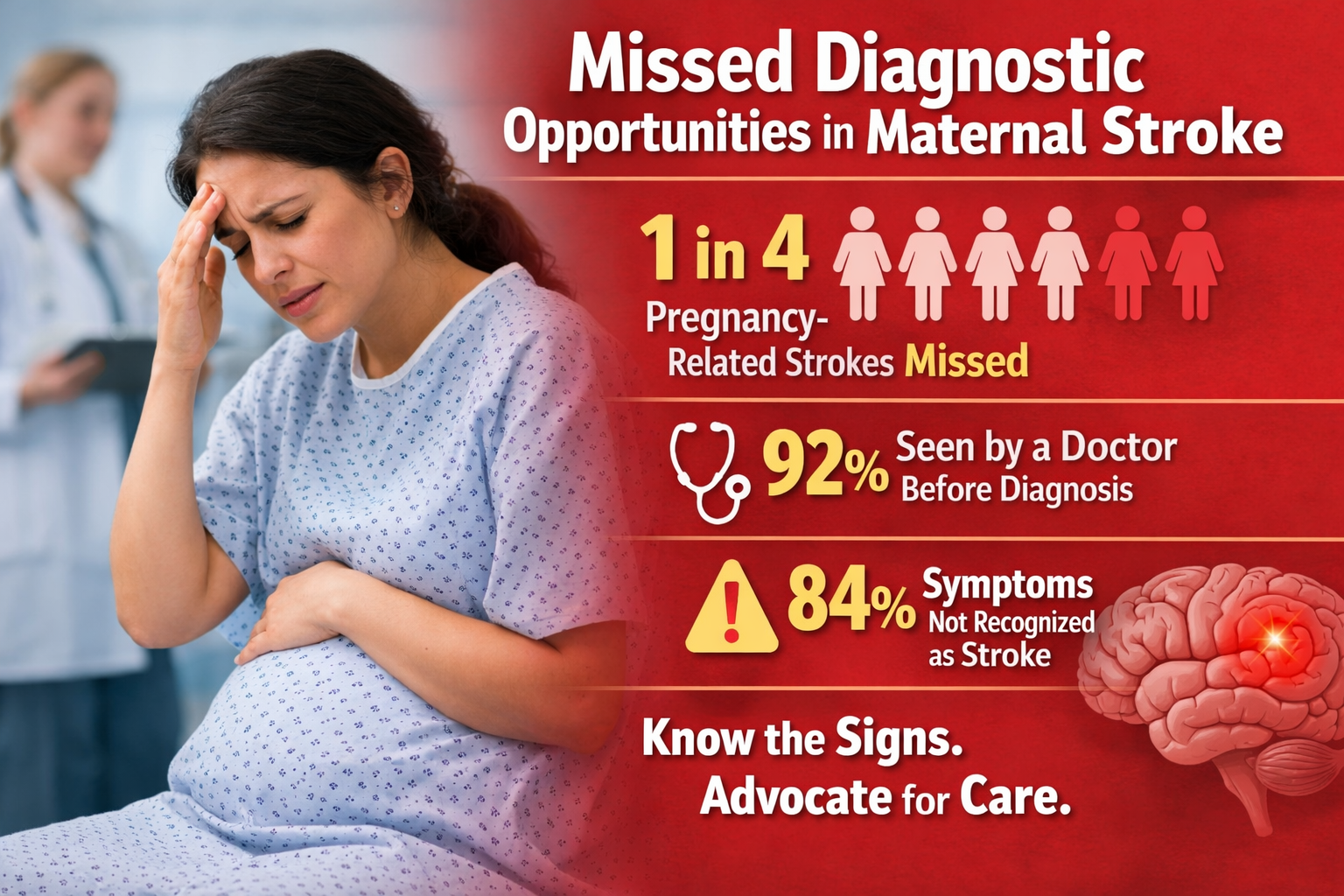
A recent research article published in Stroke on 26 January 2026 sheds new light on this issue. Titled Identifying Missed Diagnostic Opportunities in Maternal Stroke, the study reveals that more than one in four pregnancy associated strokes involved missed diagnostic opportunities. These findings underscore a pressing need for improved awareness, education, and clinical protocols, particularly for non neurologists who often serve as the first point of care.
This article explores the study’s findings, why maternal stroke is so often overlooked, and what clinicians and health systems can do to reduce preventable harm.
Why Maternal Stroke Is Often Missed
Stroke is traditionally associated with older adults and classic focal neurological deficits such as facial droop, arm weakness, and speech difficulty. Pregnancy associated stroke often looks different.
Many pregnant or postpartum patients present with nonfocal or ambiguous symptoms including headache, nausea, fatigue, confusion, or general malaise. These symptoms overlap with common pregnancy related conditions such as migraines, preeclampsia, anxiety, dehydration, or sleep deprivation. As a result, early warning signs of stroke may be attributed to benign or expected changes of pregnancy.
The Go Red campaign emphasizes that heart and brain conditions do not disappear during pregnancy. In fact, pregnancy introduces unique physiological changes that can increase stroke risk, including hypercoagulability, vascular remodeling, and blood pressure fluctuations. Without heightened clinical suspicion, these risks can be overlooked.
Overview of the Research Study
The study by Haghighi and colleagues was a retrospective analysis conducted across five comprehensive stroke centers in the United States. Researchers examined cases from 2012 through 2021 involving patients aged 18 to 50 who were pregnant or within one year postpartum and had a confirmed diagnosis of stroke.
Stroke subtypes included arterial ischemic stroke, intracerebral hemorrhage, subarachnoid hemorrhage, and cerebral venous thrombosis. Vascular neurologists reviewed each case using a validated assessment tool called Safer Stroke Dx, which is designed to identify missed diagnostic opportunities.
The goal was to determine how often clinicians had opportunities to diagnose stroke earlier and what factors contributed to delays.
Key Findings That Demand Attention
One in Four Patients Experienced Missed Diagnostic Opportunities
Out of 135 pregnancy related stroke cases, 37 patients or 27 percent experienced at least one missed diagnostic opportunity. This means that more than a quarter of patients had symptoms or encounters where stroke could reasonably have been identified earlier.
The confidence interval ranged from 20.6 percent to 35.5 percent, reinforcing that this is not a marginal issue but a systemic one.
Symptoms Were Often Present Before Diagnosis
Most patients had symptoms that, in hindsight, were consistent with stroke. Presenting features included:
- Focal neurological deficits in 57 percent of patients
- Headache in 53 percent
- Systemic symptoms such as dizziness or nausea in 26 percent
- Altered mental status in 19 percent
Crucially, among patients with missed diagnostic opportunities, 95 percent were judged by reviewers to have clinical presentations typical of their eventual stroke diagnosis. This suggests that the issue was not subtle or atypical disease, but recognition and response.
Hemorrhagic Stroke and Diagnostic Delay
The study found that hemorrhagic strokes were more common among patients with missed diagnostic opportunities. Fifty nine percent of patients with missed opportunities had hemorrhagic stroke compared with 43 percent of those without missed opportunities.
Hemorrhagic stroke in pregnancy is particularly dangerous and often presents with headache, vomiting, or altered consciousness rather than classic focal deficits. These symptoms may be misattributed to migraine, hypertension, or stress, delaying imaging and intervention.
This finding highlights the importance of maintaining a low threshold for neuroimaging in pregnant and postpartum patients with severe or unusual neurological symptoms.
Missed Opportunities Occurred Across Multiple Care Settings
One of the most striking findings was how frequently patients sought care before their stroke was diagnosed.
Among patients with missed diagnostic opportunities, 92 percent had at least one documented medical encounter in the month before stroke diagnosis. By comparison, only 59 percent of patients without missed opportunities had prior encounters.
Of the 86 patients who had prestroke encounters:
- 49 percent were evaluated by obstetricians
- 29 percent were evaluated by emergency medicine clinicians
This reinforces that maternal stroke is not solely a neurology issue. Obstetrics and emergency medicine are critical front line specialties in early stroke detection during pregnancy and postpartum care.
Contributing Factors to Missed Diagnosis
The study identified two dominant contributors to missed diagnostic opportunities:
Failure to Recognize Symptoms as Stroke
In 84 percent of missed cases, clinicians did not recognize presenting symptoms as potentially related to stroke. This likely reflects cognitive bias, low perceived risk in young patients, and symptom overlap with common pregnancy complaints.
Omission of Appropriate Neuroimaging
In 81 percent of missed cases, appropriate neuroimaging was not obtained. Concerns about fetal radiation exposure may play a role, despite clear guidelines that CT and MRI can be safely used when clinically indicated during pregnancy.
Delayed imaging directly translates into delayed diagnosis, delayed treatment, and worse outcomes.
Implications for Maternal Health and Go Red Awareness
The Go Red initiative aims to increase awareness of cardiovascular disease in women, including conditions that are frequently underdiagnosed. Maternal stroke fits squarely within this mission.
This study demonstrates that many strokes in pregnancy are not missed because they are invisible, but because they are unexpected. Changing this reality requires a cultural shift in how clinicians assess neurological symptoms in pregnant and postpartum patients.
Key implications include:
- Stroke education must extend beyond neurologists
- Obstetric and emergency clinicians need targeted training
- Protocols should emphasize early imaging when neurological symptoms are present
- Pregnancy should be viewed as a unique risk state, not a protective one
Steps Toward Reducing Missed Diagnostic Opportunities
Education for Non Neurologists
Because obstetricians and emergency clinicians frequently encounter these patients first, stroke recognition training should be incorporated into continuing education, residency programs, and hospital protocols.
Standardized Evaluation Pathways
Hospitals can implement standardized checklists or pathways for pregnant patients presenting with headache, altered mental status, or neurological complaints. These tools can help reduce reliance on individual clinical judgment alone.
Clear Imaging Guidelines
Clinicians should be reassured that appropriate neuroimaging is safe and necessary when stroke is suspected. Fear of imaging should never outweigh the risk of delayed diagnosis.
Patient Empowerment
Public awareness campaigns like Go Red can also empower pregnant and postpartum individuals to advocate for themselves when symptoms feel abnormal or severe.
Conclusion
The study Identifying Missed Diagnostic Opportunities in Maternal Stroke delivers a clear and sobering message. More than one in four pregnancy associated strokes involve missed chances for earlier diagnosis, often despite clear warning signs and recent medical encounters.
These findings are not about assigning blame. They are about recognizing patterns, addressing gaps, and improving systems of care. As maternal health continues to gain national attention, stroke must be included in the conversation.
Through education, awareness, and adherence to evidence based evaluation strategies, we can reduce missed diagnoses, improve outcomes, and save lives. Go Red is not just a campaign. It is a call to action.
Source
Haghighi N, Bourscheid R M, Shang C, Romo E, Khan F, Jankowski S, Seitz A, Miller E C. Identifying Missed Diagnostic Opportunities in Maternal Stroke. Stroke. Volume 57, Number 2. Originally published 26 January 2026.
Disclaimer
This article is for informational and educational purposes only and does not constitute medical advice. It is not intended to replace professional medical judgment, diagnosis, or treatment. Clinicians should consult current clinical guidelines and institutional protocols. Patients should seek immediate medical attention for concerning neurological symptoms.