
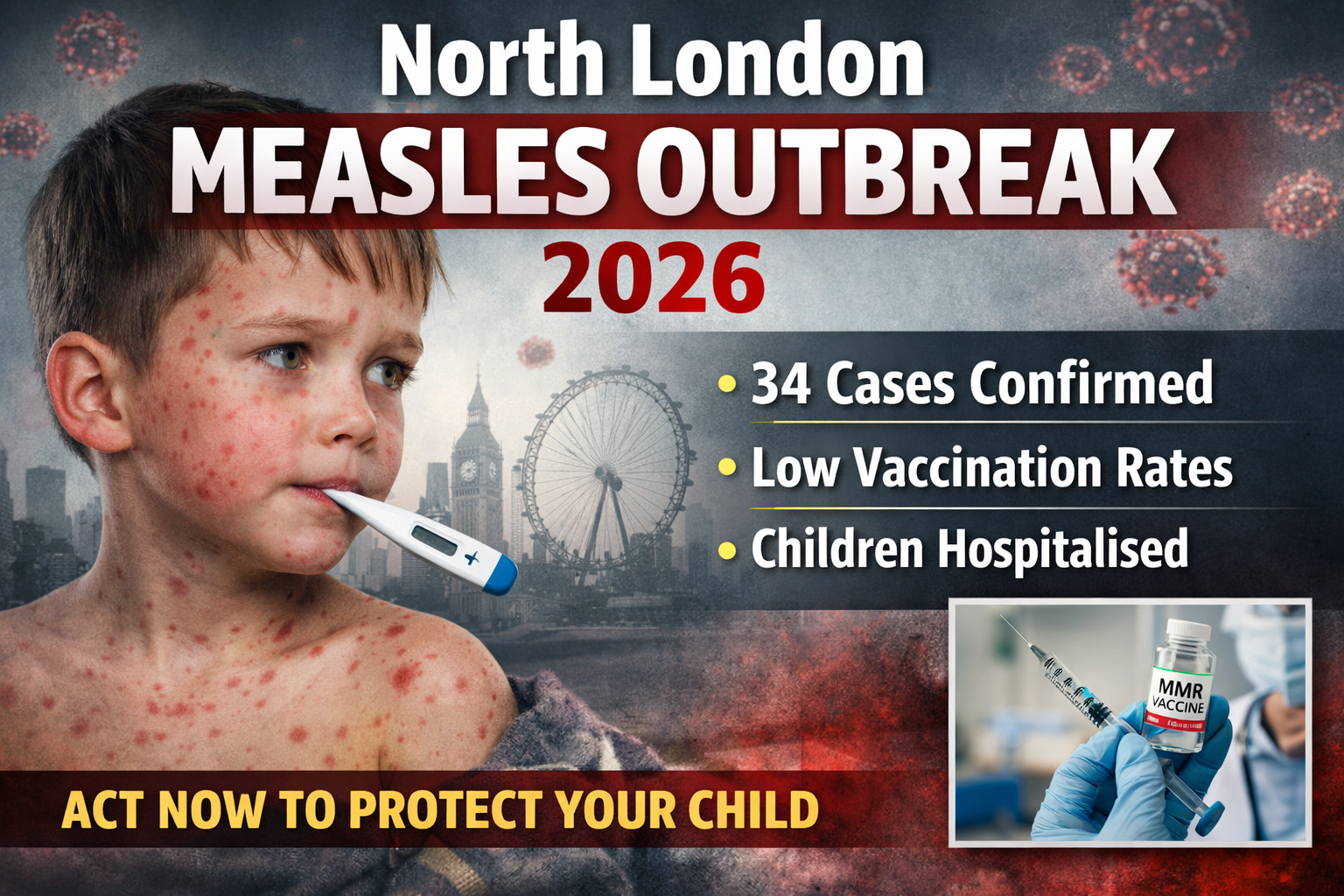
North London Measles Outbreak 2026: 34 Cases Confirmed as Vaccination Rates Fall
A fast-spreading measles outbreak has affected several schools in north London, raising urgent concerns among health officials, parents, and educators. According to a recent report by BBC News, at least 34 children in Enfield have tested positive for measles in laboratory-confirmed cases during January 2026. Health authorities warn that low vaccination rates are contributing to the rapid transmission of this highly contagious disease.
This article explores the details of the outbreak, symptoms of measles, complications to watch for, vaccination statistics in the UK, and what families can do to protect their children.
Measles Outbreak in Enfield and Haringey
The outbreak has primarily affected schools in the London boroughs of Enfield and neighbouring Haringey. The cases were confirmed by the UK Health Security Agency, which reported that the 34 infections in Enfield account for more than one third of the 96 measles cases recorded across England in the first month of the year.
Local health providers have described the outbreak as fast-spreading, particularly among unvaccinated children under the age of 10. A GP surgery in the area reported that one in five infected children required hospital admission. Notably, all hospitalized children had not been fully immunised.
Enfield Council has confirmed it is working closely with public health teams and the NHS to limit further spread in accordance with national guidelines.
Why Measles Spreads So Easily
Measles is one of the most contagious viral diseases known. It spreads through respiratory droplets when an infected person coughs or sneezes. The virus can also linger on surfaces, meaning children can become infected simply by touching contaminated objects.
Because measles is so infectious, high vaccination coverage is essential to prevent outbreaks. Health experts recommend that 95 percent of children receive two doses of the MMR vaccine to achieve herd immunity. When vaccination rates fall below this threshold, communities become vulnerable to outbreaks.
In Enfield, only 64.3 percent of five-year-olds had received both doses of the MMR vaccine in 2024 to 2025. Nationally, 84.4 percent of children had received two doses by their fifth birthday. While this is higher than Enfield’s rate, it remains below the recommended 95 percent.
The UK Loses Measles Elimination Status
In January, the World Health Organization announced that the UK had lost its measles elimination status following outbreaks in 2024. This designation is granted to countries that interrupt endemic measles transmission for at least 12 months.
Losing elimination status signals that measles is once again circulating within the population at concerning levels. Public health experts attribute this setback in part to declining vaccine uptake in recent years.
What Is Measles?
Measles is a viral infection that primarily affects children but can also infect adults who are not immune. It is preventable through vaccination, yet it remains a significant global health threat where immunisation coverage is insufficient.
Common Symptoms of Measles
Symptoms typically appear 7 to 14 days after exposure and may include:
- High fever
- Red, sore, watery eyes
- Persistent cough
- Runny nose
- Sneezing
- Small white spots inside the mouth
- A blotchy red or brown rash
The rash usually begins behind the ears and on the face before spreading across the body. On darker skin tones, the rash may be more difficult to detect, which can delay diagnosis.
Potential Complications of Measles
While many children recover fully, measles can cause serious complications. These include:
- Ear infections
- Pneumonia
- Severe dehydration
- Encephalitis, which is inflammation of the brain
- Long-term neurological damage
- In rare cases, death
Health professionals involved in the Enfield outbreak emphasized that measles is not a mild childhood illness. Some of the affected children required short hospital stays for additional care.
Children under five, pregnant women, and individuals with weakened immune systems are at greater risk of severe outcomes.
The Role of the MMR Vaccine
The MMR vaccine protects against measles, mumps, and rubella. In some cases, the MMRV vaccine also includes protection against chickenpox. Two doses are required for maximum protection.
The first dose is typically given at around one year of age, and the second dose is administered before school entry. The vaccine is offered free of charge through the NHS.
According to public health experts, two doses provide about 99 percent protection against measles. Vaccination not only protects the individual child but also helps safeguard infants who are too young to be vaccinated and people who cannot receive vaccines for medical reasons.
Why Vaccination Rates Are Falling
The decline in vaccination coverage across parts of the UK has been attributed to several factors:
- Disruption to healthcare services during the COVID-19 pandemic
- Vaccine misinformation spread online
- Missed school-based immunisation appointments
- Reduced access to primary care services
The drop from 88.8 percent coverage in 2014 to 2015 to 84.4 percent in 2024 to 2025 highlights a worrying trend. In some boroughs like Enfield, the rates are significantly lower.
Public health campaigns are now encouraging families to attend catch-up clinics if their children missed scheduled vaccinations. These clinics are free and widely available.
Measles and International Travel
Health authorities have also urged families traveling abroad, especially during school holidays, to check their vaccination status. Measles remains widespread in several countries with close links to the UK, and outbreaks are ongoing in parts of Europe.
Travel increases the risk of importing cases back into the UK, which can trigger local outbreaks in communities with low immunisation rates.
Ensuring children are fully vaccinated before travel is a key preventive measure.
Protecting Your Child During an Outbreak
If you live in an affected area or your child attends a school with confirmed cases, consider the following steps:
- Check your child’s vaccination record.
- Book a catch-up appointment if any doses were missed.
- Watch for early symptoms such as fever and cold-like signs.
- Keep your child at home and seek medical advice if measles is suspected.
Early isolation can help prevent further spread.
Parents are encouraged to contact their GP or local NHS services for guidance if they are unsure about their child’s immunisation history.
Public Health Response in London
Local authorities in Enfield are collaborating with the UK Health Security Agency, NHS teams, and school administrators to contain the outbreak. Measures include:
- Contact tracing
- Providing vaccination information to families
- Encouraging catch-up immunisations
- Monitoring hospital admissions
There have also been discussions about excluding unvaccinated pupils from school during active outbreaks to reduce transmission risk.
Community cooperation is essential to stop the spread.
The Bigger Picture: A Global Resurgence
The current outbreak in north London reflects a broader global trend. Measles cases have been rising worldwide, particularly in regions with declining vaccination coverage.
The World Health Organization and other global health bodies continue to warn that setbacks in routine immunisation could reverse decades of progress against vaccine-preventable diseases.
Rebuilding public confidence in vaccines and ensuring access to healthcare services are critical steps in preventing further outbreaks.
Final Thoughts: Prevention Is Possible
The north London measles outbreak serves as a stark reminder that vaccine-preventable diseases can quickly return when immunisation rates fall. With at least 34 confirmed cases in Enfield and dozens more across England, public health officials are urging swift action.
Measles spreads rapidly but is almost entirely preventable with two doses of the MMR vaccine. Protecting children through vaccination not only reduces their risk of severe illness but also helps shield vulnerable members of the community.
As health authorities continue their response, families are encouraged to stay informed, verify immunisation records, and seek medical advice when needed.
Source
Information referenced in this article is based on reporting by BBC News, published 15 February 2026, and statements from the UK Health Security Agency and the World Health Organization.
Disclaimer
This blog post is for informational and educational purposes only. It is not intended as medical advice, diagnosis, or treatment. Always consult a qualified healthcare professional or your GP regarding medical concerns or vaccination decisions.