
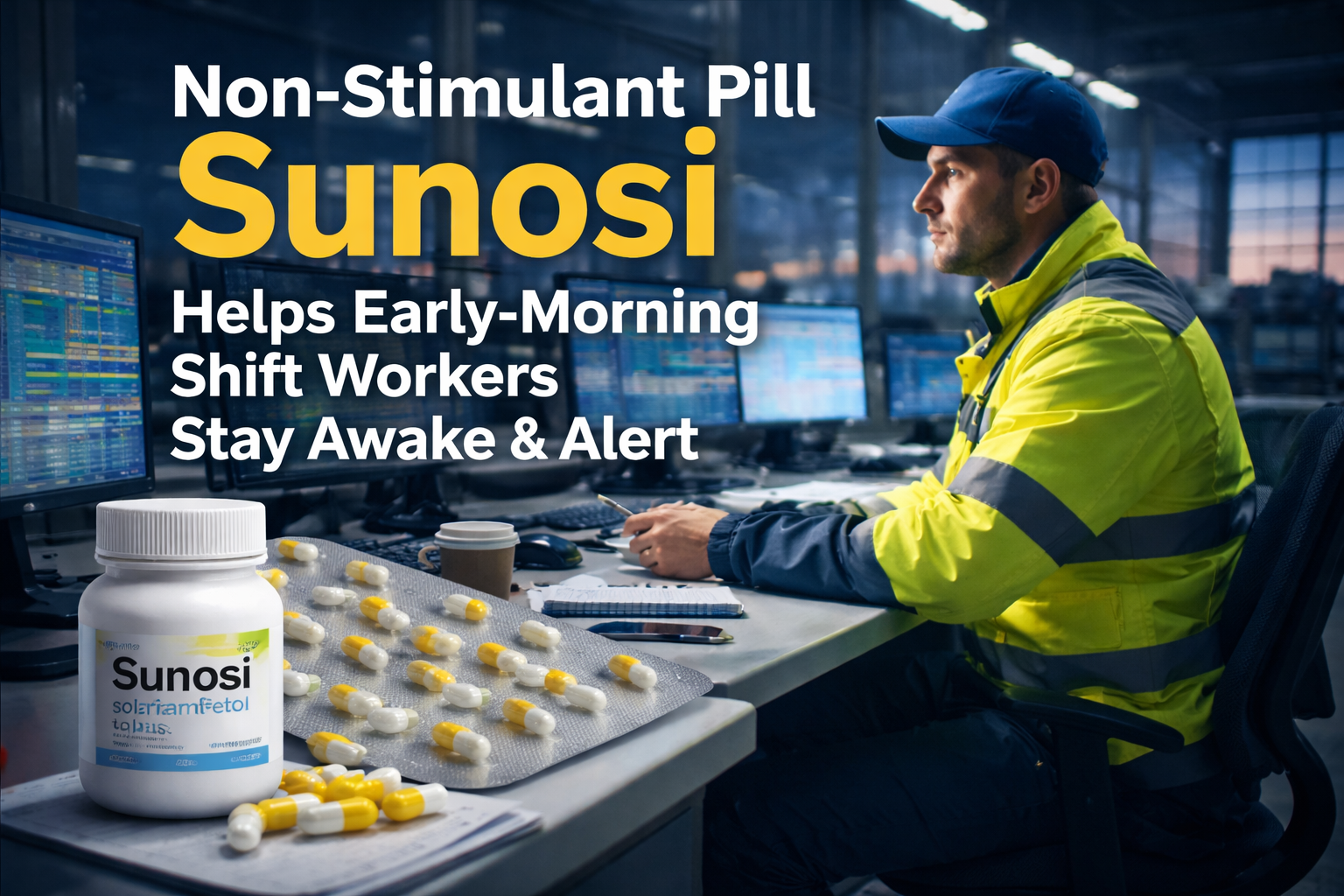
Non-Stimulant Pill Sunosi May Help Early Morning Shift Workers Stay Awake and Alert
Early morning shift workers face a unique challenge that most traditional nine to five employees never experience. Waking up for work between 3 a.m. and 7 a.m. goes directly against the body’s natural biological rhythm. For many, coffee and energy drinks become daily survival tools. Now, new research suggests a non stimulant prescription pill called Sunosi may offer a safer and more sustainable alternative for staying awake and alert on the job.
A recent clinical trial published in NEJM Evidence reports that solriamfetol, sold under the brand name Sunosi, significantly reduced sleepiness and improved alertness in early morning shift workers. The findings could mark a turning point for millions of workers who struggle with excessive sleepiness due to their work schedules.
Why Early Morning Shifts Are So Hard on the Body
Human sleep patterns are controlled by the circadian rhythm, an internal clock that regulates when we feel sleepy and when we feel alert. This rhythm is strongly influenced by light exposure and is biologically programmed for sleep during the overnight and early morning hours.
Workers who start their day before sunrise are often forced to wake up when the brain is still signaling that it is time to sleep. Even with motivation and adequate effort, staying alert during these hours can feel nearly impossible. Over time, this misalignment can lead to chronic fatigue, reduced productivity, increased accident risk, and long term health consequences.
This condition is commonly referred to as shift work disorder. While it has been widely studied in night shift workers, early morning shift workers have historically received far less attention despite representing the most common shift schedule worldwide.
What Is Sunosi and How Does It Work
Sunosi is the brand name for solriamfetol, a prescription medication approved by the U.S. Food and Drug Administration in 2019. It is currently approved to improve wakefulness in adults with excessive daytime sleepiness related to narcolepsy or obstructive sleep apnea.
Unlike traditional stimulants, solriamfetol is classified as a non stimulant wake promoting agent. It works by increasing the activity of two neurotransmitters in the brain that are closely linked to alertness and attention, dopamine and norepinephrine.
Because it does not act like classic stimulants such as amphetamines, Sunosi is less likely to cause the jitteriness, crashes, or sleep disruption commonly associated with caffeine and stimulant medications. Researchers believe this makes it a promising option for workers who need sustained alertness without sacrificing sleep later in the day.
The New Study on Early Morning Shift Workers
Researchers from Mass General Brigham conducted the first clinical trial specifically focused on early morning shift workers with excessive sleepiness. The study enrolled 78 participants whose work schedules required them to start between 3 a.m. and 7 a.m.
Participants were randomly assigned to receive either solriamfetol or a placebo once each workday for four weeks. Neither the participants nor the clinicians knew who was receiving the active medication during the study period.
The research team measured alertness using both subjective self reports and objective clinical assessments. One key test evaluated how long participants could stay awake in a quiet, dark environment during times when they would normally be working.
Study Results Show Significant Improvements
The results were striking. Workers who took solriamfetol were about four times less likely to experience excessive sleepiness during their shifts compared to those who received a placebo.
Participants in the Sunosi group stayed awake longer during testing, reported feeling more alert at work, and demonstrated improved overall functioning. Many also noted better work productivity and an improved ability to perform daily tasks without feeling overwhelmed by fatigue.
According to senior researcher Dr. Charles Czeisler, the improvements were not only statistically significant but also clinically meaningful. Workers were able to maintain alertness throughout a full eight hour shift, which has direct implications for safety, performance, and quality of life.
Why This Research Matters
Until now, no clinical trial had specifically tested a treatment for shift work disorder in early morning workers. Most existing research has focused on night shifts, leaving a major gap in care for those who start work before dawn.
Early morning shift workers are essential to many industries, including healthcare, transportation, manufacturing, emergency services, and food production. Despite their importance, they often pay a hidden biological cost in the form of chronic sleep deprivation and fatigue.
This study highlights the need to recognize early morning shift work as a legitimate health concern and to develop evidence based treatments tailored to this population.
Potential Benefits Beyond Alertness
Improved wakefulness at work is not just about feeling better. Excessive sleepiness has been linked to higher rates of workplace accidents, errors, and injuries. In safety sensitive professions, even small improvements in alertness can have life saving consequences.
Better alertness may also support mental health. Chronic fatigue is associated with increased rates of depression, anxiety, and burnout. By reducing sleepiness without disrupting sleep, Sunosi may help workers maintain a healthier balance between work demands and recovery time.
Is Sunosi a Replacement for Coffee
While coffee remains a popular and accessible solution, caffeine has limitations. Its effects are short lived, tolerance builds quickly, and excessive intake can lead to anxiety, heart palpitations, and disrupted sleep.
Sunosi is not intended to replace healthy sleep habits or eliminate the need for rest. However, for workers whose schedules make optimal sleep difficult, it may provide a more stable and predictable level of alertness compared to repeated caffeine use.
It is important to note that Sunosi is a prescription medication and should only be used under medical supervision.
Safety and Approval Status
Sunosi has been FDA approved since 2019 for excessive daytime sleepiness related to narcolepsy and obstructive sleep apnea. Its use in early morning shift workers is considered off label, meaning it is not yet an officially approved indication.
The clinical trial was funded by Axsome Therapeutics, the manufacturer of Sunosi. Researchers disclosed this funding and emphasized the importance of continued independent research to confirm long term safety and effectiveness in shift working populations.
As with any medication, potential side effects exist, and not all individuals may be appropriate candidates.
What Comes Next
The findings open the door for additional research and possible future approval for shift work disorder. Larger and longer studies will be needed to assess long term outcomes, optimal dosing, and real world safety in diverse working populations.
For now, the study provides hope for millions of workers who struggle to stay alert during early morning hours and feel that current solutions fall short.
Final Thoughts
Early morning shift work is a reality for modern society, and the people who perform these jobs keep essential systems running. Addressing their unique sleep challenges is both a medical and public safety priority.
Sunosi represents a promising step forward by offering sustained alertness without the drawbacks of traditional stimulants. While it is not a cure for shift work disorder, it may become an important tool in helping early bird workers stay awake, alert, and safe on the job.
Sources
Mass General Brigham. News release. January 28, 2026.
NEJM Evidence. Study published January 27, 2026.
HealthDay News. Thompson D. February 2, 2026.
U.S. Food and Drug Administration. Solriamfetol approval information.
Axsome Therapeutics. Product and mechanism information.
Disclaimer
This article is for informational and educational purposes only and does not constitute medical advice. Statistical data and research findings describe general trends and may not apply to individual circumstances. Individual responses to medications vary based on health status, medical history, and other factors. Always consult a qualified healthcare professional before starting or changing any medication or treatment plan.