
Nipah Virus Vaccine Development: Current Research, Clinical Trials, and Future Prospects
The Nipah virus is one of the most deadly viruses that has emerged in recent decades. It is a zoonotic pathogen, which means it can spread from animals to humans. Most outbreaks have occurred in South and Southeast Asia, primarily in countries such as Bangladesh and India. Since the virus was first identified in 1998, it has caused repeated human outbreaks with very high fatality rates. In some cases it has killed as many as three out of every four infected people. There are currently no approved vaccines or treatments available to prevent or cure Nipah virus infection. This stark reality makes vaccine development an urgent global health priority. Nipah virus vaccine development has thus become a major focus for scientists and health agencies around the world. (University of Oxford)
Understanding the science behind vaccine development for Nipah virus is important for public health, for policymakers, and for anyone concerned about global epidemic preparedness. In this blog we will explore the background of the virus, why a vaccine is needed, the current state of vaccine research, the different types of vaccine approaches being pursued, the challenges that vaccine developers face, and what the future may hold. We will also provide referenced information from reputable sources and conclude with a disclaimer regarding the information provided.
What is the Nipah Virus
The Nipah virus belongs to the genus Henipavirus and the family Paramyxoviridae. It is related to other viral pathogens but has unique characteristics that make it particularly dangerous to humans. The virus is known to be carried by fruit bats, which act as natural reservoirs. Infected animals such as bats can transmit the virus to humans through direct contact or through contamination of food sources like date palm sap. Occasionally it can spread from person to person through close contact, especially in healthcare settings. Symptoms of Nipah virus infection can vary widely but often include fever, headache, muscle pain, respiratory issues, and a severe form of brain inflammation called encephalitis. Once symptoms develop the disease can progress quickly to coma or death. There is no known cure or targeted treatment, and supportive care is the mainstay of clinical management. (University of Oxford)
Because of its high mortality rate, potential for person-to-person transmission, and ability to infect multiple species, the World Health Organization (WHO) has listed Nipah virus as a priority pathogen that requires urgent research and development. The virus’s ability to cause sporadic outbreaks with little notice has made it a focus for both vaccine development and epidemic response planning. (GOV.UK)
Why a Vaccine is Essential
Vaccines have played a transformative role in preventing infectious diseases. Diseases that once killed millions have been largely controlled or eradicated through effective vaccination programs. For example, vaccines are credited with saving millions of lives from diseases like smallpox, polio, and measles. The development of a vaccine for Nipah virus would similarly protect vulnerable populations in regions at risk for outbreaks and could help prevent larger epidemics.
Unlike many other viruses for which vaccines are available, Nipah virus has no approved vaccine or antiviral treatment. This means that public health authorities must rely on surveillance, contact tracing, isolation of cases, and supportive care to manage outbreaks. Because of the severity of the disease and the difficulty of controlling it solely through public health measures, a vaccine is widely seen as the best long-term strategy to reduce the human toll and prevent future outbreaks. (UK Health Security Agency)
Current Progress in Vaccine Development
Although no licensed vaccine is yet available, there are several promising vaccine candidates in development. Researchers are using a variety of scientific approaches to create vaccines that are safe, effective, and capable of triggering a protective immune response.
Oxford University’s ChAdOx1 NipahB Vaccine
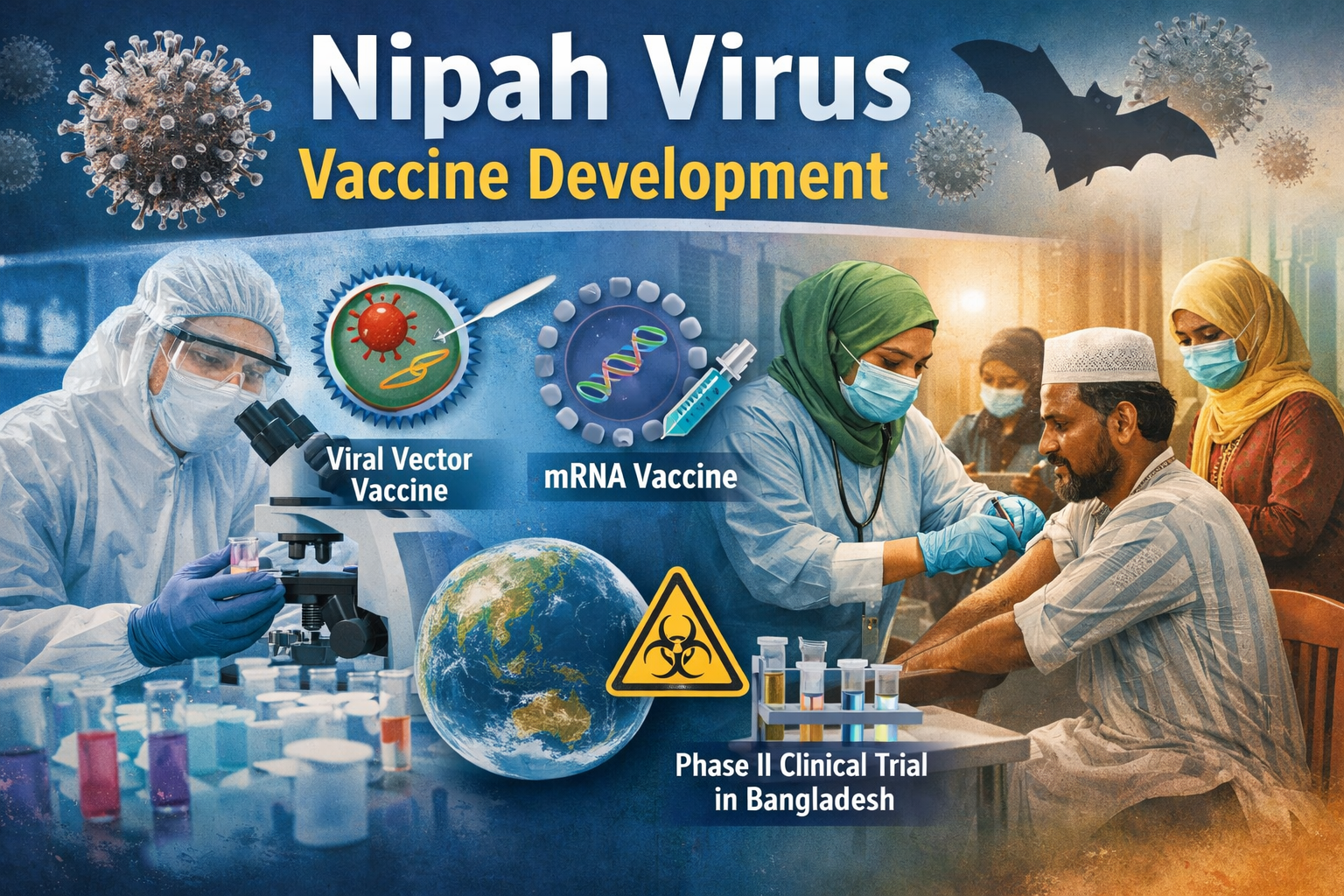
One of the most advanced Nipah vaccine candidates is known as ChAdOx1 NipahB. This vaccine is being developed by scientists at the University of Oxford’s Pandemic Sciences Institute in the United Kingdom and uses a viral vector platform similar to the one used in the Oxford/AstraZeneca COVID-19 vaccine. The vaccine works by delivering a harmless viral vector that carries genetic material encoding Nipah virus proteins. Once administered, the immune system recognises those proteins and begins building a defensive response that could protect against future exposure to the actual virus.
The first-in-human Phase I trial of the ChAdOx1 NipahB vaccine was launched in January 2024 in the United Kingdom. Healthy adult participants received doses of the vaccine as part of this early trial to evaluate safety and immune responses. This trial was a significant milestone as it marked the first time a Nipah vaccine candidate had been tested in humans. (University of Oxford)
Following this initial stage, a Phase II clinical trial was launched in December 2025 in Bangladesh, a country where Nipah virus outbreaks occur regularly. This trial is designed to further assess safety and the immune response in a population that is actually exposed to the virus in the environment. It involves more participants and is conducted in partnership with international research institutions and supported by global health funders. (University of Oxford)
In June 2025 the ChAdOx1 NipahB vaccine was granted a PRIME designation by the European Medicines Agency. This regulatory designation is intended to help accelerate the development and review of medications that address significant unmet medical needs. It provides scientific and regulatory support to the vaccine developers to help speed the process toward potential approval. (NDM Oxford)
mRNA Vaccine Research
In addition to the Oxford vaccine, there has been research into messenger RNA (mRNA) vaccines for Nipah virus. The U.S. National Institutes of Health (NIH), in collaboration with vaccine developers, launched a Phase I clinical trial of an mRNA-based Nipah vaccine in 2022. This vaccine, referred to in research documents as mRNA-1215, uses mRNA technology similar to the platforms developed for COVID-19 vaccines. In this study healthy volunteers received different dosages of the vaccine to assess safety, tolerability, and immune response. (National Institutes of Health (NIH))
mRNA vaccines work by delivering genetic instructions to cells to produce a viral protein that triggers an immune response. This type of vaccine has shown remarkable success in other infectious diseases and could offer a flexible platform for rapid vaccine design if it proves effective for Nipah virus.
Novel Vaccine Platforms and Research
Beyond the Oxford and mRNA vaccines, researchers are also exploring novel vaccine platforms. For example, scientists at Cornell University and Northwestern University have developed a rapid, cell-free method to assemble vaccine candidates that mimic the structure of the virus. This technique could enable faster creation of vaccine candidates that stimulate the immune system. (Cornell Chronicle)
Other experimental approaches, such as nanoparticle-based vaccines, DNA vaccines, and recombinant viral vectors, are also under investigation. These diverse approaches reflect the complexity of Nipah virus and the need to explore multiple scientific avenues to find the most effective solution. While many of these platforms are still in preclinical stages, they represent important steps forward in the broader effort to develop a vaccine.
Challenges in Developing a Vaccine
Developing vaccines for any virus is a complex and resource-intensive process. For Nipah virus vaccines, several challenges make the process especially difficult:
1. Sporadic Outbreaks
Unlike diseases that circulate widely and consistently, Nipah virus outbreaks are sporadic and often small in scale. While this is good from a public health perspective, it makes traditional vaccine efficacy studies difficult. In order to demonstrate that a vaccine prevents disease, researchers typically need to observe vaccinated individuals in a real outbreak setting. With infrequent outbreaks, finding enough cases to measure vaccine effectiveness becomes a major challenge. (UK Health Security Agency)
2. High Containment Requirements
Because Nipah virus is extremely dangerous, handling the live virus and conducting research often requires the highest levels of laboratory biosafety containment. This adds time to research and limits the number of facilities capable of working with the virus. Establishing and maintaining these facilities is expensive and technically demanding.
3. Regulatory Pathway Complexity
Vaccines must meet strict regulatory requirements for safety and effectiveness. For rare and sporadic diseases such as Nipah virus, regulators may need alternative pathways to evaluate whether a vaccine will work in humans. Regulatory designations such as the European Medicines Agency’s PRIME status help facilitate interactions between developers and regulatory agencies, but the path to full licensure remains long and complex. (NDM Oxford)
4. Funding and Global Coordination
Developing vaccines for diseases that primarily occur in low and middle income countries can present funding challenges. Global health organisations such as the Coalition for Epidemic Preparedness Innovations (CEPI), national research institutes, and philanthropic funders play a critical role in providing the financial support needed for research, clinical trials, and manufacturing capacity. (University of Oxford)
What the Future Holds
While Nipah virus vaccine development is still in progress, the advances made in recent years offer hope. The fact that multiple vaccine candidates have entered clinical trials is a clear sign of progress. Continued research into new technologies and trial designs could bring effective vaccines closer to reality.
Efforts to improve global epidemic preparedness may also accelerate Nipah vaccine development. Learning from the COVID-19 pandemic, scientists and policymakers are focused on building platforms and infrastructure that allow rapid vaccine development and deployment in response to emerging threats. The international community recognises that investing in vaccines today helps prevent disease outbreaks from becoming global crises tomorrow.
Conclusion
In summary, the development of vaccines against the deadly Nipah virus is advancing but remains ongoing. Research teams around the world are pursuing several promising approaches including viral vector vaccines, mRNA vaccines, and innovative platforms such as rapid assembly systems. Early human trials have begun, and regulatory agencies are providing support to speed development.
Despite significant challenges, progress continues toward the goal of a safe and effective Nipah virus vaccine. Continued scientific research, funding, international cooperation, and innovative trial methods will be essential in overcoming the hurdles that remain. This work not only protects populations at risk of Nipah virus outbreaks but also strengthens global capacity to respond to future infectious disease threats.
Sources
- NIH launches clinical trial of mRNA Nipah virus vaccine | NIH.
- New research to develop vaccines against deadly henipaviruses | GOV.UK.
- World’s first Phase II Nipah virus vaccine trial launch | University of Oxford.
- First-in-human vaccine trial for deadly Nipah virus launched | University of Oxford.
- Nipah virus vaccine granted EMA PRIME designation | University of Oxford.
- New platform enables rapid assembly of Nipah virus vaccine candidate | Cornell Chronicle.
- Progress and challenges in Nipah vaccine development and licensure | UKHSA.
Disclaimer
This blog is intended for informational and educational purposes only. The content is not medical advice and should not be used as a substitute for professional healthcare consultation, diagnosis, or treatment. Information and recommendations regarding vaccines and disease prevention can change as research progresses. Consult qualified health professionals or official public health guidance for personalized medical guidance.