
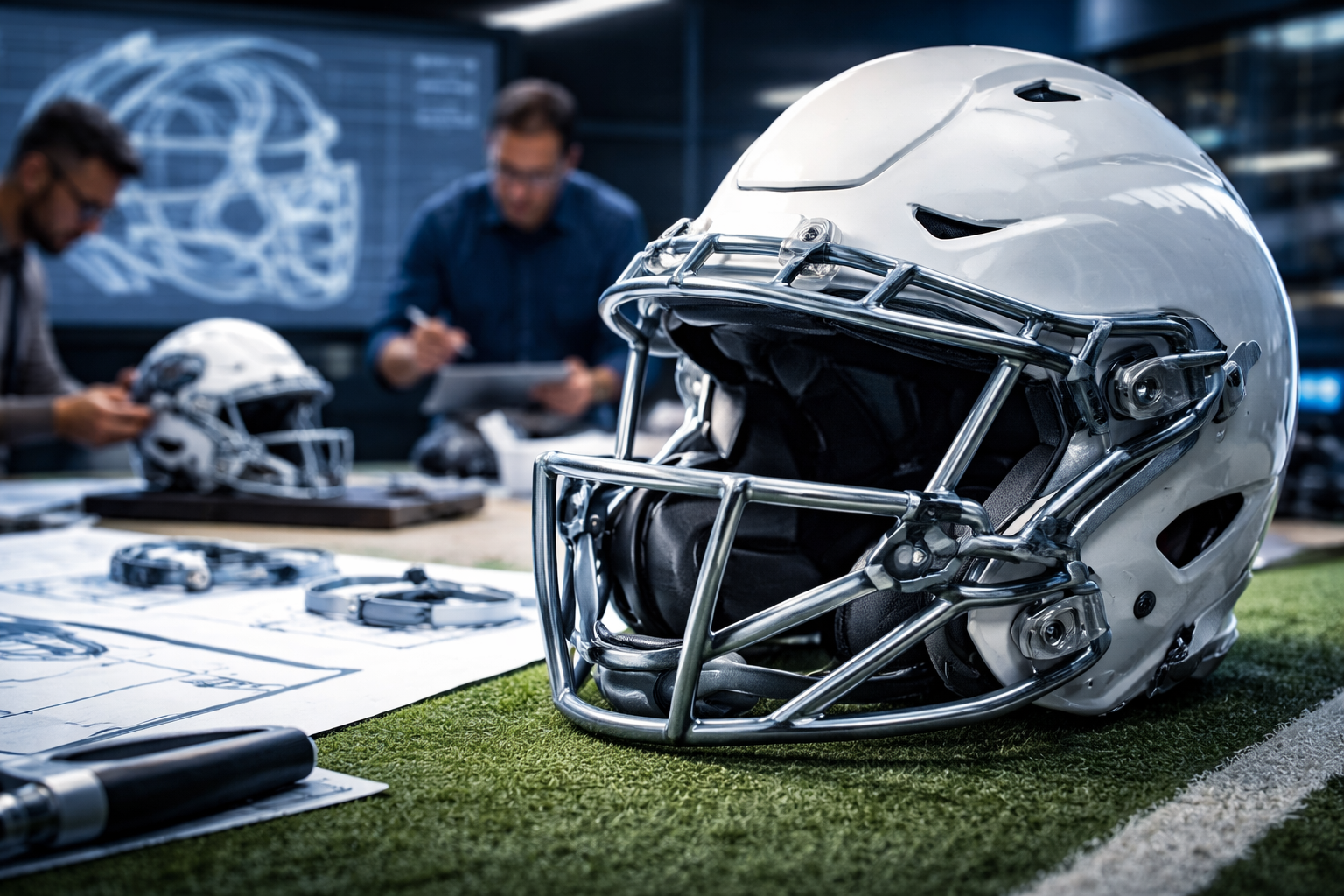
NFL Targets Helmet Facemasks in New Safety Challenge Aimed at Reducing Concussions
The National Football League is taking a new step in its ongoing effort to reduce concussions by focusing on a long overlooked part of player equipment: the helmet facemask. In February 2026, the NFL announced a new HealthTECH Challenge that invites innovators to rethink how facemasks are designed, built, and integrated into modern football helmets.
The initiative reflects a growing recognition that while helmet shells and padding have improved significantly over the past decade, facemask technology has remained largely unchanged. With new data showing that nearly half of all in game concussions now involve contact to the facemask, the league is betting that fresh ideas from engineers, startups, and researchers could meaningfully improve player safety.
Why the NFL Is Focusing on Facemasks Now
Concussions have been one of the most pressing issues facing professional football. Over the years, the NFL has invested heavily in research, equipment testing, and rule changes designed to reduce head injuries. These efforts have led to measurable improvements, especially in helmet shell design and internal padding systems.
However, recent injury data revealed an unintended consequence of those improvements.
According to NFL data, 44 percent of in game concussions during the most recent season involved hits to the facemask. That number is a sharp increase from 29 percent in 2015. As helmets have become better at dispersing force across the shell, impacts that involve the facemask have emerged as a more prominent source of injury.
Jeff Miller, the NFL’s executive vice president for player health and safety, acknowledged that while helmet technology has evolved, facemasks have not kept pace.
From a visual and structural standpoint, modern facemasks look nearly identical to those used five to seven years ago. They are still made from similar metals and rely on the same basic geometry. This lack of innovation made facemasks a logical next target for improvement.
What Is the NFL HealthTECH Facemask Challenge?
The HealthTECH Challenge is an open competition designed to attract ideas from beyond the traditional helmet manufacturing industry. The NFL is actively encouraging participation from engineers, material scientists, universities, startups, and independent inventors.
Rather than limiting submissions to established equipment makers, the league hopes to tap into cross disciplinary thinking that could lead to breakthroughs in impact management, materials, or structural design.
Participants are invited to propose new facemask concepts that better absorb, redirect, or reduce impact forces during play. Winning entries will be eligible for up to $100,000 in total funding, along with technical support to help transform prototypes into equipment that could eventually be used on the field.
The NFL plans to select a winner in August 2026, with the possibility that successful designs could be incorporated into commercial helmets soon after.
How Facemask Impacts Contribute to Concussions
Facemasks play a critical role in player protection by shielding the face, eyes, and mouth. However, they also serve as a frequent point of contact during tackles and collisions.
When a facemask is struck, force can be transmitted directly to the helmet and the player’s head and neck. Depending on the angle and severity of impact, this can result in rapid acceleration or rotational forces that increase concussion risk.
As helmet shells and padding have improved at absorbing direct blows, facemask impacts have become more noticeable in injury data. This shift does not necessarily mean the game has become more dangerous, but it does highlight how improvements in one area can expose vulnerabilities in another.
Lessons From Past Helmet Safety Innovations
The NFL’s approach to facemask redesign builds on lessons learned from previous safety initiatives. In recent years, the league worked with helmet manufacturers to develop position specific helmets tailored to how different players experience impacts.
For example, quarterbacks now often wear helmets with extra padding in the back. This change was driven by data showing that many quarterback concussions occurred when their heads struck the ground after being hit.
These targeted improvements demonstrate how data driven design can lead to meaningful reductions in injury risk. The facemask challenge aims to apply a similar approach by identifying where and how impacts occur, then designing solutions that address those specific risks.
Player Support for the Initiative
NFL players have generally responded positively to the facemask redesign challenge. Arik Armstead, an 11 year NFL veteran defensive lineman, publicly welcomed the league’s push for new ideas.
Armstead recently switched to a helmet that received higher safety ratings through league testing. He described the challenge as an exciting opportunity to bring new creative minds into the equipment development process.
Player buy in is critical for any equipment change to succeed. Even the safest design offers little benefit if athletes are unwilling to wear it. By involving players early and emphasizing innovation rather than mandates, the NFL may increase acceptance of future facemask designs.
What Innovation Could Look Like in Facemask Design
While the NFL has not specified what solutions it expects, the challenge opens the door to a wide range of possibilities.
Potential areas of innovation include new materials that flex or deform under impact, redesigned bar geometries that redirect force away from the head, and attachment systems that reduce torque during collisions. Some concepts may borrow ideas from other industries such as automotive safety, aerospace engineering, or military protective gear.
Material science could play a particularly important role. Advances in lightweight composites, smart materials, or energy absorbing alloys may offer alternatives to traditional steel facemasks without sacrificing durability.
The Broader Impact on Football at All Levels
Although the HealthTECH Challenge is focused on the NFL, its impact could extend far beyond professional football. Equipment innovations introduced at the professional level often trickle down to college, high school, and youth leagues.
Improved facemask designs could benefit millions of players, especially younger athletes who may be more vulnerable to head injuries. As public awareness of concussion risks continues to grow, safer equipment may also help reassure parents and encourage participation in the sport.
In this sense, the facemask challenge represents not only a technological opportunity but also a chance to shape the future of football’s safety culture.
Balancing Safety and Performance
One of the key challenges in any equipment redesign is balancing safety with performance. Football players rely on facemasks for visibility, breathing, and communication. Any new design must preserve these functions while improving impact protection.
There are also considerations related to weight, comfort, and durability. A facemask that is safer but heavier or more restrictive may face resistance from players and teams.
The open nature of the HealthTECH Challenge suggests the NFL is aware of these tradeoffs and is seeking a wide range of ideas before narrowing down potential solutions.
A Sign of Continued Commitment to Player Health
The facemask redesign initiative underscores the NFL’s ongoing commitment to addressing head injuries through science and innovation. While no single change can eliminate concussion risk entirely, incremental improvements can add up over time.
By focusing on an area that has seen little change in recent years, the league is signaling that no part of player equipment is beyond scrutiny. The challenge also reflects a broader trend in sports toward data driven decision making and interdisciplinary collaboration.
Whether the competition produces a revolutionary new facemask or more modest improvements, it represents another step in the long process of making football safer.
Conclusion
The NFL HealthTECH Facemask Challenge highlights how evolving injury data can reshape priorities in player safety. As helmet technology improves, attention is shifting to components like facemasks that now play a larger role in concussion risk.
By inviting innovators from diverse fields to contribute ideas, the NFL is opening the door to new approaches that could benefit players at every level of the game. The coming months will reveal which concepts rise to the top and how quickly they can be translated into real world equipment.
For fans, players, and families alike, the initiative offers a hopeful reminder that progress in sports safety is ongoing and that even familiar pieces of equipment can still be improved.
Source
CNN, Feb. 8, 2026
Disclaimer
Statistical data and medical related information in this article are provided for general informational purposes only and do not apply to individual cases. Individual health risks and outcomes can vary widely. This content is not intended as medical advice, diagnosis, or treatment. Always seek the guidance of a qualified healthcare professional for personalized medical decisions.