
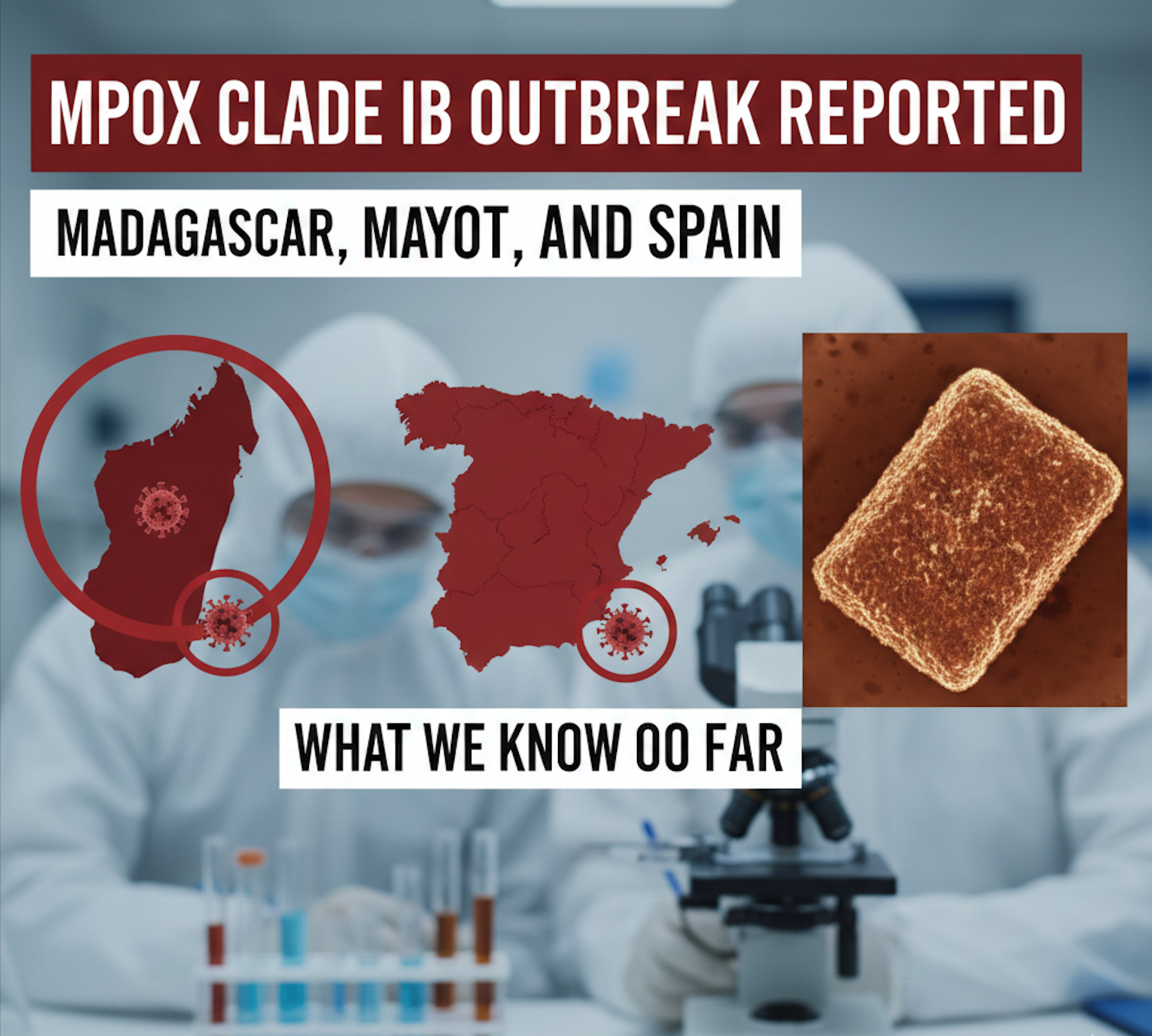
Mpox Clade Ib Outbreak Reported in Madagascar, Mayotte, and Spain: What We Know So Far
Mpox continues to pose a complex global public health challenge as new outbreaks emerge in different regions. Between December 2025 and mid January 2026, health authorities confirmed the circulation of mpox clade Ib in Madagascar, with linked cases detected in Mayotte and sustained transmission reported in parts of Europe, particularly Spain. These developments highlight the evolving epidemiology of mpox and the importance of surveillance, early detection, and targeted public health responses.
This article provides a detailed overview of the newly reported mpox clade Ib outbreak, covering the situation in Madagascar, Mayotte, Spain, and the United Kingdom. It also explains why clade Ib is significant, how transmission patterns are changing, and what this means for international health preparedness.
Understanding Mpox and Clade Ib
Mpox is a viral zoonotic disease caused by the mpox virus, a member of the Orthopoxvirus genus. It is related to smallpox but is generally less severe, although serious illness can occur, especially in vulnerable populations.
There are two main genetic groups of the virus, historically referred to as clade I and clade II. Clade I is further divided into subclades, including clade Ib. Clade Ib has drawn increased attention due to evidence suggesting higher transmissibility in certain settings and its association with recent outbreaks outside traditionally affected regions.
Symptoms of mpox typically include fever, headache, muscle aches, swollen lymph nodes, and a characteristic rash that can progress through several stages. Transmission occurs through close physical contact, including skin to skin contact, exposure to respiratory secretions, and contact with contaminated materials such as bedding or clothing.
Mpox Outbreak in Madagascar
First Detection and Official Declaration
Madagascar detected its first mpox cases on 17 December 2025. Less than two weeks later, on 31 December 2025, national health authorities officially declared an outbreak following laboratory confirmation and epidemiological investigation.
On 13 January 2026, the Institut Pasteur de Madagascar confirmed that the circulating virus belonged to mpox clade Ib. This confirmation was a key milestone, as it provided insight into the potential origin and transmission dynamics of the outbreak.
Case Numbers and Geographic Spread
As of 15 January 2026, Madagascar reported a total of 290 mpox cases across 18 regions. Of these, 78 cases were laboratory confirmed, while the remainder were classified as suspected or probable based on clinical and epidemiological criteria.
The Boeny region has been the most affected area, reporting 180 cases, including 61 confirmed infections. This concentration suggests active local transmission and highlights Boeny as a focal point for public health interventions.
Public Health Response
Health authorities in Madagascar have implemented a range of response measures, including case isolation, contact tracing, and community awareness campaigns. Surveillance has been expanded to additional regions to identify cases early and limit further spread.
Given that this is Madagascar’s first documented mpox outbreak, capacity building and international cooperation play an essential role in supporting diagnostics, reporting, and response coordination.
Travel Associated Case in Mayotte
First Detection in the Overseas Department
On 8 January 2026, the Regional Health Agency of Mayotte reported the territory’s first confirmed mpox case. The infection was identified in an individual who had recently traveled to Madagascar, indicating a clear epidemiological link to the ongoing outbreak there.
Mayotte is an overseas department of France located in the Indian Ocean, with frequent travel connections to Madagascar. These connections increase the likelihood of cross border transmission during outbreaks.
Implications for Regional Surveillance
The detection of mpox in Mayotte underscores the importance of vigilant surveillance in regions with close travel and trade ties. While only one case has been reported so far, authorities have increased monitoring of contacts and reinforced awareness among healthcare providers.
The situation also highlights the need for coordinated responses between mainland France, overseas territories, and neighboring countries to prevent further spread.
Clade Ib Mpox in Spain
Overview of Reported Cases
According to data reported by the European Centre for Disease Prevention and Control, Spain recorded 45 cases of mpox clade Ib between August 2024 and 15 January 2026. This makes Spain one of the European countries with the highest number of clade Ib cases during this period.
Of these 45 cases, 34 were reported among specific Gay, Bisexual, and other Men who have Sex with Men, commonly abbreviated as GBMSM, sexual networks. This pattern aligns with observations from other European countries where mpox transmission has been linked to close physical and sexual contact within defined social networks.
Shift From Travel Related to Local Transmission
Before October 2025, most clade Ib mpox cases in Spain were associated with travel to countries where clade I mpox was circulating. However, more recent investigations provide increasing evidence of local transmission within Spain and other parts of Europe.
This shift represents a significant epidemiological change. Local transmission suggests that the virus is no longer being introduced solely through travel but is circulating within communities, making containment more challenging.
Situation in the United Kingdom
The United Kingdom has also reported mpox cases caused by both clade Ib and clade IIb. As of 31 December 2025, a total of 21 clade Ib mpox cases had been identified.
Most of these cases were linked directly or indirectly to travel to countries where clade Ib mpox is known to be circulating. At the time of reporting, there was limited evidence of sustained local transmission of clade Ib in the UK, although health authorities continue to monitor the situation closely.
The UK experience illustrates how international travel continues to play a role in the spread of mpox, even as some regions begin to see localized transmission.
Why Clade Ib Matters
Clade Ib mpox has become a focal point for public health agencies due to several factors. First, its appearance in new geographic areas indicates expanding transmission pathways. Second, its involvement in localized transmission within specific social networks raises concerns about silent spread, particularly when symptoms are mild or atypical.
Understanding the behavior of clade Ib is essential for designing effective interventions. This includes tailoring risk communication, improving access to testing, and ensuring that vaccination strategies reach populations at higher risk of exposure.
Global Public Health Implications
The emergence of mpox clade Ib in Madagascar, followed by linked cases in Mayotte and sustained transmission in Europe, highlights the interconnected nature of global health. Outbreaks in one region can quickly have implications elsewhere, especially when international travel is involved.
These events reinforce the importance of international data sharing, timely reporting, and coordinated response efforts. Institutions such as national public health agencies, the World Health Organization, and regional bodies like the European Centre for Disease Prevention and Control play a critical role in tracking outbreaks and issuing guidance.
Prevention and Risk Reduction
While the risk to the general population remains low in many settings, targeted prevention measures are essential. These include:
- Prompt identification and isolation of suspected cases
- Contact tracing and monitoring of exposed individuals
- Clear communication with communities at higher risk
- Access to vaccination where recommended by health authorities
Public awareness is also crucial. Individuals who develop symptoms consistent with mpox, especially after travel or close contact with a confirmed case, should seek medical advice and testing.
Conclusion
The reporting of mpox clade Ib cases in Madagascar, Mayotte, Spain, and the United Kingdom between December 2025 and January 2026 marks an important moment in the ongoing global mpox situation. Madagascar’s first outbreak, the travel associated case in Mayotte, and evidence of local transmission in Spain collectively demonstrate how quickly mpox can cross borders and adapt to new contexts.
Continued vigilance, research, and cooperation will be key to limiting the impact of this outbreak and preventing further spread. As the situation evolves, timely and transparent communication from public health authorities will remain essential for protecting public health.
Sources
- Institut Pasteur de Madagascar
- European Centre for Disease Prevention and Control
- National public health authorities in Madagascar, France, Spain, and the United Kingdom
- World Health Organization mpox guidance and situation reports
Disclaimer
This article is for informational purposes only and is based on publicly available data reported between 17 December 2025 and 15 January 2026. It does not constitute medical advice. For personal health concerns, diagnosis, or treatment, readers should consult qualified healthcare professionals or follow guidance issued by local public health authorities.