
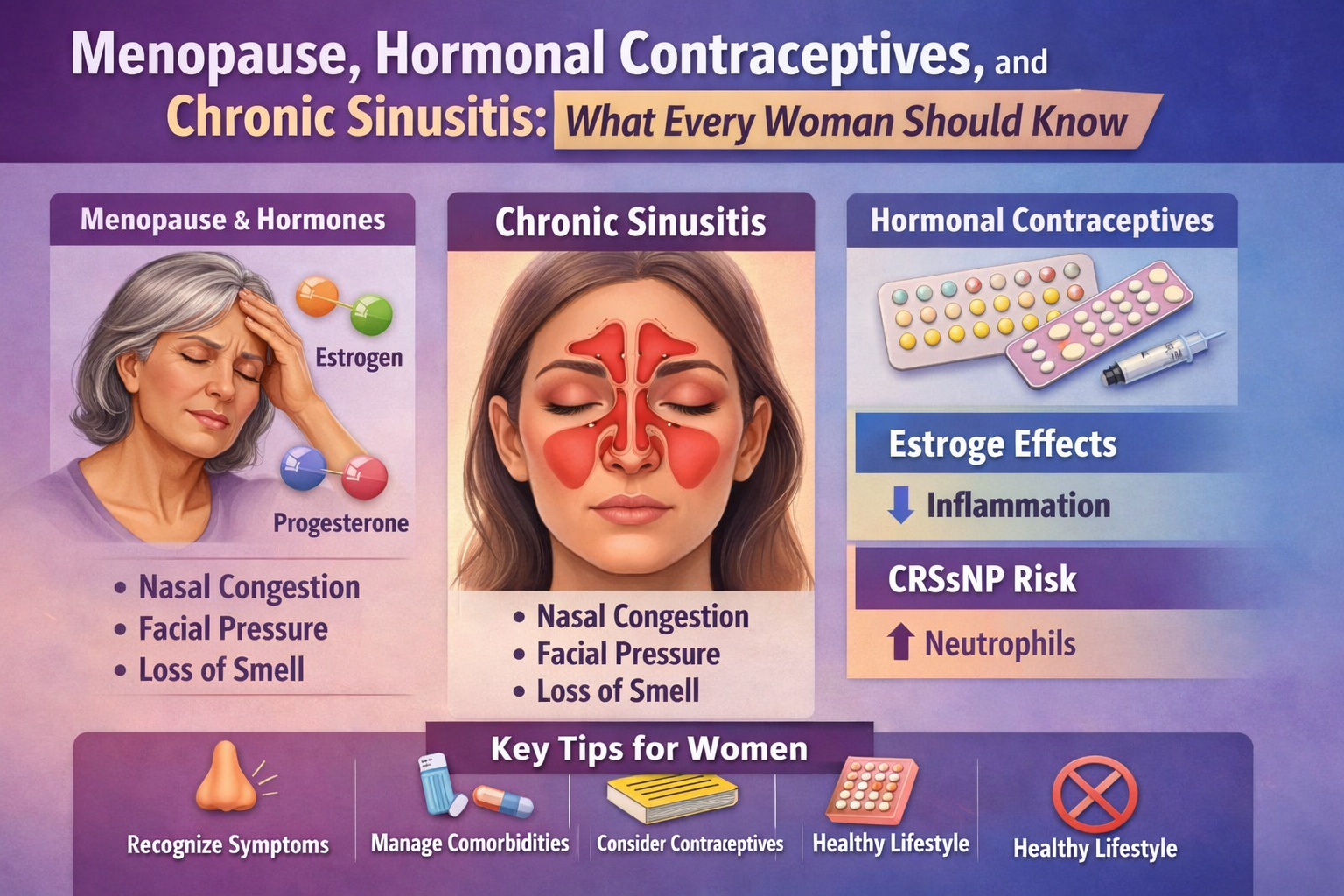
Menopause, Hormonal Contraceptives, and Chronic Sinusitis: What Every Woman Should Know
Chronic sinusitis, also known as chronic rhinosinusitis (CRS), is a persistent inflammation of the nasal and sinus lining that lasts at least twelve weeks. It causes nasal congestion, facial pressure, postnasal drip, and reduced sense of smell, affecting daily life and productivity. In the United States, CRS affects between 2 and 14 percent of adults, contributing to over $10 billion in healthcare costs annually.
CRS is categorized into two types: CRS with nasal polyps (CRSwNP) and CRS without nasal polyps (CRSsNP). CRSwNP usually involves an eosinophilic, T-helper 2 immune response, while CRSsNP involves a neutrophilic, T-helper 1 response. These differences in immune pathways help doctors understand disease severity and predict treatment outcomes.
How Hormones Influence CRS
Sex hormones such as estrogen, progesterone, and testosterone affect immune function. Progesterone and testosterone generally reduce inflammation, while estrogen can either increase or decrease inflammation depending on tissue type and context. The nasal lining contains estrogen receptors, making it responsive to hormone fluctuations. Research has shown that hormone levels, whether from menopause or systemic hormonal contraceptives, may alter immune markers in the sinuses, potentially affecting CRS risk.
Menopause and CRS
A recent analysis of the All of Us Research Program looked at over 239,000 adult women to explore how menopause influences CRS. Women aged 40 to 60 who were not taking hormonal medications were evaluated. After adjusting for age, race, smoking, asthma, and other factors, menopause was not significantly associated with CRS prevalence.
However, biomarker analysis revealed that postmenopausal women had higher eosinophil levels and lower neutrophil levels, particularly in CRSsNP and non-CRS populations. These findings suggest that while menopause does not increase CRS odds, it does shift immune response patterns, which may influence symptom severity.
Hormonal Contraceptives and CRS
The same study assessed women aged 20 to 40 using systemic hormonal contraceptives (SHCs). Women on estrogen-containing contraceptives (ECCs) had a lower prevalence of CRSsNP compared to those not on hormonal contraception. Progestin-only contraceptives did not show a significant effect.
Biomarker analysis revealed that ECC users had lower neutrophil and uric acid levels, suggesting a protective effect against neutrophil-driven inflammation seen in CRSsNP. These findings indicate that estrogen-containing contraceptives may modulate immune response in the nasal lining, reducing the risk of certain CRS types.
Practical Takeaways for Women
- Recognize CRS symptoms: Persistent nasal congestion, facial pressure, or loss of smell for over 12 weeks warrants evaluation.
- Manage comorbidities: Asthma and reflux can worsen CRS, so controlling these conditions is essential.
- Consider contraceptive options: Women prone to CRSsNP may discuss estrogen-containing contraceptives with their healthcare provider.
- Lifestyle matters: Smoking cessation and overall health optimization support sinus health.
Understanding how hormones affect CRS can help women make informed decisions and guide personalized treatment strategies.
References
- Ahn A, Chiu RC, Eldeirawi K, et al. Association of Menopause and Hormonal Contraceptive Use With Chronic Rhinosinusitis: An All of Us Analysis. Otolaryngology–Head and Neck Surgery. 2025; DOI: 10.1002/ohn.70067
- Fokkens WJ, Lund VJ, Hopkins C, et al. European Position Paper on Rhinosinusitis and Nasal Polyps 2020. Rhinology. 2020;58(S29):1-464
- Bachert C, Zhang N, Holtappels G, et al. Chronic Rhinosinusitis with Nasal Polyps: Pathogenesis, Endotypes, and Therapy. Allergy. 2020;75:288-300
- Straub RH. The Complex Role of Estrogens in Inflammation. Endocr Rev. 2007;28(5):521-574
- Kovats S. Estrogen Receptors and Immune Response. Trends Immunol. 2015;36(7):449-456
Disclaimer
This article is for informational purposes and does not replace professional medical advice. Always consult a qualified healthcare provider for questions about CRS, menopause, or hormonal contraceptive use.