
Measles Returns in Force as U.S. Records Highest Case Numbers in Over 30 Years
Introduction
For more than two decades, measles was considered a largely controlled disease in the United States. After achieving elimination status in 2000, cases were typically limited to small outbreaks linked to international travel. That sense of security has now been shaken.
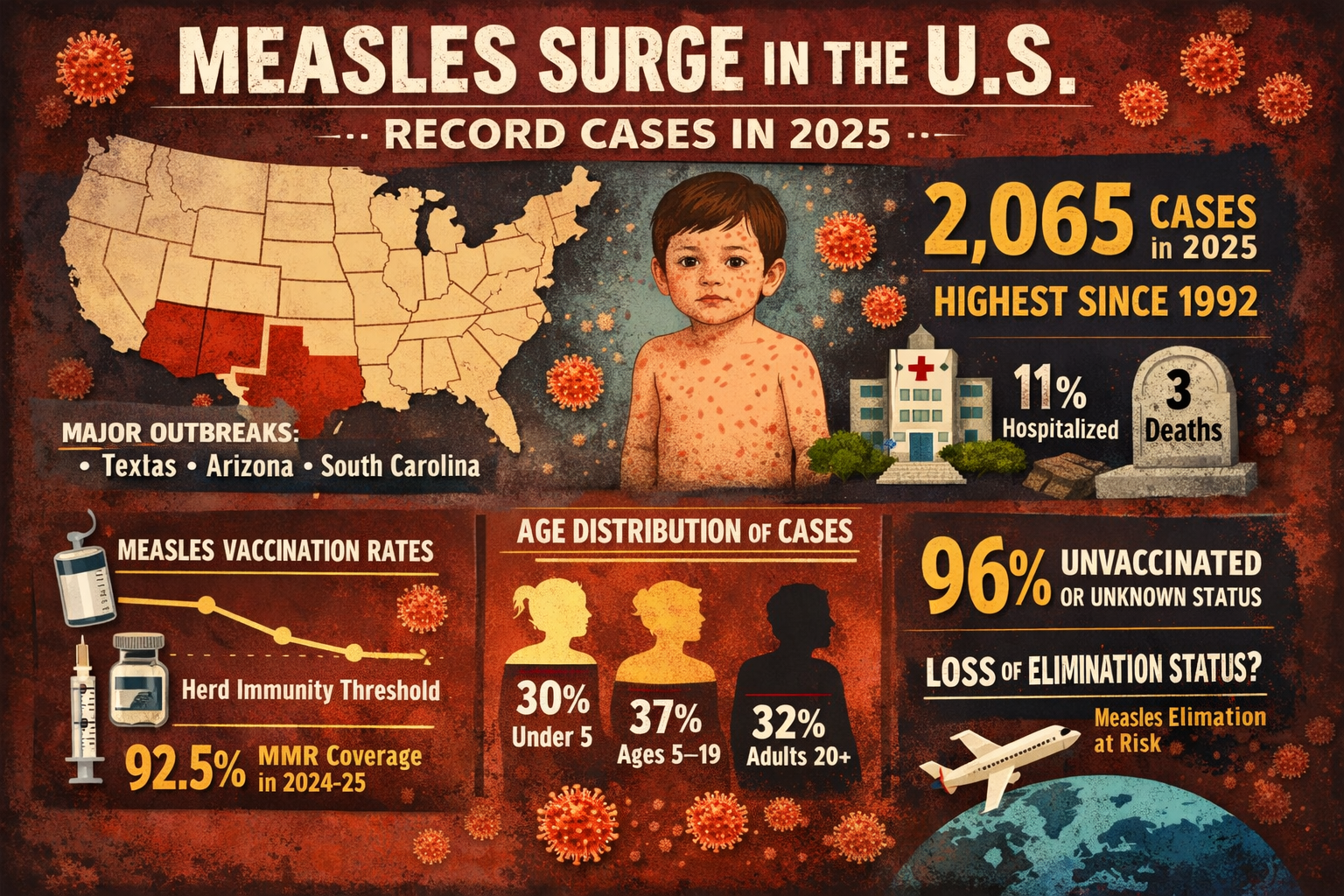
In 2025, the United States recorded more than 2,000 confirmed measles cases, the highest annual total since 1992. Ongoing outbreaks across multiple states, declining childhood vaccination rates, and growing global transmission have pushed measles back into the national spotlight. Health officials now warn that the country could be at risk of losing its measles elimination status if sustained transmission continues.
This article examines the data behind the resurgence, explains why measles spreads so easily, highlights the regions most affected, and explores what can be done to prevent further outbreaks.
Measles Case Numbers Reach a Historic High
According to the U.S. Centers for Disease Control and Prevention, 2,065 measles cases were confirmed nationwide as of December 30, 2025. This figure represents the highest annual case count in more than three decades.
The last time the U.S. experienced a higher number of measles cases in a single year was 1992, before the routine recommendation of two doses of the measles mumps rubella vaccine for children.
Table 1. U.S. Measles Cases by Selected Year
| Year | Confirmed Cases | Public Health Context |
|---|---|---|
| 1992 | Approx. 2,100 | Before routine 2 dose MMR |
| 2000 | 86 | Measles elimination declared |
| 2019 | 1,274 | Major outbreaks in several states |
| 2024 | 285 | Relatively low transmission |
| 2025 | 2,065 | Highest since 1992 |
The sharp increase between 2024 and 2025 underscores how quickly measles can return when immunity gaps widen.
Understanding Measles and Why It Spreads So Easily
Measles is one of the most contagious infectious diseases known to medicine. It spreads through respiratory droplets when an infected person coughs, sneezes, or even breathes in close proximity to others.
The virus can remain airborne for up to two hours after an infected person leaves a room. As a result, people can be exposed without ever having direct contact.
Key Facts About Measles Transmission
- Up to 90 percent of unvaccinated people exposed to measles will become infected
- Symptoms usually begin 7 to 14 days after exposure
- People are contagious four days before and four days after the rash appears
Because measles spreads so efficiently, very high vaccination coverage is required to prevent outbreaks.
Vaccine Effectiveness and Herd Immunity
Vaccination remains the most powerful tool to prevent measles. The CDC reports the following effectiveness rates for the MMR vaccine:
Table 2. MMR Vaccine Effectiveness
| Vaccine Doses | Effectiveness Against Measles |
|---|---|
| One dose | About 93 percent |
| Two doses | About 97 percent |
Public health experts estimate that at least 95 percent of the population must be vaccinated to maintain herd immunity. When coverage falls below this level, measles can spread rapidly through communities.
Vaccination Rates Are Falling Below Safe Levels
During the 2024 to 2025 school year, CDC data showed that only 92.5 percent of kindergarteners had received the MMR vaccine. While this may appear high, it falls short of the herd immunity threshold.
Table 3. MMR Vaccination Coverage Among Kindergarteners
| School Year | MMR Coverage |
|---|---|
| 2019 to 2020 | 95.2 percent |
| 2022 to 2023 | 93.1 percent |
| 2024 to 2025 | 92.5 percent |
This decline has left an estimated hundreds of thousands of children susceptible to measles infection nationwide.
Who Is Being Infected
Measles is often thought of as a childhood illness, but recent outbreaks show that people of all ages are affected.
Table 4. Measles Cases by Age Group in 2025
| Age Group | Approximate Share of Cases |
|---|---|
| Under 5 years | About 30 percent |
| Ages 5 to 19 | About 37 percent |
| Ages 20 and older | About 32 percent |
| Unknown | About 1 percent |
Adults account for nearly one third of cases, often due to missed childhood vaccinations or uncertainty about vaccination history.
Vaccination Status of Confirmed Cases
Data from outbreak investigations show a strong link between measles infection and lack of vaccination.
Table 5. Vaccination Status of Measles Cases
| Vaccination Status | Percentage of Cases |
|---|---|
| Unvaccinated or unknown | About 96 percent |
| One MMR dose | About 1 percent |
| Two MMR doses | About 1 percent |
These figures reinforce that measles overwhelmingly affects those without full vaccination.
Hospitalizations and Deaths in 2025
While many measles patients recover, the disease can cause severe complications. In 2025, the U.S. recorded three measles related deaths, including two children and one adult, all of whom were unvaccinated.
Table 6. Severe Outcomes From Measles in 2025
| Outcome | Estimated Figure |
|---|---|
| Hospitalized cases | About 11 percent |
| Confirmed deaths | 3 |
Complications from measles can include pneumonia, brain inflammation, permanent hearing loss, and long term immune system damage.
Major Outbreaks Across the United States
West Texas and New Mexico
One of the largest outbreaks of 2025 began in West Texas and spread into New Mexico. The outbreak involved hundreds of cases and lasted several months before being declared over in August.
This outbreak was notable for its severity and fatalities, underscoring the risks faced by unvaccinated communities.
South Carolina
In October 2025, South Carolina confirmed a measles outbreak that grew to nearly 180 cases by year’s end. At least 20 new cases were reported in late December alone.
Health officials reported that nearly 300 people were placed in quarantine due to exposure. The virus spread in homes, schools, and churches, highlighting how quickly measles can circulate in close contact settings.
Utah and Arizona Border
Another significant outbreak occurred along the Utah Arizona border, where combined case counts exceeded 350 cases by the end of 2025. Genetic testing suggested links between outbreaks in multiple states, indicating ongoing interstate transmission.
Geographic Distribution of Measles Cases
Table 7. Selected States With High Measles Case Counts in 2025
| State or Region | Approximate Cases |
|---|---|
| Texas | Over 800 |
| Arizona | Over 180 |
| South Carolina | Nearly 180 |
| Utah Arizona border region | Over 350 combined |
These clusters demonstrate how regional vaccination gaps can fuel large scale outbreaks.
Risk of Losing Measles Elimination Status
The United States achieved measles elimination status in 2000, defined as the absence of continuous disease transmission for at least 12 months.
Health officials now warn that sustained transmission into 2026 could put that status at risk. Genetic links between outbreaks suggest the virus may continue spreading without interruption.
Losing elimination status would represent a major setback for public health and could signal ongoing endemic transmission rather than isolated outbreaks.
Global Context and International Spread
Measles is resurging worldwide. In November 2025, Canada lost its measles elimination status following a major outbreak, according to the Pan American Health Organization.
Global travel increases the risk of imported cases, which can quickly spark outbreaks in communities with low vaccination coverage. While many countries in the Americas remain measles free, global circulation of the virus poses an ongoing threat.
Why Children Are Especially Vulnerable
Children under age five face the highest risk of severe complications from measles. Infants who are too young to be vaccinated rely on community immunity for protection.
When vaccination rates decline, these children are exposed to unnecessary risk. Schools and childcare settings can amplify transmission when immunity levels are insufficient.
Addressing Vaccine Hesitancy
Vaccine hesitancy remains a major challenge in preventing measles outbreaks. Misinformation about vaccine safety continues to circulate despite decades of scientific evidence supporting the safety and effectiveness of the MMR vaccine.
Healthcare providers play a crucial role in addressing concerns, answering questions, and building trust with patients and families.
What Can Be Done to Prevent Future Outbreaks
Public health experts emphasize several strategies to control measles:
Strengthen Vaccination Coverage
Increasing access to vaccines through schools, clinics, and community outreach programs.
Improve Public Education
Providing clear, evidence based information to counter misinformation.
Enhance Surveillance
Rapid identification and isolation of cases to prevent further spread.
Protect Vulnerable Groups
Maintaining high community immunity to protect infants and immunocompromised individuals.
Conclusion
The resurgence of measles in the United States in 2025 is a clear warning that progress against infectious diseases cannot be taken for granted. With more than 2,000 confirmed cases, multiple large outbreaks, and declining vaccination rates, the country faces a critical moment.
Measles remains a preventable disease. Restoring high vaccination coverage, strengthening public trust, and maintaining vigilant public health systems are essential to protecting communities and preserving decades of hard won progress.
Sources
- U.S. Centers for Disease Control and Prevention, Measles Case Data
- CNN Health reporting, December 31, 2025
- Pan American Health Organization statements on measles elimination
Disclaimer
This article is intended for informational and educational purposes only and does not constitute medical advice, diagnosis, or treatment. Statistical data reflects reported trends and may change as new information becomes available. Always consult a qualified healthcare professional for individual medical guidance.