
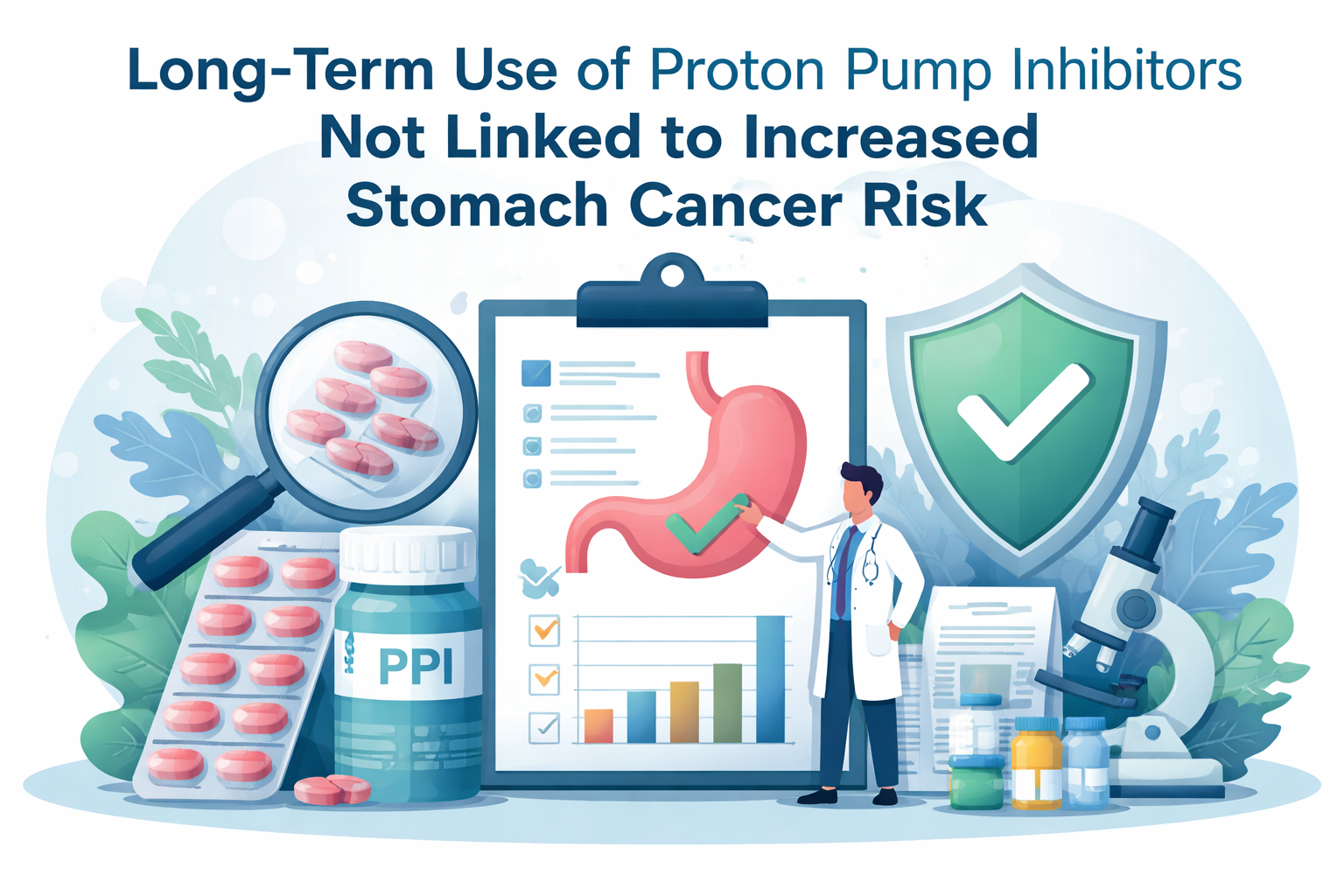
Long-Term Use of Proton Pump Inhibitors and Risk of Stomach Cancer: What Recent Research Shows
Proton pump inhibitors, commonly known as PPIs, are among the most widely prescribed medications worldwide. They are used primarily to treat conditions such as gastro-oesophageal reflux disease (GERD), peptic ulcers, and Zollinger-Ellison syndrome by reducing stomach acid production. Since their introduction in the 1980s, PPIs have been considered highly effective and generally safe. However, there has been longstanding concern regarding their potential link to gastric cancer, especially when used for extended periods.
A new population-based study across five Nordic countries provides robust evidence addressing this concern. Published in BMJ 2026; 392 (doi: 10.1136/bmj-2025-086384), this research examined whether long-term PPI use is associated with an increased risk of gastric adenocarcinoma. The findings suggest that long-term use of PPIs may not be linked to stomach cancer, offering important insights for patients and healthcare providers alike.
Understanding Gastric Cancer and Its Risk Factors
Gastric cancer ranks as the fifth most common malignancy globally, with adenocarcinoma accounting for more than 95 percent of cases. Other gastric tumors, such as neuroendocrine tumors, lymphomas, and gastrointestinal stromal tumors, have distinct causes and treatment strategies.
The primary risk factor for non-cardia gastric adenocarcinoma, which affects the lower part of the stomach, is infection with Helicobacter pylori. For cardia gastric adenocarcinoma, which occurs near the junction of the stomach and esophagus, gastro-oesophageal reflux disease is the dominant risk factor. Other contributing factors include smoking, obesity, excessive alcohol consumption, and certain dietary habits, including high salt intake.
PPIs, by reducing stomach acid, can lead to compensatory overproduction of the hormone gastrin. This hypergastrinaemia may stimulate the proliferation of gastric cells, potentially leading to polyps, some of which have been speculated to have malignant potential. This proposed mechanism has fueled concerns that long-term PPI use could increase the risk of gastric cancer.
Limitations of Previous Studies
Earlier studies and meta-analyses suggested that PPI users might have a higher risk of gastric cancer. Reported risk estimates ranged from 1.67 to 2.88 times higher compared with non-users. However, most of these studies had significant methodological limitations:
- Short follow-up periods: Many studies did not account for the long latency of gastric cancer.
- Protopathic bias: PPI use shortly before cancer diagnosis could falsely appear associated with cancer due to treatment of early symptoms.
- Inability to exclude cardia adenocarcinoma: Mixing cardia and non-cardia cancers confounded results, as PPIs are often prescribed for reflux, a risk factor for cardia cancer.
- Incomplete adjustment for Helicobacter pylori: Failure to account for this major risk factor can skew results.
- Low statistical power: Small sample sizes limited the reliability of findings.
Given these issues, the relationship between long-term PPI use and gastric cancer remained uncertain.
The Nordic Gastric and Esophageal Tumor Study (NordGETS)
To overcome the weaknesses of previous research, a multinational, population-based case-control study called NordGETS was conducted across Denmark, Finland, Iceland, Norway, and Sweden. The study used prospectively collected registry data from 1994 to 2020, covering nearly all patients with gastric cancer in these countries.
Study Design
- Cases: 17,232 patients with non-cardia gastric adenocarcinoma.
- Controls: 172,297 individuals from the general population, matched 10-to-1 with cases based on age, sex, calendar year, and country.
- Exposure: Long-term PPI use, defined as more than one year of cumulative use, excluding the 12 months prior to cancer diagnosis to avoid protopathic bias.
- Comparator: Histamine-2-receptor antagonists, used to assess whether findings were specific to PPIs.
- Covariates: Adjustments were made for multiple potential confounders including Helicobacter pylori eradication therapy, peptic ulcer disease, smoking-related illnesses, alcohol-related diseases, obesity or type 2 diabetes, and use of metformin, non-steroidal anti-inflammatory drugs, and statins.
Data Sources
Data were obtained from high-quality national registries, including:
- Population registries for demographics.
- Prescription registries for detailed medication history.
- Cancer registries for histologically confirmed diagnoses.
- Patient registries for comorbidities.
- Cause of death registries for follow-up and censoring.
The unique personal identity numbers in Nordic countries allowed precise data linkage across registries, ensuring complete and accurate information.
Key Findings
Long-Term PPI Use
- Among cases, 10.2% used PPIs long-term, while 9.5% of controls had similar usage.
- After adjusting for confounders, long-term PPI use showed no significant association with non-cardia gastric adenocarcinoma (adjusted odds ratio 1.01, 95% confidence interval 0.96 to 1.07).
- Crude analyses initially suggested a higher risk (odds ratio 1.16), but this disappeared after proper adjustment for confounders, particularly Helicobacter pylori infection.
Histamine-2-Receptor Antagonist Use
- Long-term use of H2-receptor antagonists showed no increased risk of non-cardia gastric adenocarcinoma (adjusted odds ratio 1.03, 95% CI 0.86 to 1.23), supporting the specificity of findings for PPI use.
Bias Assessment
The study conducted additional analyses to examine potential sources of bias:
- Short-term PPI use was associated with higher cancer risk, likely reflecting treatment for early symptoms or underlying conditions like ulcers.
- Including cardia cancers or shortening the dismissal period before diagnosis produced a false-positive association.
- Excluding Helicobacter pylori-related variables also led to spurious risk increases.
These analyses confirmed that careful methodological design is crucial to avoid false-positive conclusions.
Implications of the Study
Clinical Reassurance
This study provides strong evidence that long-term PPI therapy may not increase the risk of non-cardia gastric adenocarcinoma. Patients with GERD or other chronic acid-related conditions can be reassured about the cancer risk of sustained PPI use when used for legitimate indications.
Need for Balanced Use
Although PPIs appear safe regarding gastric cancer risk, long-term use still carries other potential side effects, including:
- Clostridium difficile-associated diarrhea
- Osteoporosis and bone fractures
- Vitamin and mineral deficiencies (e.g., magnesium, vitamin B12)
- Possible kidney disease
Healthcare providers should regularly reassess the necessity of continued PPI therapy and weigh benefits against potential risks.
Importance of Methodological Rigor
The study highlights how methodological flaws in prior research can produce misleading conclusions. Accurate assessment of long-term medication safety requires:
- Long follow-up periods
- Proper dismissal of recent medication use
- Exclusion of irrelevant cancer subtypes
- Adjustment for key confounders
Without these precautions, studies may report spurious associations that do not reflect real-world risk.
Strengths and Limitations
Strengths
- Population-based design with complete participation reduced selection bias.
- Large multinational sample provided high statistical power.
- Registry data were prospectively collected and comprehensive.
- Long study period (up to 26 years) allowed assessment of latency effects.
- Adjustment for major confounders, including Helicobacter pylori infection.
Limitations
- Observational design cannot definitively prove causality.
- Some rare risk factors, such as genetic predisposition and prior gastric surgery, were not included.
- Dietary factors, including salt intake, were not assessed, although these are minor risk contributors in Western populations.
Comparison with Previous Literature
Earlier systematic reviews reported pooled risk estimates between 1.67 and 2.88, suggesting a positive association. This study demonstrates that much of that perceived risk was likely due to:
- Protopathic bias
- Short-term PPI use
- Inclusion of cardia cancers
- Lack of adjustment for Helicobacter pylori
By addressing these methodological issues, this research provides a clearer, more reliable estimate, showing no increased risk of non-cardia gastric adenocarcinoma with long-term PPI use.
Mechanistic Insights
Animal studies have suggested that long-term acid suppression could lead to hypergastrinaemia and hyperproliferation of gastric mucosa. However, in humans, these changes do not appear to result in precancerous or cancerous lesions. Fundic gland polyps, often observed with chronic PPI use, have not been shown to transform malignantly.
This mechanistic evidence further supports the epidemiological finding that long-term PPI therapy is not a significant risk factor for non-cardia gastric cancer.
Policy and Patient Care Implications
- Clinical decision-making: Physicians can prescribe PPIs for chronic acid-related disorders without heightened concern for non-cardia gastric cancer.
- Patient reassurance: Individuals on long-term PPI therapy can be reassured regarding cancer risk.
- Monitoring for other side effects: Regular review of therapy necessity remains important due to potential adverse effects unrelated to cancer.
Overall, this research supports a balanced, evidence-based approach to PPI use.
Conclusion
The Nordic multicountry study published in BMJ 2026 provides compelling evidence that long-term PPI therapy does not increase the risk of gastric non-cardia adenocarcinoma. By using a rigorous, population-based approach, adjusting for critical confounders, and addressing methodological pitfalls of previous studies, the research offers clear guidance for clinicians and patients. While PPIs should always be used appropriately, concerns regarding stomach cancer risk with long-term use may be substantially reduced.
References
- Sung H, et al. Global Cancer Statistics 2020: GLOBOCAN estimates. CA Cancer J Clin. 2021;71:209-249.
- Crew KD, Neugut AI. Epidemiology of gastric cancer. World J Gastroenterol. 2006;12:354-362.
- El-Serag HB. Epidemiology of GERD. Nat Rev Gastroenterol Hepatol. 2014;11:20-30.
- Andersson T, et al. Proton pump inhibitors: history and mechanism. Gut. 2019;68:1227-1236.
- Cheung KS, et al. Hypergastrinaemia and gastric mucosa proliferation. Aliment Pharmacol Ther. 2017;45:112-122.
- Duru O, et al. Long-term use of proton pump inhibitors and risk of stomach cancer: population-based case-control study in five Nordic countries. BMJ. 2026;392:e086384.
- Ngamruengphong S, et al. Fundic gland polyps and risk of malignancy. Am J Gastroenterol. 2014;109:203-209.
- Zou D, et al. PPI use and gastric cancer: meta-analysis. PLoS One. 2021;16:e0253410.
- Xie Y, et al. Association of PPIs and gastric cancer risk. Gut. 2019;68:1749-1757.
- Ji F, et al. Proton pump inhibitors and risk of gastric cancer. BMJ Open. 2020;10:e035489.
Disclaimer
This blog is based on open-access research published under CC BY-NC license. It is intended for informational purposes only and should not be considered medical advice. Always consult a qualified healthcare provider before starting, stopping, or changing any medication.