
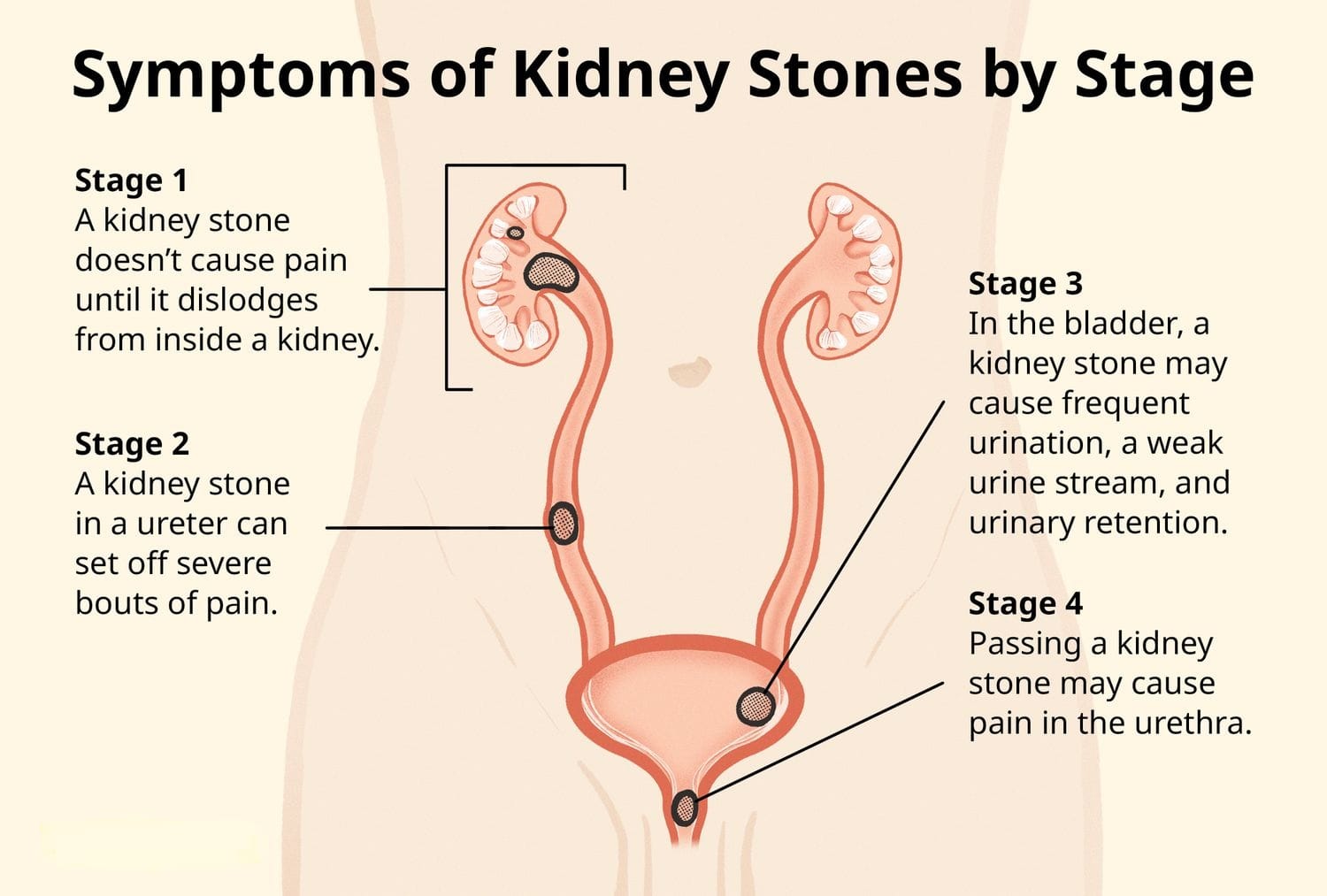
KIDNEY STONES and Symptoms
Kidney stones (also called renal calculi, nephrolithiasis or urolithiasis) are hard deposits made of minerals and salts that form inside your kidneys. They can be as small as a grain of sand or, rarely larger than a golf ball.
What are the causes of kidney stone?
There are different types of kidney stones. The cause of the problem depends on the type of stone.
- Calcium stones are most common. They are most likely to occur in men between ages 20 to 30. Calcium stones can also form from combining with phosphate or carbonate.
- Oxalate is the most common of these. Oxalate is present in certain foods such as spinach. It is also found in vitamin C supplements. Diseases of the small intestine increase your risk for these stones.
- Cystine stones can form in people who have cystinuria. This disorder runs in families. It affects both men and women.
- Struvite stones are mostly found in men or women who have repeated urinary tract infections. These stones can grow very large and can block the kidney, ureter, or bladder.
- Uric acid stones are more common in men than in women. They can occur with gout or chemotherapy.
The biggest risk factor for kidney stones is not drinking enough fluids. Kidney stones are more likely to occur if you make less than 1 liter (32 ounces) of urine a day. (https://www.pennmedicine.org/for-patients-and-visitors/patient-information/conditions-treated-a-to-z/kidney-stones)
What are the symptoms of kidney stones?
Movement of the stone within the kidney or passing into one of the ureters triggers the symptoms. The ureters are the tubes that connect the kidneys and bladder. If a kidney stone becomes lodged in the ureters, it may block the flow of urine and cause the kidney to swell and the ureter to spasm, which can be very painful. At that point, you may experience these symptoms:
- Severe, sharp pain in the side and back, below the ribs
- Pain that radiates to the lower abdomen and groin
- Pain that comes in waves and fluctuates in intensity
- Pain or burning sensation while urinating
Other signs and symptoms may include:
- Pink, red or brown urine
- Cloudy or foul-smelling urine
- A persistent need to urinate, urinating more often than usual or urinating in small amounts
- Nausea and vomiting
- Fever and chills if an infection is present
Pain caused by a kidney stone may change intensity. For example, if the stone is shifting to a different location through your urinary tract.
Immediate medical appointment is required if:
- Pain so severe that you can't sit still or find a comfortable position
- Pain accompanied by nausea and vomiting
- Pain accompanied by fever and chills
- Blood in urine
Difficulty passing urine (https://www.mayoclinic.org/diseases-conditions/kidney-stones/symptoms-causes/syc-20355755)