
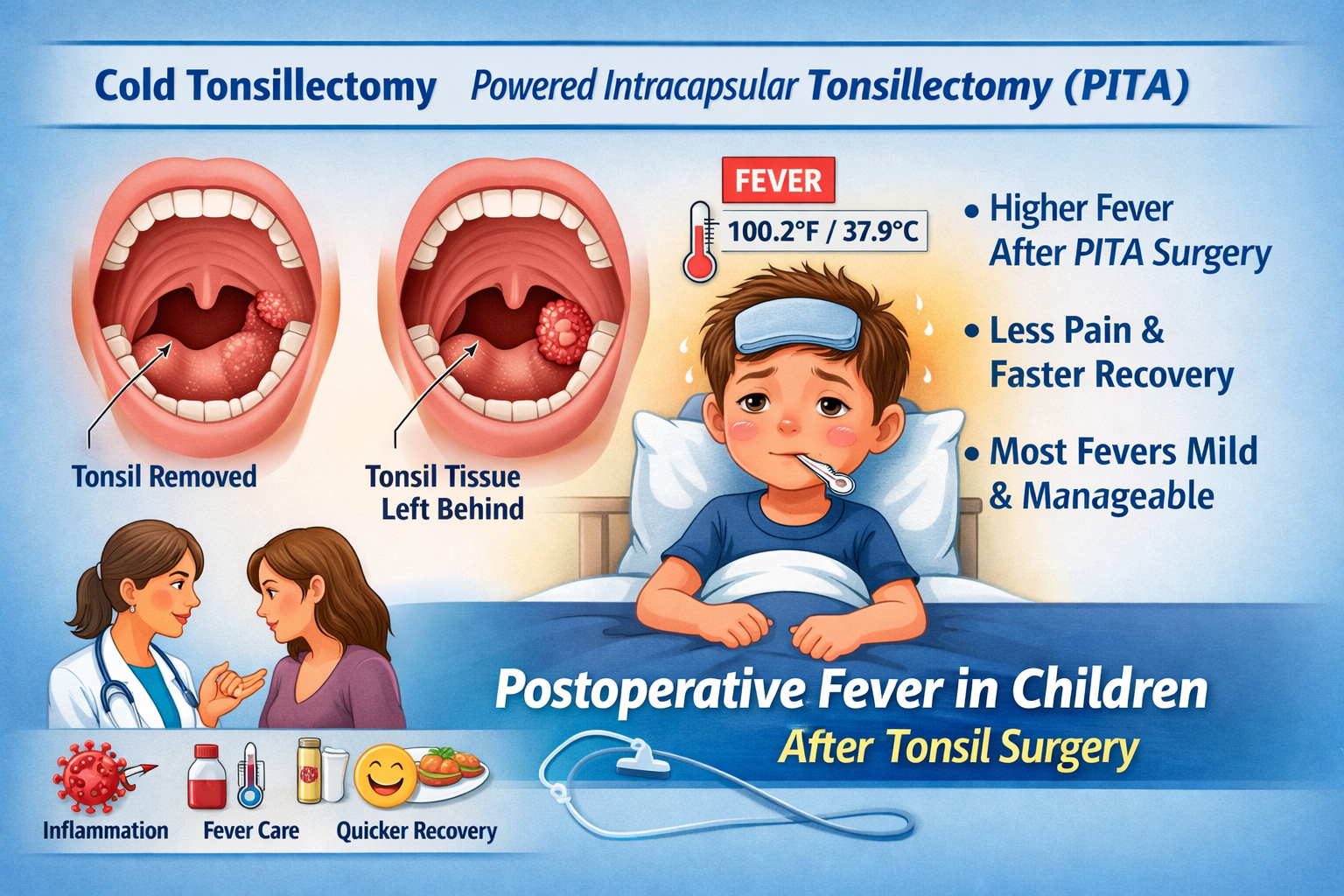
Intracapsular Tonsillectomy and Postoperative Fever in Children: What Parents and Clinicians Should Know
Tonsillectomy with or without adenoidectomy is one of the most common surgical procedures performed in children worldwide. Over the past two decades, surgical techniques have evolved with the aim of reducing postoperative pain, bleeding, and recovery time. One such technique is powered intracapsular tonsillectomy and adenoidectomy, commonly referred to as PITA.
While PITA has gained popularity due to its favorable recovery profile, emerging evidence suggests it may be associated with higher rates of postoperative fever. A recent prospective cohort study published in Clinical Otolaryngology sheds new light on this issue and offers important insights for clinicians and parents alike.
This article reviews the findings of that study, explains what postoperative fever means in practical terms, compares intracapsular and traditional tonsillectomy techniques, and discusses how families can be better prepared after surgery.
Understanding Tonsillectomy Techniques
What Is Cold Adenotonsillectomy?
Cold adenotonsillectomy is the traditional surgical approach. The tonsils are removed completely using cold steel instruments, such as scissors or a scalpel, often followed by cauterization for bleeding control. This method removes both the tonsillar tissue and its capsule, leaving the pharyngeal muscle exposed.
Advantages include a low risk of tonsillar regrowth and recurrence of symptoms. Disadvantages include higher postoperative pain and a longer recovery period.
What Is Powered Intracapsular Tonsillectomy and Adenoidectomy (PITA)?
PITA involves partial removal of the tonsils while preserving the tonsillar capsule. Surgeons use powered devices such as coblation or a microdebrider to remove most of the lymphoid tissue but leave a thin layer intact.
The rationale is that preserving the capsule reduces exposure of nerve endings and muscle, resulting in less pain, reduced bleeding, and faster healing.
However, leaving residual lymphatic tissue may also have biological consequences, including inflammation and immune activation.
Why Postoperative Fever Matters
Postoperative fever in children is common after many surgical procedures and is often benign. However, fever can cause significant anxiety for parents and may lead to unnecessary medical visits, antibiotic use, or hospital readmission.
Clinically, fever may be caused by:
- Normal inflammatory response to surgery
- Cytokine release from injured tissue
- Dehydration
- Infection, although this is less common
Understanding whether surgical technique influences fever risk is essential for appropriate counseling and postoperative care.
Overview of the Study
Study Design and Setting
The study was a prospective cohort study conducted at a tertiary referral center between June 1, 2023, and November 30, 2024.
Participants
A total of 82 children underwent tonsillectomy with or without adenoidectomy.
- 46 were male, representing 56 percent of participants
- Mean age was 5.1 years
- Age interquartile range was 3 to 5 years
Surgical Groups
- 40 children underwent cold adenotonsillectomy
- 42 children underwent PITA
- 22 using coblation
- 20 using a microdebrider
Primary Outcome
The primary outcome was postoperative fever defined as temperature greater than 37.9°C or 100.2°F within one week following surgery.
Secondary Outcomes
- Postoperative hemorrhage
- Pain scores using a visual analogue scale
- Time to return to normal diet
- Halitosis
- Referrals to a treating physician
- Hospital readmissions within one week
Key Findings
Increased Fever Rates With PITA
The overall one week postoperative fever rate was 24.4 percent.
Children who underwent PITA had significantly higher rates of fever compared to those who underwent cold adenotonsillectomy.
- Odds ratio for fever was 4.81
- 95 percent confidence interval ranged from 1.29 to 22.02
This means children in the PITA group were nearly five times more likely to experience fever during the first postoperative week.
More Physician Referrals
Parents of children who underwent PITA were more likely to seek medical evaluation postoperatively.
- 35.7 percent in the PITA group
- 15 percent in the cold adenotonsillectomy group
This difference was statistically significant and likely reflects parental concern related to fever rather than serious complications.
Less Pain and Faster Recovery
Despite higher fever rates, PITA showed clear advantages in recovery outcomes.
- Lower mean pain scores at one week
- Faster return to normal diet
- Mean of 3.4 days for PITA
- Mean of 4.07 days for cold adenotonsillectomy
These findings are consistent with previous studies highlighting reduced morbidity with intracapsular techniques.
No Difference in Serious Complications
Importantly, there were no significant differences between groups in:
- Postoperative hemorrhage
- Hospital readmissions
- Halitosis
Most fever episodes were mild, self-limited, and managed conservatively at home.
Why Might PITA Cause More Fever?
The study authors suggest that postoperative fever after PITA may be related to inflammatory activity in retained lymphatic tissue.
Possible mechanisms include:
- Ongoing immune activation in residual tonsillar tissue
- Release of inflammatory cytokines such as interleukin-6
- Delayed tissue remodeling and healing
Unlike cold tonsillectomy, which removes the entire lymphoid structure, PITA leaves behind tissue capable of mounting an inflammatory response.
Importantly, this does not necessarily indicate infection.
What This Means for Parents
Fever Does Not Always Mean Infection
Parents should understand that mild fever after tonsil surgery, especially following PITA, is often part of the normal healing process.
Most fevers in the study did not require antibiotics, hospitalization, or invasive evaluation.
When to Be Concerned
Parents should seek medical advice if:
- Fever exceeds 38.5°C or 101.3°F
- Fever persists beyond several days
- Fever is accompanied by lethargy, dehydration, neck stiffness, or worsening pain
- There is active bleeding or difficulty breathing
Clear postoperative instructions can significantly reduce anxiety and unnecessary clinic visits.
Implications for Clinicians
Surgeons should incorporate these findings into preoperative counseling.
Key points to discuss include:
- PITA offers less pain and faster recovery
- There is a higher likelihood of mild postoperative fever
- Fever is usually self-limited and noninfectious
- Parents should be educated on fever management
Setting expectations may reduce unplanned healthcare utilization and improve satisfaction.
Balancing Risks and Benefits
No tonsillectomy technique is without trade-offs.
| Outcome | Cold Adenotonsillectomy | PITA |
|---|---|---|
| Postoperative pain | Higher | Lower |
| Return to diet | Slower | Faster |
| Fever risk | Lower | Higher |
| Tissue regrowth | Minimal | Possible |
| Bleeding risk | Comparable | Comparable |
The choice of technique should be individualized based on patient age, indication for surgery, surgeon experience, and family preferences.
Conclusion
Powered intracapsular tonsillectomy and adenoidectomy continues to be an attractive option for pediatric patients due to reduced pain and faster recovery. However, evidence now shows that it is associated with higher rates of postoperative fever during the first week after surgery.
These fevers are typically mild, inflammatory in nature, and manageable with conservative care. Proper parental education and reassurance are essential to prevent unnecessary anxiety and medical visits.
As surgical techniques evolve, understanding not only the benefits but also the expected postoperative course is key to delivering high quality, family centered care.
Source
Noy R, Barzilai R, Khoury EE, Gordin A. Intracapsular Tonsillectomy and Adenoidectomy Is Associated With Higher Rates of Postoperative Fever: A Prospective Cohort Study. Clinical Otolaryngology. First published December 30, 2025. DOI: 10.1111/coa.70078
Disclaimer
This article is intended for educational and informational purposes only and does not constitute medical advice. It is not a substitute for professional diagnosis, treatment, or consultation with a qualified healthcare provider. Parents and caregivers should always seek the advice of their child’s physician or surgeon regarding postoperative symptoms or concerns.