
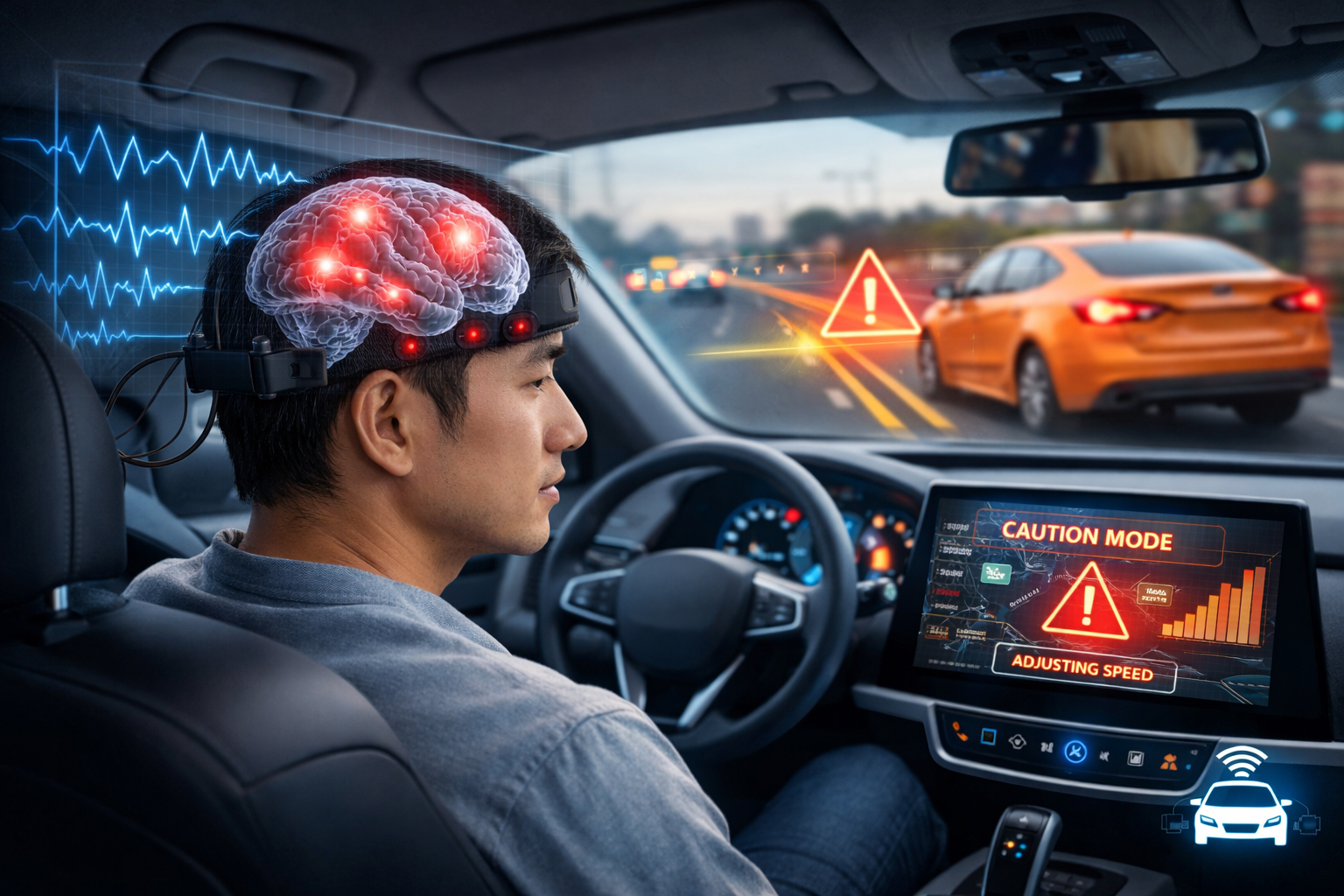
How Passengers’ Brain Signals Could Make Self-Driving Cars Safer
Self-driving cars have long been a symbol of the future of transportation, promising hands-free driving and fewer accidents. Companies like Tesla, Waymo, and others have developed vehicles that can navigate roads with minimal human input. Despite this technological progress, recent accidents show that autonomous systems still struggle in unpredictable or risky driving situations. A new line of research suggests that the solution may involve an unexpected factor: the brains of passengers inside these vehicles.
Brain Activity Meets Autonomous Vehicles
A team of researchers in China explored whether monitoring passengers’ brain signals could enhance the safety of self-driving cars. The study, led by Professor Xiaofei Zhang at Tsinghua University, tested whether real-time brain data could inform autonomous vehicles to make safer decisions in potentially dangerous scenarios.
The technology used is called functional Near-Infrared Spectroscopy, or fNIRS. This noninvasive method measures brain activity related to stress, emotional responses, and risk perception. By understanding how passengers react to specific driving situations, the autonomous system can adapt its behavior to improve safety and comfort.
“Functional Near-Infrared Spectroscopy, as a non-invasive real-time brain activity monitoring method, can provide cognitive information related to human risk perception and emotional states,” said Zhang. “It is a tool that can enhance autonomous driving systems.”
How the System Works
The research team developed a system that integrates fNIRS data with the vehicle’s driving software. The concept is straightforward: when the system detects signs of passenger stress or unease, it prompts the car to adopt a more cautious driving strategy.
This approach relies on a deep reinforcement learning algorithm, a type of artificial intelligence that allows systems to learn from experience and improve their decision-making over time. The algorithm considers human responses as part of its learning process, adjusting driving patterns to match the passengers’ comfort and risk tolerance.
During testing, the system demonstrated several advantages over conventional autonomous driving methods. For example, when passengers exhibited elevated stress levels, the vehicle automatically slowed down or avoided maneuvers considered risky. The results showed improvements in overall safety, decision-making speed, and passenger comfort.
Potential Benefits of Passenger-Based Feedback
Integrating passenger brain signals into self-driving cars could offer multiple benefits:
- Enhanced Safety: By detecting stress or fear, vehicles can proactively adjust driving strategies before a dangerous situation escalates.
- Improved Comfort: Passengers may feel more at ease knowing that their emotional and physiological responses are part of the car’s decision-making process.
- Faster Learning Algorithms: AI systems that incorporate human feedback can adapt more quickly than those relying solely on sensors and preprogrammed rules.
- Reduced Accident Rates: A cautious driving approach triggered by passenger signals could help prevent collisions in complex traffic scenarios.
These benefits are particularly important because current autonomous driving systems are not yet capable of fully understanding human factors. Traditional sensors, such as cameras and LIDAR, can detect objects but cannot gauge passenger reactions to sudden stops, sharp turns, or near misses.
Limitations and Future Directions
While the study presents promising results, researchers acknowledged some limitations. The driving scenarios tested were relatively simple, and the participants represented a narrow age range and similar backgrounds. Therefore, the results may not fully apply to the diverse population of real-world drivers and passengers.
Professor Zhang highlighted the need for further research: “Future studies will aim to validate the algorithm in more complex and realistic driving scenarios and enhance the accuracy and robustness of driving risk assessment by integrating information from vehicle sensors.”
Additional challenges include ensuring privacy, managing the cost of fNIRS sensors, and developing standards for how brain signals should influence vehicle behavior. Nevertheless, the concept opens up a new avenue for improving autonomous vehicle safety by combining human intuition with artificial intelligence.
How fNIRS Technology Works
Functional Near-Infrared Spectroscopy is a non-invasive brain imaging technique that measures oxygen levels in the blood within the brain. Because oxygenated and deoxygenated blood absorb near-infrared light differently, fNIRS can detect which brain regions are more active during specific tasks or emotional responses.
In the context of autonomous vehicles, fNIRS sensors are placed on the passenger’s head. These sensors continuously monitor cognitive and emotional states, providing data in real time. When integrated with AI algorithms, this information can help the car anticipate risks that may not be apparent through traditional sensors alone.
Real-World Applications
The integration of passenger brain signals could revolutionize several aspects of autonomous driving:
- Urban Traffic Navigation: In busy city streets, human reactions to sudden pedestrian crossings or aggressive drivers could guide the vehicle to adopt safer strategies.
- Highway Driving: Passenger stress during lane changes or heavy traffic could prompt smoother and more cautious maneuvers.
- Emergency Situations: Rapid detection of fear or panic could trigger conservative actions, reducing the likelihood of accidents.
- Personalized Driving Experience: Vehicles could learn individual passengers’ comfort levels, creating a tailored driving style for each user.
The potential applications extend beyond personal vehicles. Public transport, ridesharing, and delivery services could all benefit from systems that monitor passenger states and adjust vehicle behavior accordingly.
Ethical Considerations
While the technology offers promise, ethical questions remain. Using brain data raises privacy concerns, as sensitive cognitive and emotional information would be collected continuously. Clear guidelines are needed to ensure that this data is used only to improve safety and not for marketing, profiling, or other purposes.
Additionally, automakers must address issues of consent. Passengers must be informed about how their brain data will be used and stored, and they should have the option to opt out without affecting the vehicle’s functionality.
Looking Ahead
The study’s findings, published in Cyborg and Bionic Systems, mark an important step toward more human-aware autonomous vehicles. By leveraging brain activity, researchers are bridging the gap between human intuition and artificial intelligence.
As autonomous driving technology continues to evolve, incorporating passenger feedback may become a standard feature. This approach could complement existing sensors and algorithms, making cars not only self-driving but also self-aware in terms of passenger comfort and safety.
Future developments may include combining brain data with other biometric signals, such as heart rate, skin conductance, and eye tracking. Such multimodal approaches could further improve the accuracy of risk assessment and decision-making in autonomous vehicles.
Conclusion
The integration of passengers’ brain signals into autonomous vehicle systems represents a promising frontier in transportation safety. By combining real-time cognitive data with AI algorithms, vehicles can adapt to human emotions and stress, making driving safer, more comfortable, and more responsive.
While there are technical and ethical challenges to address, the potential benefits are significant. As research progresses, the dream of truly intelligent, human-aware self-driving cars may soon become a reality, transforming the way we travel.
Source:
- Beijing Institute of Technology Press Co., news release, Dec. 29, 2025
Disclaimer:
This article is for educational purposes only. The research discussed provides general insights and does not reflect individualized medical or psychological advice. Individual responses to technology and risk can vary. Always consult professionals for personalized guidance.