
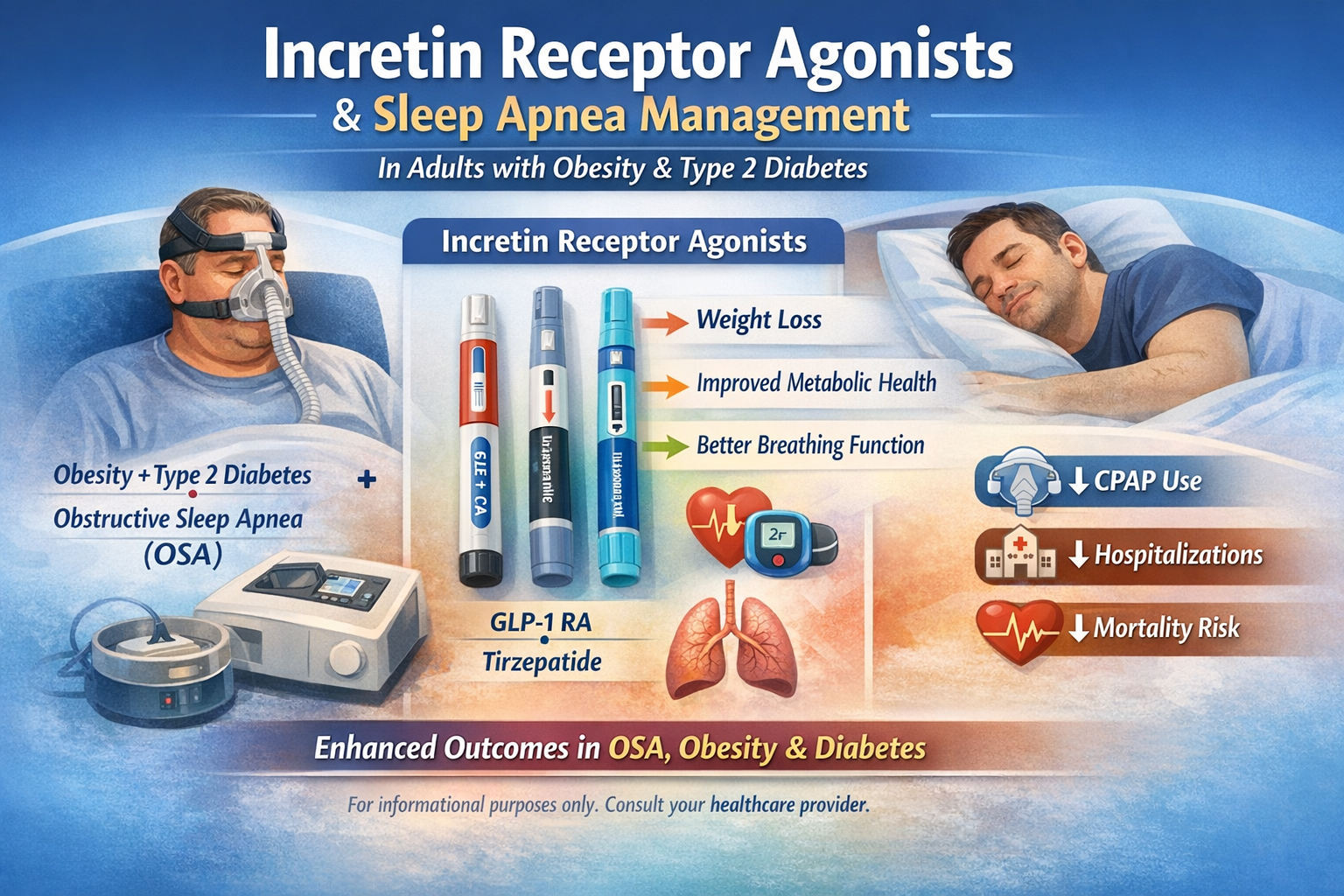
How Incretin Receptor Agonists Are Transforming Sleep Apnea Management in Adults With Obesity and Diabetes
Discover how incretin receptor agonists, including tirzepatide, can improve sleep apnea, reduce CPAP dependence, and enhance health outcomes in adults with obesity and type 2 diabetes.
Obstructive sleep apnea (OSA) affects millions of adults worldwide, especially those with obesity and type 2 diabetes (T2D). This chronic sleep disorder, characterized by repeated pauses in breathing, can lead to daytime fatigue, cardiovascular complications, and decreased quality of life. While continuous positive airway pressure (CPAP) remains the standard treatment, adherence is often low, limiting its effectiveness.
Recent research highlights a promising alternative: incretin receptor agonists (IRAs). These medications, initially developed for diabetes management, may reduce the severity of sleep apnea and improve overall health outcomes. A recent study published in JAMA Network Open examined the real-world effectiveness of IRAs in adults with obesity, T2D, and OSA, revealing encouraging results (Tang et al., 2025).
This article explores the study’s findings, mechanisms, clinical implications, and future directions, offering insights for patients, clinicians, and researchers interested in innovative strategies for managing OSA alongside metabolic disorders.
Understanding Obstructive Sleep Apnea and Its Connection to Diabetes
Obstructive sleep apnea occurs when the upper airway collapses during sleep, interrupting airflow. These interruptions, called apneas and hypopneas, reduce oxygen levels and fragment sleep. Over time, untreated OSA can increase the risk of heart disease, hypertension, and metabolic dysfunction.
OSA frequently coexists with type 2 diabetes and obesity, likely due to shared risk factors such as excess body weight, insulin resistance, and chronic inflammation. Studies estimate that about 25% of U.S. adults have OSA, with a significant overlap among those with diabetes (Gottlieb & Punjabi, 2020; Reutrakul & Mokhlesi, 2017).
While CPAP therapy is effective for keeping the airway open, many patients discontinue or inconsistently use their devices due to discomfort, noise, or other challenges. As a result, researchers have explored adjunctive treatments that can reduce OSA severity or its health consequences.
What Are Incretin Receptor Agonists and How Do They Work?
Incretin receptor agonists (IRAs) are medications that mimic gut hormones involved in glucose regulation and appetite control. They include:
- GLP-1 receptor agonists (GLP-1RAs), such as semaglutide,
- Dual GIP and GLP-1 receptor agonists, like tirzepatide.
These drugs improve blood sugar control, suppress appetite, slow gastric emptying, and support weight loss. Notably, weight loss is strongly linked to improved OSA outcomes, making IRAs a potential dual-purpose therapy for patients with T2D and sleep apnea.
Recent clinical trials suggest that tirzepatide not only promotes significant weight reduction but also may directly reduce OSA severity (Malhotra et al., 2024). Until recently, evidence from routine clinical practice had been limited.
The JAMA Network Study: Real-World Evidence
The 2025 study in JAMA Network Open evaluated IRA use among adults with obesity, T2D, and OSA using real-world electronic health record data from the TriNetX network. This database aggregates deidentified health records from multiple U.S. healthcare organizations, enabling large-scale observational research.
Study Design
Researchers identified adults starting either:
- An incretin receptor agonist (IRA), or
- A sodium-glucose cotransporter-2 inhibitor (SGLT2I), another diabetes medication not typically associated with weight loss.
After matching patients based on demographics, health status, and clinical characteristics, the study analyzed 36,981 matched pairs for outcomes including:
- CPAP use,
- All-cause mortality, and
- All-cause hospitalization.
Follow-up averaged about 11 months, with subgroup analyses by age, sex, and specific IRA type.
Key Findings
Reduced CPAP Use
Patients initiating IRAs were 8% less likely to use CPAP compared to those on SGLT2Is, suggesting potential improvement in OSA severity.
Lower Risk of Hospitalization and Death
- Mortality: IRA users had a 32% lower risk of death from any cause.
- Hospitalization: There was a 10% reduction in hospital admissions among IRA users.
These benefits were consistent across most subgroups, although the reduction in CPAP use was not statistically significant among females and older adults.
Tirzepatide Shows the Greatest Benefits
When comparing different IRAs:
- Both tirzepatide and GLP-1RAs reduced CPAP use and mortality relative to SGLT2Is.
- Tirzepatide demonstrated stronger effects than GLP-1RAs, highlighting its potential as a preferred therapy for patients with obesity, T2D, and OSA.
How Do IRAs Improve Sleep Apnea?
The study suggests several mechanisms:
- Weight Loss: By reducing fat around the airway and decreasing inflammation, IRAs may alleviate airway obstruction.
- Metabolic Improvements: Better glucose control and cardiovascular health could reduce complications linked to OSA.
- Potential Respiratory Effects: Early research indicates that incretin pathways might influence breathing regulation, though this is not fully understood.
These effects collectively support the idea that IRAs may reduce OSA severity while offering broader cardiometabolic benefits.
Limitations to Consider
While compelling, the study has some limitations:
- CPAP Use vs. Adherence: The research used procedure codes to track CPAP use, which may not accurately reflect actual nightly usage or compliance.
- Observational Design: Associations cannot establish causation; unmeasured factors such as socioeconomic status or exact OSA severity could influence results.
- Limited Subgroup Data: The benefits for females and older adults were less clear, suggesting possible sex- or age-related differences in response.
Implications for Clinical Practice
This study provides real-world evidence that IRAs, particularly tirzepatide, may:
- Reduce the need for CPAP in some patients,
- Lower mortality and hospitalization risk, and
- Offer an integrated approach to managing obesity, diabetes, and sleep apnea.
Clinicians may consider IRAs as part of a comprehensive treatment strategy for patients struggling with OSA alongside metabolic disease. Combining pharmacologic therapy with lifestyle interventions or CPAP could further improve outcomes.
Future Directions
Further research is needed to:
- Confirm causal relationships between IRA use and improved OSA outcomes,
- Explore the impact of IRAs on objective measures like the apnea-hypopnea index, and
- Investigate long-term effects on metabolic health and quality of life.
As evidence grows, IRAs could become a cornerstone of multimodal therapy for patients with coexisting obesity, diabetes, and sleep apnea.
Conclusion
In adults with obesity, type 2 diabetes, and obstructive sleep apnea, incretin receptor agonists are associated with lower CPAP use, reduced hospitalizations, and decreased mortality. Among these drugs, tirzepatide shows particularly strong potential, combining weight loss with metabolic and respiratory benefits.
These findings support a growing trend toward integrated treatment strategies that address multiple interconnected health challenges simultaneously. While more research is necessary to establish causation, IRAs represent a promising step forward in managing sleep apnea beyond traditional CPAP therapy.
References
- Tang H, Zhang B, Lu Y, et al. Incretin Receptor Agonists and CPAP Use in Adults With Diabetes, Obesity, and Obstructive Sleep Apnea. JAMA Netw Open. 2025;8(12):e2550978. doi:10.1001/jamanetworkopen.2025.50978
- Gottlieb DJ, Punjabi NM. Diagnosis and management of obstructive sleep apnea: a review. JAMA. 2020;323(14):1389-1400. doi:10.1001/jama.2020.3514
- Reutrakul S, Mokhlesi B. Obstructive sleep apnea and diabetes: a state of the art review. Chest. 2017;152(5):1070-1086. doi:10.1016/j.chest.2017.05.009
- Malhotra A, Grunstein RR, Fietze I, et al; SURMOUNT-OSA Investigators. Tirzepatide for the treatment of obstructive sleep apnea and obesity. N Engl J Med. 2024;391(13):1193-1205. doi:10.1056/NEJMoa2404881
Disclaimer
This content is for informational purposes only and is not a substitute for professional medical advice. Consult a healthcare professional for personal diagnosis and treatment. The associations discussed do not establish causation, and medication changes should only be made under medical supervision.