
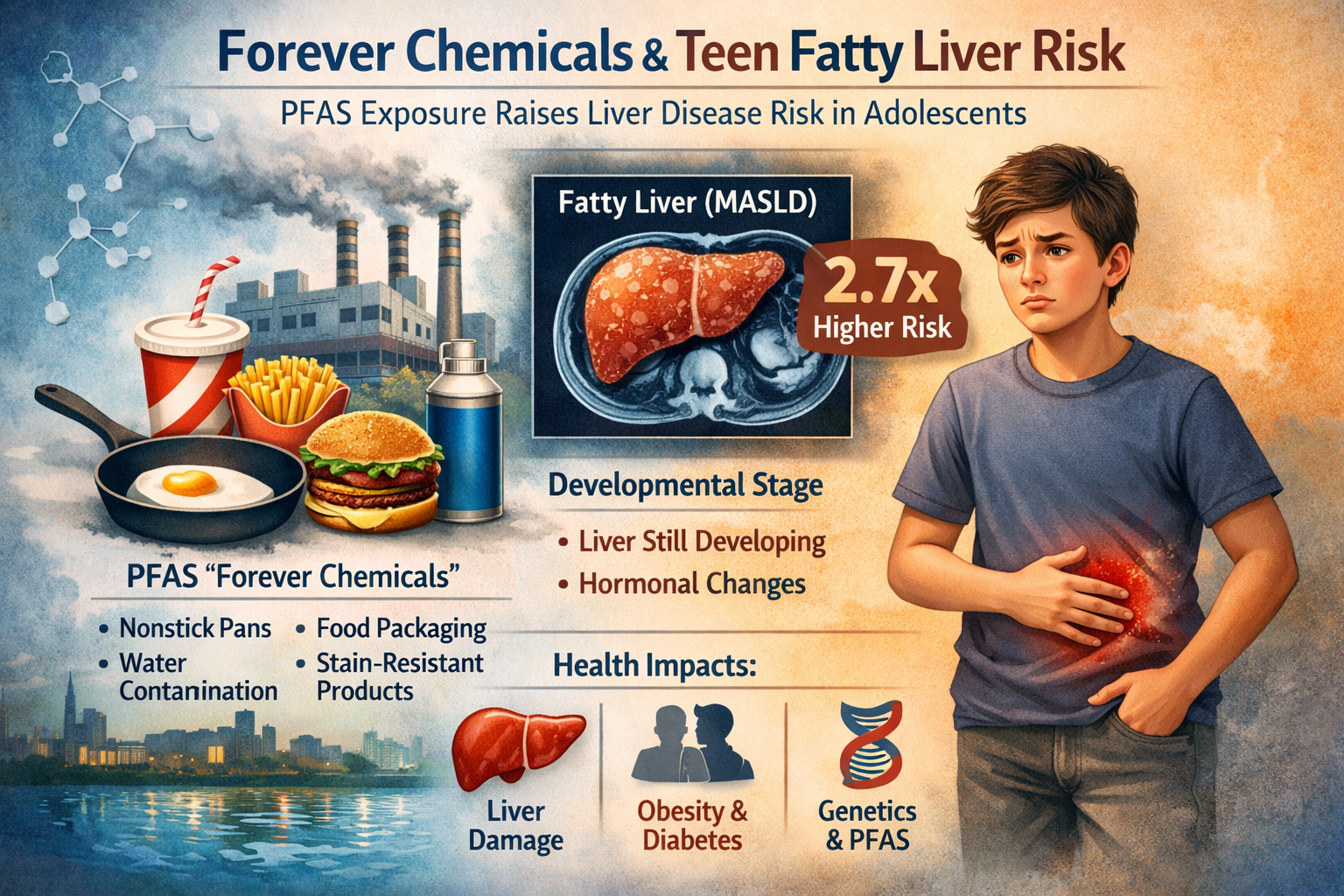
How “Forever Chemicals” May Significantly Increase Fatty Liver Disease Risk in Teenagers
PFAS exposure during adolescence could have long-term consequences for liver and metabolic health
Fatty liver disease is no longer a condition limited to adults. Increasingly, it is being diagnosed in children and teenagers, raising serious concerns among public health experts. New research suggests that exposure to PFAS, often called forever chemicals, may dramatically raise the risk of developing fatty liver disease during adolescence, a critical stage of physical development.
According to a study published in the January 2026 issue of Environmental Research, higher blood levels of specific PFAS compounds were linked to a sharply increased likelihood of fatty liver disease in teenagers and young adults. The findings add to growing evidence that everyday chemical exposures may play a larger role in chronic disease than previously understood.
This article breaks down what the study found, what PFAS are, why teenagers may be especially vulnerable, and what families can do to reduce exposure risks.
What Is Fatty Liver Disease in Adolescents?
Fatty liver disease, now clinically referred to as metabolic dysfunction-associated steatotic liver disease or MASLD, occurs when excess fat accumulates in liver cells. Over time, this buildup can trigger inflammation, fibrosis, liver scarring, and even liver cancer.
In children and teens, MASLD is especially concerning because it often develops silently. Many young people have no obvious symptoms until liver damage has already progressed. Researchers estimate that about 10 percent of all children have fatty liver disease. Among children with obesity, that number may reach as high as 40 percent.
Left unmanaged, fatty liver disease that begins in adolescence can persist into adulthood, increasing lifelong risks for type 2 diabetes, cardiovascular disease, and severe liver complications.
What Are PFAS and Why Are They Called Forever Chemicals?
PFAS stands for per- and polyfluoroalkyl substances. These are synthetic chemicals that have been used in consumer and industrial products since the 1940s. They are known for their resistance to heat, water, and oil, properties that made them attractive for manufacturing.
PFAS are often referred to as forever chemicals because they are made with carbon-fluorine bonds, one of the strongest chemical bonds in existence. This makes them extremely difficult to break down in the environment or in the human body.
Common sources of PFAS exposure include:
- Nonstick cookware
- Fast food and microwave popcorn wrappers
- Stain-resistant carpets and furniture
- Waterproof clothing
- Firefighting foam
- Some cosmetics and personal care products
- Drinking water contaminated through industrial runoff
Studies show that more than 99 percent of Americans have measurable levels of PFAS in their blood. At least one PFAS compound has been detected in roughly half of United States drinking water supplies.
Key Findings From the New Study
The new research examined data from 284 adolescents and young adults in Southern California. Participants were drawn from two long-running studies conducted by the University of Southern California. All participants were considered at elevated risk for metabolic disease because their parents had obesity or type 2 diabetes.
Researchers measured PFAS levels through blood tests and assessed liver fat using MRI scans, a highly accurate imaging method.
Main results included:
- Each doubling of blood levels of perfluorooctanoic acid, known as PFOA, was associated with 2.7 times higher odds of having fatty liver disease.
- Another PFAS compound, perfluoroheptanoic acid or PFHpA, was also linked to increased liver fat.
- Teens who smoked or carried a specific genetic variant related to liver fat storage had an even higher risk.
- The prevalence of fatty liver disease increased with age during adolescence, suggesting cumulative exposure effects.
The study highlights how chemical exposure, genetics, and lifestyle factors can interact to shape long-term health outcomes.
Why Adolescence Is a High-Risk Window
Adolescence is a period of rapid physical growth and hormonal change. During this time, organs including the liver are still developing. According to the researchers, this makes teenagers particularly sensitive to environmental exposures like PFAS.
Dr. Lida Chatzi, senior author of the study and professor at the Keck School of Medicine of USC, emphasized that early liver fat accumulation may set the stage for lifelong metabolic problems.
When exposure occurs during key developmental windows, the biological effects may be more profound and more difficult to reverse later in life.
How PFAS May Affect Liver Health
Although the study was observational and does not prove direct causation, scientists have identified several ways PFAS may interfere with liver function:
- Disruption of lipid metabolism, leading to increased fat storage in the liver
- Interference with insulin signaling, raising the risk of insulin resistance
- Activation of inflammatory pathways that damage liver tissue
- Alteration of hormone signaling involved in metabolism and growth
PFAS are known to accumulate in the liver, which may explain why this organ appears especially vulnerable.
The Role of Genetics and Lifestyle
One of the study’s most important insights is that PFAS exposure does not act in isolation. Genetic predisposition and lifestyle behaviors such as smoking can amplify the risk.
Researchers found that teens carrying a genetic variant associated with liver fat accumulation were more likely to develop MASLD when exposed to higher PFAS levels. This supports the idea of precision environmental health, where individual genetic differences influence how environmental exposures affect disease risk.
What This Means for Parents and Families
While it is nearly impossible to eliminate PFAS exposure entirely, families can take steps to reduce risk, especially for children and teenagers.
Practical ways to lower PFAS exposure include:
- Using stainless steel or cast iron cookware instead of nonstick pans
- Avoiding fast food and heavily packaged foods when possible
- Checking local water quality reports and using certified water filters if PFAS contamination is reported
- Limiting stain-resistant treatments on carpets and furniture
- Encouraging healthy lifestyle habits that support liver health, including balanced nutrition and regular physical activity
Parents of children with obesity, a family history of metabolic disease, or known liver issues may want to discuss environmental risk factors with a healthcare provider.
A Growing Public Health Concern
The findings add urgency to calls for stronger regulation of PFAS chemicals. Although some PFAS compounds have been phased out, many replacements remain poorly studied, and legacy contamination persists in water and soil.
Public health experts emphasize that reducing PFAS exposure early in life could help prevent not only fatty liver disease but also other conditions linked to these chemicals, including certain cancers, immune dysfunction, and reproductive issues.
As researchers continue to uncover how environmental chemicals shape long-term health, studies like this underscore the importance of prevention at the population level.
Looking Ahead
More research is needed to confirm these findings in larger and more diverse populations. Long-term studies will be especially valuable in determining whether reducing PFAS exposure in adolescence leads to measurable improvements in liver health over time.
Still, the evidence so far suggests that adolescence represents a critical opportunity for intervention. Reducing exposure during this window may help protect liver function and metabolic health for decades to come.
Source
- Keck School of Medicine of USC, News Release, January 6, 2026
- Environmental Research, January 1, 2026
Disclaimer
This article is for informational and educational purposes only and does not constitute medical advice, diagnosis, or treatment. Statistical associations described in medical research apply to populations, not individuals. Individual health risks can vary widely based on genetics, lifestyle, and environmental factors. Always consult a qualified healthcare professional for personalized medical guidance.