
Global Eligibility for GLP-1 Receptor Agonists in Obesity Across 99 Countries
Introduction: Obesity and the Search for Scalable Solutions
Obesity is one of the most pressing public health challenges of the 21st century. Defined by excessive adiposity that increases the risk of chronic disease, obesity now affects hundreds of millions of adults worldwide. Its rapid rise has driven parallel increases in type 2 diabetes, hypertension, cardiovascular disease, and health care spending. Despite decades of public health messaging around diet and physical activity, long-term weight loss remains difficult for many individuals, particularly in environments shaped by highly processed foods, sedentary work, and socioeconomic constraints.
In recent years, glucagon-like peptide-1 receptor agonists, commonly referred to as GLP-1 receptor agonists, have reshaped the clinical landscape of obesity treatment. Originally developed for type 2 diabetes, these medications have demonstrated substantial and sustained weight loss in large randomized trials. As a result, governments, insurers, and global health agencies are now exploring how GLP-1 receptor agonists could be integrated into routine obesity care.
A critical policy question has emerged. How many people worldwide would actually be eligible for these medications under existing clinical trial criteria? A major new analysis published in The Lancet Diabetes & Endocrinology provides the most comprehensive answer to date, estimating eligibility for GLP-1 receptor agonists across 99 countries.
This article breaks down the findings, explains why they matter, and explores the implications for health systems globally.
What Are GLP-1 Receptor Agonists?
GLP-1 receptor agonists are injectable or oral medications that mimic the action of the naturally occurring hormone GLP-1. This hormone plays a role in regulating appetite, insulin secretion, and gastric emptying. In people with obesity, GLP-1 receptor agonists reduce hunger, increase satiety, and lead to clinically meaningful weight loss.
Newer formulations, including combination therapies that also target glucose-dependent insulinotropic polypeptide, have shown even greater effects. These medications are now approved in several countries specifically for chronic weight management, not just diabetes.
However, their high cost, need for long-term use, and infrastructure requirements make widespread adoption challenging, particularly outside high-income countries.
The Global Study at a Glance
Researchers led by Sang Gune K Yoo and colleagues analyzed pooled individual-level data from nationally representative household health surveys conducted in 99 countries between 2008 and 2021. The dataset included over 810,000 non-pregnant adults aged 25 to 64 years with measured body mass index, blood pressure, and diabetes biomarkers.
Eligibility for GLP-1 receptor agonists was determined using inclusion criteria from major randomized clinical trials. Adults were considered eligible if they met one of the following conditions:
- A body mass index of 30 kg/m² or higher
- A body mass index of 27 kg/m² or higher with hypertension, diabetes, or both
For South, East, and Southeast Asian countries, lower BMI thresholds were applied to reflect region-specific clinical trial criteria:
- A body mass index of 28 kg/m² or higher
- A body mass index of 24 kg/m² or higher with hypertension or diabetes
The analysis incorporated population weighting to estimate national and global eligibility totals.
Key Findings: How Many Adults Are Eligible?
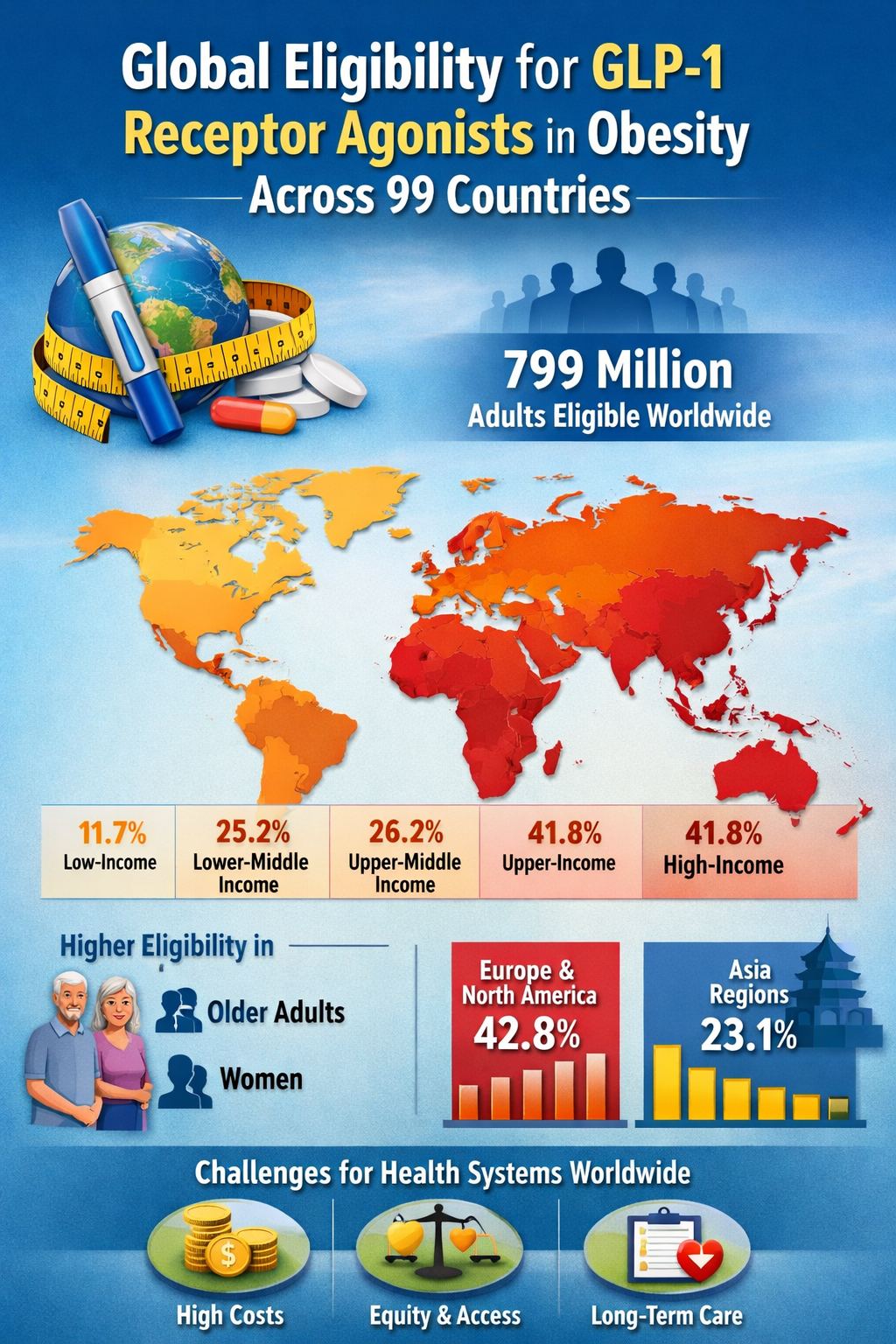
The results are striking. Across all 99 countries, an estimated 27 percent of adults met eligibility criteria for GLP-1 receptor agonists. When applied to global population estimates, this corresponds to approximately 799 million adults worldwide.
Eligibility varied widely by country income level:
- Low-income countries: 11.7 percent
- Lower-middle-income countries: 25.2 percent
- Upper-middle-income countries: 26.2 percent
- High-income countries: 41.8 percent
Although eligibility rates were highest in high-income countries, nearly four-fifths of all eligible individuals lived in low-income and middle-income countries due to population size.
Regional Differences in Eligibility
Geographic variation was substantial. Europe and North America showed the highest eligibility at 42.8 percent, followed closely by the Pacific Islands at 41.0 percent. These regions face high obesity prevalence driven by long-standing dietary and lifestyle patterns.
South, East, and Southeast Asia had a lower overall eligibility rate at 23.1 percent. However, this region accounted for the largest absolute number of eligible individuals globally, reflecting its massive population base. Even modest increases in obesity prevalence in these countries translate into tens of millions of potential candidates for pharmacologic treatment.
Age, Sex, and Income Patterns
Eligibility increased steadily with age. Only 17.9 percent of adults aged 25 to 34 years met criteria, compared with 38.3 percent among those aged 54 to 64 years. This reflects the cumulative nature of weight gain and cardiometabolic disease over time.
Women were more likely to be eligible than men, with eligibility rates of 28.5 percent and 25.5 percent respectively.
Income patterns differed by national context. In low-income and lower-middle-income countries, eligibility increased with household income, likely reflecting greater access to calorie-dense diets and sedentary lifestyles. In high-income countries, the opposite pattern emerged, with the highest eligibility observed in the lowest income quintiles. This underscores the strong link between socioeconomic disadvantage and obesity in wealthy nations.
Why These Findings Matter for Health Policy
The scale of eligibility identified in this study has profound implications. If even a fraction of eligible adults sought treatment with GLP-1 receptor agonists, the financial impact on health systems would be enormous. Current prices make universal coverage unrealistic in most countries.
As a result, policymakers face difficult trade-offs. Decisions will need to balance clinical benefit, cost-effectiveness, equity, and health system capacity. Targeted approaches may be required, prioritizing individuals with severe obesity, multiple comorbidities, or the highest cardiovascular risk.
The findings also raise concerns about global inequity. While most eligible individuals live in low-income and middle-income countries, access to GLP-1 receptor agonists is currently concentrated in a small number of high-income settings. Without deliberate policy intervention, these therapies risk widening existing health disparities.
Beyond Medication: The Need for Comprehensive Obesity Care
The authors emphasize that GLP-1 receptor agonists are not a standalone solution to the obesity epidemic. Long-term success requires integration with broader strategies, including nutrition policy, food system reform, physical activity promotion, and social support.
Patients with lower incomes or limited health literacy may need additional resources to maintain adherence and manage side effects. Health systems must also be prepared to monitor adverse events, prevent inappropriate off-label use, and support long-term treatment when indicated.
Limitations to Keep in Mind
While this study represents the most comprehensive global analysis to date, several limitations apply:
- Only hypertension and diabetes were included as obesity-related comorbidities
- Individuals with contraindications or prior bariatric surgery were not excluded
- BMI thresholds for Asian populations may not capture all regional risk variation
- Surveys were conducted over different years, introducing some temporal variability
- Not all countries worldwide were represented
Despite these limitations, the authors note that the overall direction of bias is unlikely to overestimate current eligibility.
Conclusion: A Turning Point for Global Obesity Policy
This landmark analysis shows that more than one in four adults globally could qualify for GLP-1 receptor agonists under existing clinical criteria. The sheer scale of potential demand highlights both the promise and the challenge of these medications.
As obesity rates continue to rise, GLP-1 receptor agonists will likely play an increasing role in treatment strategies. However, their integration into routine care must be thoughtful, equitable, and grounded in evidence-based prioritization. For most countries, especially those with limited resources, the future of obesity care will depend on combining targeted pharmacologic treatment with population-level prevention and health system reform.
Source
Yoo SGK, Teufel F, Theilmann M, Sif Y, Toure EA, Aryal K, et al. GLP-1 receptor agonists for obesity: eligibility across 99 countries. The Lancet Diabetes & Endocrinology. 2026;14:105–108. Corrected January 12, 2026.
Medical Disclaimer
This article is for informational and educational purposes only and does not constitute medical advice. GLP-1 receptor agonists are prescription medications and may not be appropriate for all individuals. Eligibility, risks, and benefits should be discussed with a qualified health care professional. Treatment decisions should be based on individual clinical evaluation, local regulatory approval, and national guidelines.