GALL STONES
What are gall stones?
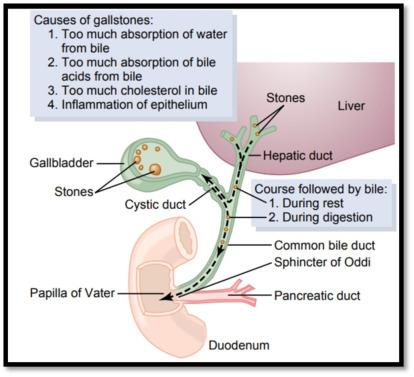
Gallstones form when bile stored in the gallbladder hardens into stone-like material. Too much cholesterol, bile salts, or bilirubin (bile pigment) can cause gallstones.
When gallstones are present in the gallbladder itself, it is called cholelithiasis. When gallstones are present in the bile ducts, it is called choledocholithiasis. Gallstones that obstruct bile ducts can lead to a severe or life-threatening infection of the bile ducts, pancreas, or liver. Bile ducts can also be obstructed by cancer or trauma, but this is not related to gallstones. (https://www.hopkinsmedicine.org/health/conditions-and-diseases/gallstones)
How common are gall stones?
At least 10% of U.S. adults have gallstones, and up to 75% of them are females. But only 20% of those diagnosed will ever have symptoms or need treatment for gallstones.
What causes gall stones?
- Excess bilirubin: Bilirubin is a byproduct of broken-down old red blood cells. You might have an excess of bilirubin if you have a blood disorder that destroys too many red blood cells, or if your liver is impaired in some way and struggling to process its normal load of bilirubin into bile.
- Not enough bile salts: Certain diseases can cause bile acid malabsorption, which means that you lose bile acids in your poop. If you lose too many, your liver won’t have enough left to make bile with. The lack of bile acids creates an excess of lipids (cholesterol) in your bile.
- Cholestasis or gallbladder stasis: “Stasis” means inactivity. If your bile ducts or gallbladder aren’t moving bile effectively through your biliary tract, the bile is more likely to form sediment. This might be an issue with the muscles or with the chemical signalling that tells them to move.
Excess cholesterol: Your liver extracts cholesterol from your blood to make bile. If there’s too much cholesterol in your blood, the proportions in your bile will be off. Bile needs a balance of lipids and acids to hold all the ingredients together. Any excess will fall by the wayside.
Who is at risk of getting gall stones?
- Age: Males are more likely to get them after age 60. Females are more likely to get them during their fertile years, roughly between the ages of 20 and 50.
- Hormones: Females are three times more likely to get gallstones. Their risk peaks and declines with their estrogen and progesterone levels. Estrogen increases cholesterol levels, while progesterone slows your gallbladder from emptying.
- Weight: Body fat releases estrogen, so having more of it raises your estrogen levels and your cholesterol levels. On the other hand, rapid weight loss, like after weight loss surgery, can also cause gallstones. Losing body fat quickly releases large loads of cholesterol into your bile.
- Genetics: Native American or Mexican descent are likely to have higher cholesterol levels in your bile, leading to gallstones. (https://my.clevelandclinic.org/health/diseases/7313-gallstones)
What are the symptoms of gall stones?
Gallstones may cause no signs or symptoms. If a gallstone lodges in a duct and causes a blockage, the resulting signs and symptoms may include:
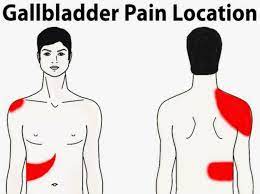
- Sudden and rapidly intensifying pain in the upper right portion of your abdomen.
- Sudden and rapidly intensifying pain in the center of your abdomen, just below your breastbone.
- Back pain between shoulder blades.
- Right shoulder pain.
- Nausea or vomiting.
Pain may last from few minutes to several hours.
How are gall stones diagnosed?
Abdominal ultrasound is most commonly used to detect gall stones. Smaller stones can be picked up by using endoscopic ultrasound.
Additional tests may include oral cholecystography, a hepatobiliary iminodiacetic acid (HIDA) scan, computerized tomography (CT), magnetic resonance cholangiopancreatography (MRCP) or endoscopic retrograde cholangiopancreatography (ERCP). Gallstones discovered using ERCP can be removed during the procedure.
Blood tests may reveal infection, jaundice, pancreatitis or other complications caused by gallstones. (https://www.mayoclinic.org/diseases-conditions/gallstones/diagnosis-treatment/drc-20354220)
What is the treatment for gall stones?
If the gallstones cause no symptoms, treatment is usually not necessary. However, if pain persists, treatment may include:
- Gall bladder removal (cholecystectomy): Once removed, the bile flows directly from the liver to the small intestine. Side effects of this may include diarrhea because the bile is no longer stored in the gallbladder.
- Oral dissolution therapy: Drugs made from bile acid are used to dissolve the stones.
- Methyl-tert-butyl ether: A solution injected into the gallbladder to dissolve stones.
Contact dissolution therapy: An experimental procedure that involves injecting a drug directly into the gallbladder to dissolve the stones. (https://www.hopkinsmedicine.org/health/conditions-and-diseases/gallstones)