
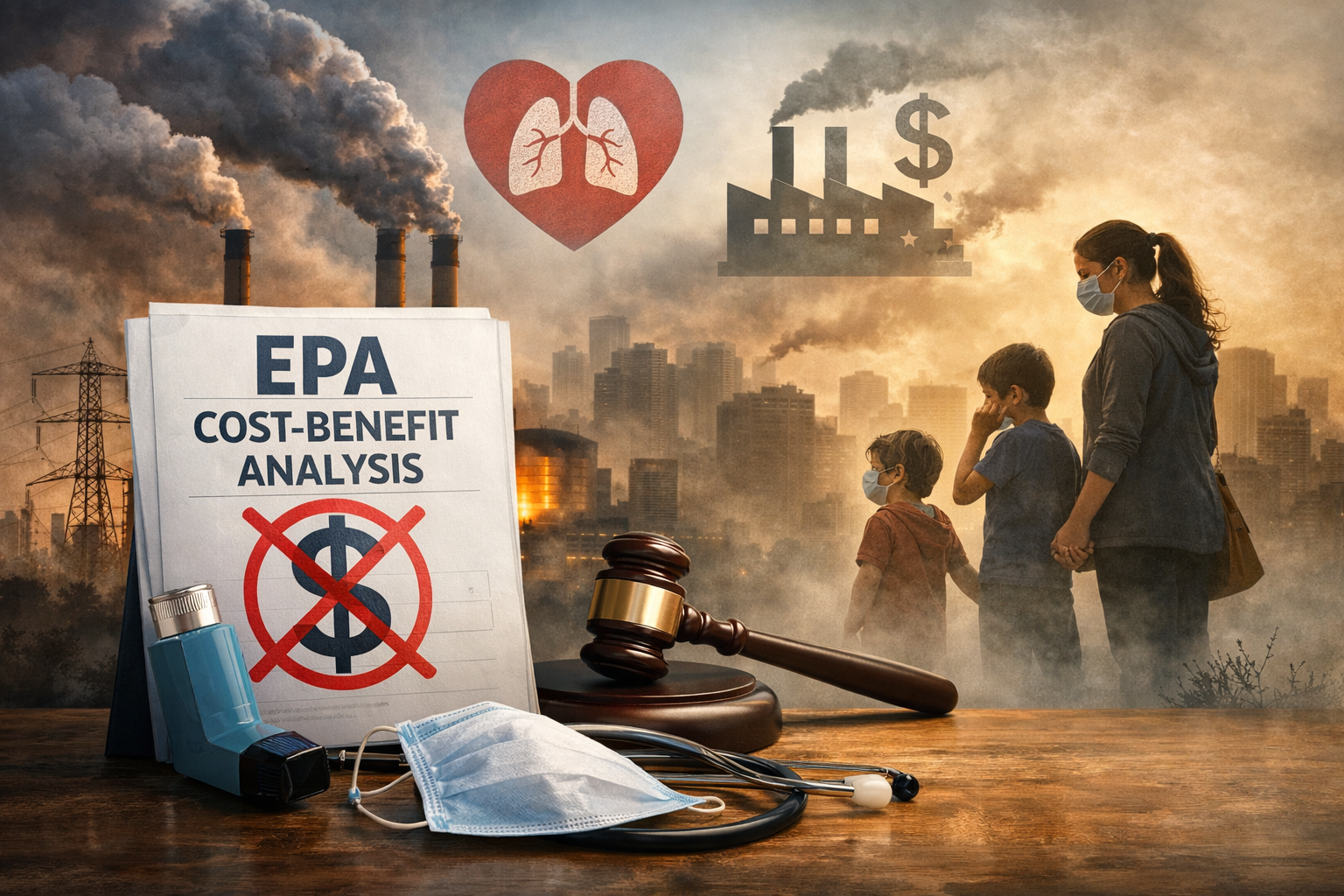
EPA May Stop Assessing Health Benefits When Setting Air Pollution Rules: What It Means for Public Health and Policy
Air pollution regulations in the United States have long been shaped by a balance between economic costs and public health benefits. For decades, the Environmental Protection Agency has relied on scientific and medical data to estimate how cleaner air translates into fewer hospital visits, reduced chronic illness, and lives saved. A proposed policy shift could fundamentally change that approach.
According to internal agency documents reported by major media outlets, the EPA may stop assigning a dollar value to the health benefits of reducing key air pollutants such as fine particulate matter and ozone. Supporters of the change argue that current health estimates are too uncertain. Critics warn that removing these calculations could weaken clean air protections and expose millions of Americans to higher health risks.
This potential shift has significant implications for environmental policy, public health, and regulatory oversight. Understanding what is at stake requires a closer look at how air pollution is regulated, why health benefits have been monetized, and what could happen if those benefits are no longer included in official cost benefit analyses.
How the EPA Traditionally Evaluates Air Pollution Rules
The Clean Air Act requires the EPA to protect public health by setting limits on harmful pollutants. To justify these regulations, the agency has historically conducted cost benefit analyses that compare the economic cost to industry with the benefits to society.
Those benefits include measurable health outcomes such as fewer premature deaths, reduced asthma attacks, lower rates of heart and lung disease, and fewer missed workdays. By assigning dollar values to these outcomes, the EPA has been able to show that the benefits of cleaner air often far outweigh the costs of compliance.
For example, when the agency tightened limits on fine particulate matter under the Biden administration, it estimated that the updated rules could prevent thousands of premature deaths each year. The EPA also calculated that for every dollar spent on reducing this pollution, society could see dozens of dollars in health related benefits.
These calculations have played a central role in defending environmental regulations against legal challenges and political pressure.
What Are PM2.5 and Ozone, and Why Do They Matter?
Two pollutants are at the center of the proposed policy change: PM2.5 and ozone.
PM2.5 refers to fine particulate matter that is 2.5 micrometers or smaller in diameter. These particles are small enough to penetrate deep into the lungs and even enter the bloodstream. Long term exposure has been linked to asthma, chronic obstructive pulmonary disease, heart attacks, strokes, and early death. Major sources include coal fired power plants, oil refineries, vehicle emissions, and industrial processes.
Ozone, a major component of smog, forms when pollutants from cars, trucks, and factories react in sunlight. Ground level ozone irritates the respiratory system and can worsen asthma, reduce lung function, and increase hospital admissions for breathing problems.
Because these pollutants are widespread and affect vulnerable populations such as children, older adults, and people with chronic illness, they have been a primary focus of EPA regulation.
What the Proposed Change Would Do
Under the proposed approach, the EPA would still acknowledge that PM2.5 and ozone harm human health. However, it would stop assigning monetary values to those health impacts in formal cost benefit calculations.
Instead, analyses would focus more heavily on the costs to businesses and industries of complying with pollution rules. Health effects would be discussed qualitatively rather than quantified in economic terms.
Internal agency language suggests that previous analyses provided a false sense of precision by placing dollar values on health outcomes that involve scientific uncertainty. The new framework is intended to avoid what officials describe as overstating benefits that cannot be calculated with complete accuracy.
EPA representatives have stated that not monetizing health benefits does not mean ignoring them. Critics counter that excluding those values from formal calculations effectively sidelines public health in regulatory decision making.
Why Health Experts Are Alarmed
Public health researchers and legal scholars have expressed deep concern about the potential consequences of this shift.
Monetized health benefits have historically been the strongest justification for clean air rules. Without them, regulations may appear economically unjustified even when they prevent widespread illness and death.
Experts argue that uncertainty is not a valid reason to exclude health data. Medicine and public health regularly rely on probabilistic models to guide decisions, from drug approvals to disease prevention strategies. Eliminating these models from environmental policy could set a dangerous precedent.
There is also concern that the change could make it easier to roll back existing pollution limits. If industry costs are emphasized while benefits are downplayed, agencies may struggle to defend strong environmental protections in court.
Potential Impact on Communities
If air pollution rules are weakened, the effects would not be evenly distributed.
Communities located near highways, power plants, refineries, and industrial zones already experience higher levels of pollution. These areas often include low income neighborhoods and communities of color, raising concerns about environmental justice.
Increased exposure to PM2.5 and ozone could lead to higher rates of asthma in children, more emergency room visits, increased cardiovascular disease, and shorter life expectancy. Lost workdays and rising health care costs would also place additional strain on families and local economies.
Public health advocates warn that these impacts may not be immediately visible but would accumulate over time, leading to measurable declines in population health.
Business and Industry Perspectives
Business groups, including major trade organizations, have long criticized the EPA’s use of monetized health benefits. They argue that these calculations rely on assumptions that can inflate benefits and skew policy decisions.
From this perspective, removing dollar values could lead to more balanced and transparent analyses. Industry representatives contend that regulations should be based on clear statutory authority rather than economic models that involve uncertainty.
Supporters of the change also argue that excessive regulation can raise energy costs, reduce competitiveness, and slow economic growth. They view the proposed shift as a way to rein in what they see as regulatory overreach.
Legal and Policy Ramifications
The proposed change could face significant legal challenges.
Courts have historically upheld EPA regulations in part because the agency demonstrated that benefits exceeded costs. Removing monetized health benefits may weaken that defense, especially if new rules are perceived as favoring industry interests over statutory mandates to protect public health.
Legal scholars note that the Clean Air Act does not require the EPA to ignore economic impacts, but it does prioritize health based standards for certain pollutants. How courts interpret the new analytical framework could shape environmental law for years to come.
There is also the possibility that future administrations could reverse the policy, creating regulatory uncertainty for both industry and communities.
The Bigger Picture
At its core, the debate reflects a broader philosophical question about how society values human health.
Assigning a dollar value to reduced mortality and illness is inherently uncomfortable. Yet without some form of quantification, public health benefits can be easily minimized in policy debates dominated by financial metrics.
Supporters of monetization argue that it makes invisible benefits visible, ensuring that health outcomes carry weight alongside economic costs. Opponents argue that such valuations are flawed and misleading.
What is clear is that air pollution remains one of the leading environmental health risks in the United States. Decisions about how it is regulated will have lasting consequences for millions of people.
Conclusion
The EPA’s consideration of ending the monetization of health benefits in air pollution rules represents a significant shift in environmental policy. While framed as a move toward analytical caution, the change could alter how regulations are justified, defended, and enforced.
For public health advocates, the concern is simple. If the benefits of clean air are not fully counted, they may be easier to ignore. For industry, the change represents an opportunity to reduce regulatory burdens. For policymakers and courts, it presents a complex challenge that balances economic interests against the fundamental mission of protecting human health.
As this issue continues to unfold, it will be closely watched by scientists, legal experts, businesses, and communities across the country. The outcome will shape not only the air Americans breathe, but also how the nation defines the value of health in public policy.
Source
The New York Times, January 12, 2026
Disclaimer
This article is for informational and educational purposes only. It does not constitute medical, legal, or environmental policy advice. Statistical and health related data describe general trends and may not apply to individual circumstances. Always consult qualified professionals for personalized medical or policy guidance.