
Do Cochlear Implants Affect Music Enjoyment? New Research on Speech Scores and Listening Habits
Hearing loss affects millions of people worldwide and continues to rise as populations age. For individuals with severe to profound sensorineural hearing loss, cochlear implants have become the gold standard treatment. These devices can dramatically improve speech understanding and communication ability. However, when it comes to music enjoyment and music listening habits, outcomes are more complex.
A 2026 study published in Otolaryngology–Head and Neck Surgery offers new insight into how audiometric performance relates to music enjoyment and listening time in cochlear implant recipients. The research, conducted by Isaac L. Alter, AB; Alexander Chern, MD; Megan E. Kuhlmey, AuD; Meghan A. Despotidis, AuD; Scott Kelly, BS; Tiffany Hwa, MD; and Anil K. Lalwani, MD, helps clarify how speech outcomes influence musical engagement.
In this in depth blog, we break down the findings, what they mean for cochlear implant users, and how optimizing hearing outcomes may improve music listening habits.
Why Music Matters in Hearing Loss Rehabilitation
Music plays a central role in emotional well being, cognitive stimulation, and social connection. For individuals with hearing loss, reduced music enjoyment can significantly affect quality of life.
While hearing aids provide benefit for many people, cochlear implants are often recommended when hearing aids no longer provide sufficient speech clarity. Cochlear implants are highly effective at restoring speech recognition. However, music perception presents unique challenges because music requires accurate pitch and timbre recognition, areas where implants are less precise compared to acoustic hearing.
Previous studies have shown:
- Rhythm perception is generally preserved.
- Pitch and timbre recognition are more significantly affected.
- Many cochlear implant users report reduced music enjoyment.
- Music listening time often decreases after implantation.
This new study aimed to better understand whether objective hearing performance predicts music enjoyment and listening habits.
Study Overview: Music Enjoyment and Listening Time in CI Users
The research was published in Otolaryngology–Head and Neck Surgery, Volume 174, Issue 2, pages 489 to 494, 2026.
Study Objective
The primary goal was to determine whether:
- Pure tone average (PTA)
- Word recognition score (WRS)
in either the implanted or non implanted ear were associated with:
- Self rated music enjoyment
- Time spent listening to music
Study Design
- Cross sectional study
- 72 adult cochlear implant recipients
- Participants recruited from a tertiary academic center and community outreach
- Both unilateral and bilateral users included
The study population consisted of:
- 25 bilateral cochlear implant users
- 27 bimodal users with one cochlear implant and one hearing aid
- 20 unilateral users with no contralateral device
Participants had:
- An average of 29.5 years since hearing loss diagnosis
- 7.5 years of cochlear implant experience
- Mean age of 63 years
Key Audiometric Measures Explained
To understand the results, it helps to review two key hearing metrics.
Pure Tone Average (PTA)
PTA measures hearing sensitivity across key frequencies. Lower numbers indicate better hearing.
Word Recognition Score (WRS)
WRS measures how well a person understands speech, typically using standardized word lists. Higher percentages indicate better speech recognition.
In this study:
- CI aided PTA and WRS were measured in implanted ears
- Unaided PTA and WRS were recorded in non implanted ears
Major Findings: What Impacts Music Listening?
1. Hearing Performance Did Not Predict Music Enjoyment
The most surprising finding was that neither PTA nor WRS in either ear was significantly associated with self rated music enjoyment.
In other words:
Better audiometric scores did not necessarily mean greater enjoyment of music.
This aligns with prior large studies that also found no strong link between objective hearing measures and music enjoyment.
Music enjoyment appears to involve more than measurable hearing ability. Psychological, emotional, and social factors likely play a major role.
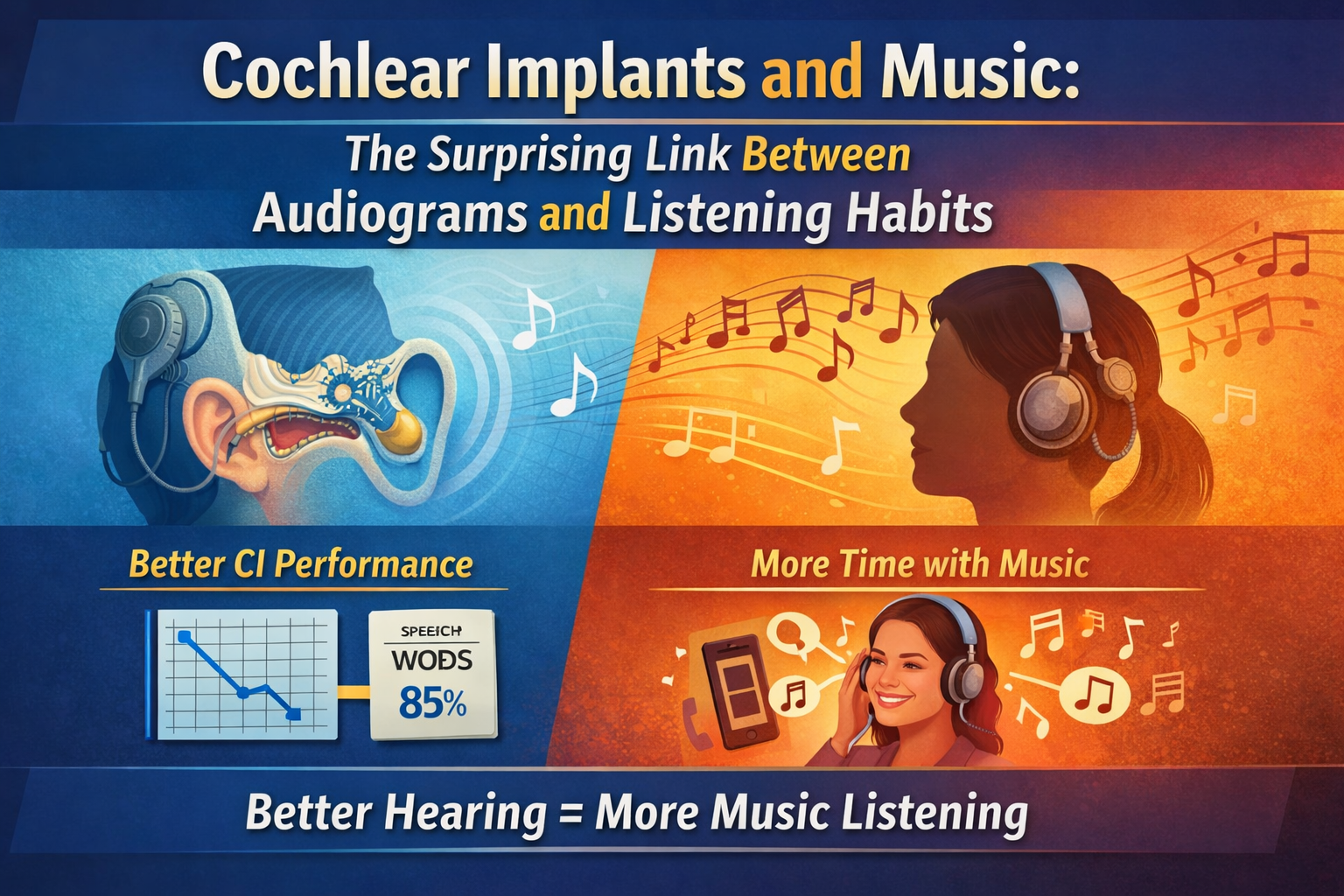
2. CI Aided Hearing Strongly Predicted Music Listening Time
In contrast, objective hearing performance in the implanted ear was significantly associated with time spent listening to music.
Specifically:
- Worse CI aided PTA correlated with decreased music listening time.
- Worse CI aided WRS also correlated with reduced listening time.
- Non implanted ear hearing was not associated with listening time.
For every 10 dB worsening of PTA in the implanted ear, there was a 1.3 point decrease on a 10 point music listening scale.
For every 10 percent drop in WRS, there was a measurable decline in listening time.
This means that cochlear implant performance directly influences how much time people choose to spend listening to music.
Why Does the Implanted Ear Matter More?
One unexpected finding was that hearing ability in the non implanted ear did not significantly influence music listening habits.
Even among individuals with normal hearing in the opposite ear, music listening time was primarily linked to the cochlear implant ear's performance.
Possible explanations include:
- Integration between ears may influence perception
- Patients may rely heavily on the implanted ear
- Brain adaptation may prioritize the electrical signal over acoustic input
- Listening fatigue may play a role
This suggests that optimizing cochlear implant programming is critical not just for speech, but also for music engagement.
Clinical Implications: Why Optimization Matters
The study highlights an important takeaway:
Improving cochlear implant speech outcomes may increase music listening time.
This has broader implications because music listening is associated with:
- Improved mood
- Reduced stress
- Enhanced cognitive stimulation
- Greater social participation
- Improved overall quality of life
While music enjoyment may be influenced by complex emotional factors, time spent listening appears to be influenced by measurable hearing performance.
Clinicians should consider:
- Fine tuning implant programming
- Encouraging aural rehabilitation
- Incorporating music based therapy
- Monitoring speech recognition outcomes carefully
Optimizing CI aided PTA and WRS could have meaningful effects beyond communication.
Why Music Enjoyment Is Different from Listening Time
The disconnect between music enjoyment and listening time is fascinating.
Enjoyment is subjective and influenced by:
- Personal expectations
- Pre implant music experience
- Emotional associations
- Psychological adaptation
- Social context
Listening time, however, appears more behaviorally linked to hearing clarity.
Someone may enjoy music emotionally but still avoid listening if it sounds distorted or requires effort.
This distinction is crucial for clinicians counseling patients.
Study Limitations
Like all research, this study had limitations:
- Self reported listening time may be subject to recall bias
- Listening habits were rated using Likert scales rather than measured in hours
- Device manufacturer data was not analyzed
- Limited racial and socioeconomic diversity in the sample
- Other programming factors such as dynamic range were not examined
Future research may include:
- Objective tracking of music listening duration
- Inclusion of more diverse populations
- Analysis of device specific programming variables
- Examination of long term quality of life outcomes
What This Means for Cochlear Implant Users
If you are a cochlear implant recipient, this research suggests:
- Speech performance matters for music engagement.
- Fine tuning your device can affect how much music you listen to.
- Enjoyment may not directly reflect audiogram results.
- Rehabilitation and auditory training remain important.
If music listening has decreased since implantation, discussing programming adjustments or music focused auditory training with your audiologist may help.
The Bigger Picture in Hearing Healthcare
This study expands the conversation beyond speech recognition.
For years, cochlear implant success has been measured primarily by speech outcomes. However, quality of life includes more than conversation. Music plays a vital role in human experience.
By identifying that CI aided hearing ability influences music listening habits, this research underscores the importance of holistic hearing care.
Clinicians should not only ask, "Can you understand speech?" but also, "Are you engaging with music the way you want to?"
Final Takeaways
Here are the key points:
- Cochlear implant speech performance does not predict music enjoyment.
- Better CI aided hearing strongly predicts increased music listening time.
- Non implanted ear hearing does not significantly influence music listening habits.
- Optimizing cochlear implant programming may increase music engagement.
- Music listening contributes to overall quality of life.
For cochlear implant users, maximizing device performance may enhance both communication and musical participation.
Source
Alter IL, Chern A, Kuhlmey ME, Despotidis MA, Kelly S, Hwa T, Lalwani AK. Music Enjoyment and Listening Time in Cochlear Implant Recipients: The Role of Audiometric Performance. Otolaryngology–Head and Neck Surgery. 2026;174(2):489 to 494. DOI: 10.1002/ohn.70064. Published by the American Academy of Otolaryngology–Head and Neck Surgery Foundation.
Disclaimer
This article is for informational and educational purposes only and is not intended as medical advice. Always consult a qualified healthcare professional, audiologist, or otolaryngologist regarding diagnosis, treatment, or changes to your cochlear implant programming. Individual outcomes vary, and clinical decisions should be made based on personalized medical evaluation.