
Complete Guide to CPR and AED Use to Save Lives in Cardiac Emergencies
Introduction
Cardiopulmonary Resuscitation (CPR) and Automated External Defibrillators (AEDs) are two life‑saving tools that everyone should understand. Cardiac arrest can strike suddenly, often without warning, leaving victims unresponsive and without a normal heartbeat. In these situations, immediate action is not just beneficial, it can be the difference between life and death. According to recent data from the Cardiac Arrest Registry to Enhance Survival (CARES) Annual Report, more than 70% of out‑of‑hospital cardiac arrests happen at home, yet less than half of these victims receive bystander CPR. When performed correctly, CPR can double or even triple a person’s chances of survival, and using an AED early can dramatically increase those odds further.
In this comprehensive, SEO‑friendly guide, we break down what cardiac arrest is, how hands‑only CPR works, when and how to perform it, the role of AEDs, and practical tips that could help you save a life, even without formal medical training.
What Is Cardiac Arrest?
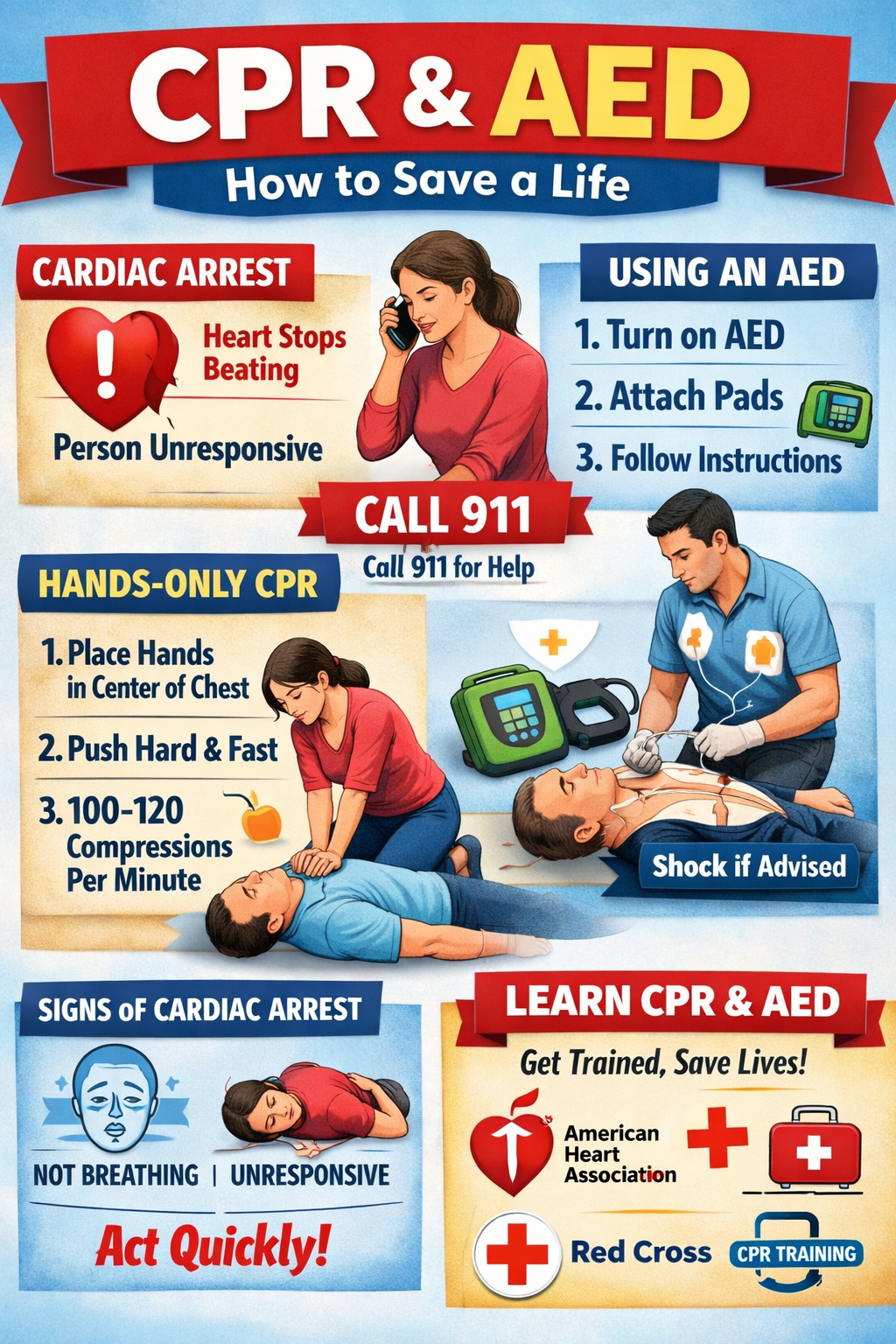
Cardiac arrest is a sudden loss of heart function. This is not the same as a heart attack, although the two are sometimes confused. In cardiac arrest, the heart stops beating effectively, and blood can no longer reach vital organs like the brain. Without immediate intervention, death can occur within minutes.
Because the brain is highly sensitive to the lack of oxygenated blood, every second without CPR or defibrillation compounds the risk of death or serious neurological damage. Effective bystander intervention buys precious time until professional help arrives.
Understanding Hands‑Only CPR
Hands‑only CPR is a simplified version of traditional CPR that focuses exclusively on chest compressions. It was created so that untrained bystanders could confidently and effectively help someone in cardiac arrest.
Why Hands‑Only CPR Works
The heart’s primary job is to pump blood. When it stops, compressing the chest manually forces blood to circulate through the body, especially to the brain and heart, increasing the victim’s chance of survival.
Hands‑only CPR does not include rescue breaths. This reduces hesitation among bystanders who may be uncomfortable performing mouth‑to‑mouth resuscitation.
Spotting a Cardiac Arrest
A person in cardiac arrest:
- Is unresponsive
- Is not breathing normally
- May exhibit agonal breathing, gasping or irregular breaths that can be mistaken for normal breathing but are not sufficient to sustain life.
Gasping may continue several minutes after the heart stops, so don’t assume someone is breathing normally, check for responsiveness and call for help first.
When to Start CPR
Begin CPR immediately if a person:
- Is unresponsive
- Is not breathing normally
You should:
- Call emergency services immediately (911 in the U.S.)
- Put the phone on speaker mode so the dispatcher can guide you
- Begin chest compressions without waiting for professional help
Every second without blood flow increases the likelihood of irreversible brain damage. Early CPR maintains circulation until advanced care arrives.
How to Perform Hands‑Only CPR (Step by Step)
Here’s a clear, step‑by‑step approach to performing hands‑only CPR effectively:
1. Position the Person
Lay the person flat on their back on a firm surface.
2. Find the Correct Hand Placement
Kneel beside the victim and place the heel of one hand on the center of the chest (on the sternum). Place your other hand directly on top and interlock your fingers. Keep your arms straight.
3. Begin Chest Compressions
- Push hard and fast, compress about 2 inches (5 cm) into the chest in adults.
- Let the chest fully recoil (rise) after each push.
- Maintain a rhythm of 100–120 compressions per minute.
A simple way to maintain the correct pace is to think of songs that match the rhythm, such as “Stayin’ Alive” by the Bee Gees, “Dynamite” by BTS, or “Dance the Night” by Dua Lipa (all close to the ideal tempo). Metronome apps or playlists with CPR‑friendly songs can be very helpful.
4. Continue Until Help Arrives
Do not stop compressions unless:
- A trained responder takes over
- The person shows signs of life
- You are physically unable to continue
- EMS instructs you to stop
What Is an AED and How Does It Help?
An Automated External Defibrillator (AED) is a portable electronic device designed to diagnose and treat sudden cardiac arrest by delivering an electrical shock, if needed, to help the heart re‑establish an effective rhythm.
How an AED Works
AEDs are built for layperson use and provide step‑by‑step visual and audio instructions. Here’s how they generally work:
- Turn on the AED.
- Attach pads to the person’s bare chest as indicated.
- The AED will analyze the heart’s rhythm.
- If a shock is advised, the device will prompt you to press a button to deliver it.
- After the shock, continue CPR as instructed.
Safety Notes With AEDs
- Do not touch the victim while the AED analyzes or delivers a shock. Movement can interfere with the device’s ability to read the heart.
- Pads must adhere to bare skin; clothing should be removed if necessary.
- A bra does not always need to be removed; pads can often be placed under straps.
AEDs are safe for use by untrained people and are widely available in public places, workplaces, schools, and even private homes.
Common Questions and Misconceptions
“What If I Start CPR and the Person Didn’t Need It?”
In many regions, including the United States, Good Samaritan laws protect bystanders who provide emergency assistance in good faith. As long as you act responsibly and in a genuine emergency, legal protection typically applies.
“Won’t CPR Injure the Person?”
Chest compressions may cause bruising or rib fractures, especially in older adults, but if someone is in cardiac arrest, they are already in a life‑threatening situation. Immediate CPR is crucial and cannot make the situation worse.
“Do I Change Hand Placement Based on Gender?”
No. Hand placement for compressions is the same regardless of a person’s gender.
“Do I Need Medical Training to Use an AED?”
No. AEDs are designed to be intuitive and guide you through every step. Formal training is helpful but not required to use a public AED in an emergency.
“Should I Remove Clothing Before Performing CPR?”
No. CPR can be performed through clothing. AED pads, however, must be placed on bare skin.
Why Learning CPR Matters
Even a few minutes of CPR training can dramatically increase your confidence and ability to act in a real emergency. Formal courses — offered by organizations like the American Heart Association, Red Cross, and Illinois Heart Rescue — provide hands‑on practice and a deeper understanding.
Ways to Prepare
- Take an in‑person CPR course
- Use online tutorials with video demonstrations
- Practice hands‑only CPR rhythm with music or metronome apps
- Locate nearby AED units in public spaces
Being prepared means you are ready to act, and that can save a life.
Real‑World Impact
Here’s what the statistics say:
- 41.7% of out‑of‑hospital cardiac arrest victims receive bystander CPR.
- Bystander CPR can double or triple survival chances.
That means nearly half of all people experiencing cardiac arrest outside of hospitals aren’t getting crucial help early. Each of us who learns CPR and AED use becomes part of the solution.
Conclusion: Empowering You to Save Lives
Cardiac arrest can happen anywhere, at home, work, or in public, often without warning. Knowing when and how to perform hands‑only CPR, and how to use an AED, turns a bystander into a potential lifesaver. With simple training and confidence to act, you could help double or triple someone’s chance of survival.
Here’s what you should remember:
- Call emergency services immediately.
- Start hands‑only CPR without hesitation.
- Use an AED if one is available.
- Do not worry about causing harm; doing nothing is far more dangerous.
Learning these skills empowers you, strengthens your community, and could one day save someone you love.
Disclaimer
This blog post is for educational purposes only. It does not replace professional medical advice, diagnosis, or treatment. Always consult with qualified healthcare professionals for individualized medical guidance. The techniques described are simplified for general understanding; formal CPR and AED training is recommended for all individuals seeking to perform these procedures in real emergencies.