
Chronic Stress and Racism May Explain Nearly Half the Life Expectancy Gap in Black Americans
How Long-Term Stress, Inflammation, and Structural Inequality Are Linked to Early Death
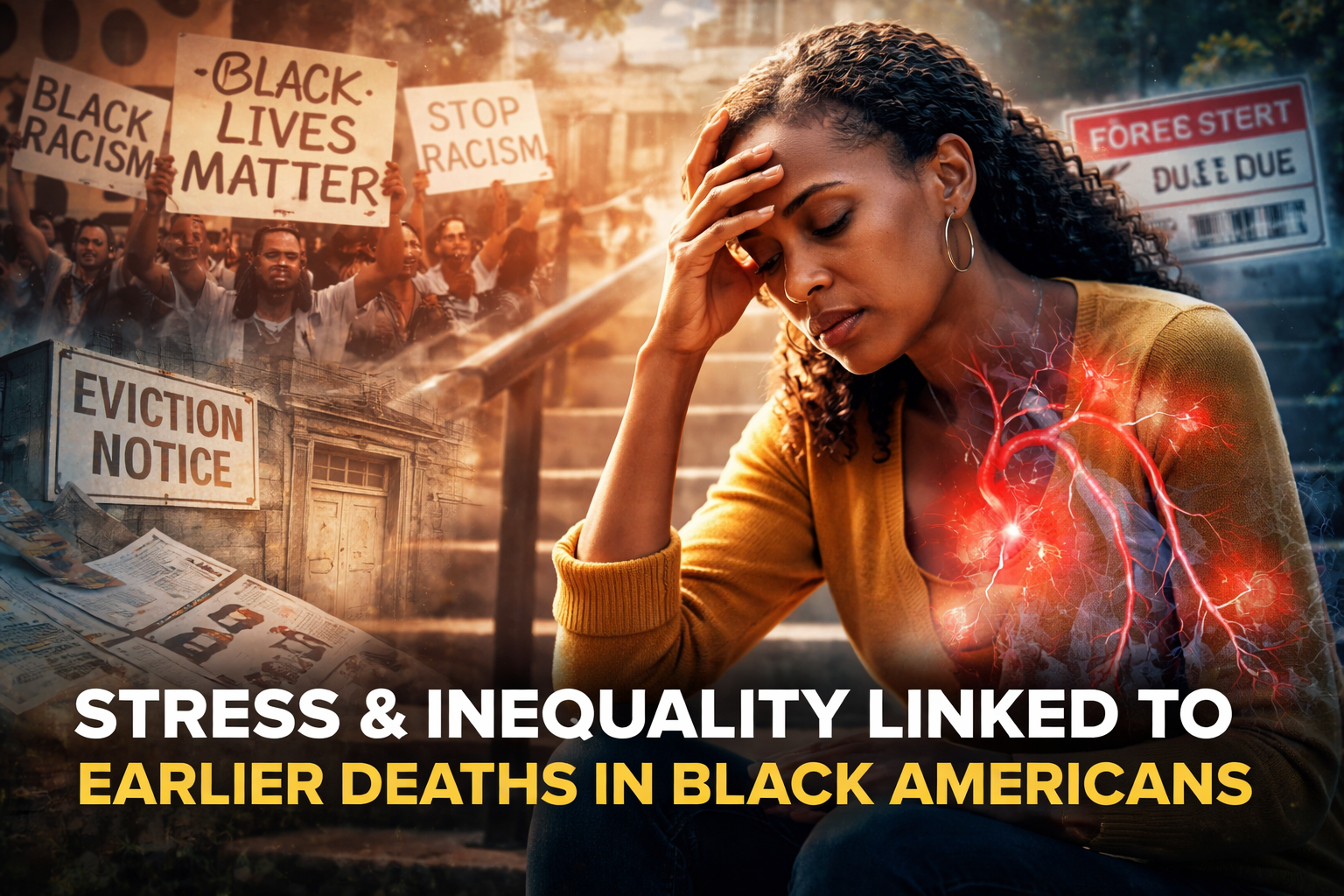
Life expectancy in the United States has long reflected deep racial inequities. While medical advances continue to extend average lifespans, Black Americans still die younger than their white counterparts. A new study published in JAMA Network Open offers compelling evidence that chronic stress linked to racism, discrimination, and socioeconomic hardship plays a major role in this gap.
According to the research, nearly half of the difference in life expectancy between Black and white adults can be explained by long-term stress and the inflammation it causes in the body. These findings reinforce decades of research showing that racism is not only a social or moral issue, but also a biological one with measurable effects on health and longevity.
This article breaks down what the study found, how stress affects the body, and why addressing racism at a structural level is essential for improving health outcomes.
The Life Expectancy Gap in the United States
In 2023, Black Americans had an average life expectancy of about 74 years. White Americans lived longer on average, while Asian Americans had the highest life expectancy at roughly 85 years. These gaps have persisted despite improvements in healthcare access and public health initiatives.
Researchers have long debated what drives these differences. Factors such as income, education, healthcare access, and neighborhood conditions all play a role. However, the new study highlights another powerful contributor that is often overlooked or minimized: cumulative stress caused by systemic racism and long-term hardship.
Inside the Study: Stress, Inflammation, and Mortality
The research was conducted by scientists at Washington University in St. Louis and followed more than 1,500 adults living in the St. Louis area over a 17-year period. Participants included both Black and white adults, allowing researchers to directly compare outcomes across racial groups.
Measuring Stress Through the Body
Rather than relying only on surveys or self-reported stress, researchers examined biological markers of inflammation found in blood samples. Specifically, they measured:
- C-reactive protein (CRP)
- Interleukin-6 (IL-6)
These proteins increase when the body’s stress response is activated. While short-term inflammation can be helpful in fighting illness or injury, chronic inflammation is harmful and has been linked to heart disease, diabetes, cancer, and early death.
When stress is experienced repeatedly over years or decades, these inflammatory markers tend to remain elevated, signaling ongoing wear and tear on the body.
Key Findings
The study found that people who experienced long-term stress related to childhood adversity, trauma, discrimination, and financial hardship had significantly higher levels of inflammation later in life.
Over the study period:
- About 25 percent of Black participants died
- Roughly 12 percent of white participants died
When researchers analyzed the data, they determined that stress-related inflammation explained approximately 49.3 percent of the life expectancy gap between Black and white participants.
This means that nearly half of the difference in mortality could be traced back to chronic stress and its biological consequences.
Understanding the Weathering Hypothesis
The study supports a well-established theory in public health known as the weathering hypothesis. This concept was developed by Dr. Arline Geronimus, a professor at the University of Michigan.
The weathering hypothesis suggests that constant exposure to social inequality, discrimination, and economic hardship causes accelerated aging in marginalized groups. Over time, the body becomes worn down, much like a structure exposed to harsh weather year after year.
Stress as a Form of Biological Wear
Under this framework, racism is not just an emotional or psychological burden. It is a chronic stressor that repeatedly activates the body’s stress response system. This leads to:
- Persistent inflammation
- Higher risk of chronic disease
- Earlier onset of health problems
- Shortened lifespan
Dr. Geronimus, who was not involved in the study, noted that the findings may actually underestimate the true impact of weathering. Many of the most heavily affected individuals may have already died before the study began.
She also emphasized that the ages between 35 and 60 are often the most stressful years of life for marginalized groups, particularly for those navigating work, family responsibilities, and systemic barriers simultaneously.
Everyday Racism Matters Too
One important limitation of the study is that it focused primarily on major life stressors, such as financial hardship or major trauma. It did not fully capture the effects of daily experiences of racism.
These include:
- Microaggressions
- Being treated with suspicion or disrespect
- Code-switching to fit into predominantly white environments
- Constant vigilance and self-monitoring
Dr. Geronimus described these experiences as “everyday fists in the face,” highlighting how even small, repeated stressors can accumulate and cause harm over time.
Why Stress Management Alone Is Not Enough
Some might assume that the solution lies in teaching individuals better coping skills. However, experts strongly caution against framing the problem this way.
Linda Martinez, a professor and health equity researcher at UConn Health, emphasized that stress management classes cannot solve a problem rooted in systemic racism.
Removing the source of stress is far more effective than asking people to endure it better.
Structural Problems Require Structural Solutions
The study did not measure factors such as:
- Housing discrimination
- Income inequality
- School segregation
- Historical and intergenerational trauma
Yet these forces shape daily life and stress exposure in powerful ways. Addressing them requires policy changes, institutional accountability, and long-term investment in equitable communities.
Inflammation as a Window Into Health Inequities
Despite its limitations, researchers agree that measuring inflammation is one of the most reliable ways to understand how stress affects the body.
Ryan Bogdan, the study’s senior author, explained that inflammatory markers capture the biological aftermath of stressful life events. They provide objective evidence that lived experiences are literally embedded in the body.
Derek Griffith of the University of Pennsylvania noted that while the link between stress and health is not new, the strength of the relationship found in this study is striking.
Implications for Public Health and Medicine
The findings have important implications for how healthcare providers, policymakers, and researchers approach racial health disparities.
For Healthcare Providers
- Screening for chronic stress should be part of routine care
- Providers should recognize racism as a legitimate health risk
- Cultural humility and bias training are essential
For Policymakers
- Reducing health disparities requires addressing racism directly
- Policies should focus on housing, education, and economic equity
- Long-term investments are needed, not short-term programs
For Researchers
- Future studies should capture everyday experiences of discrimination
- More work is needed to understand protective factors and resilience
- Community-based research can provide deeper insight
Moving Beyond Individual Blame
One of the most important takeaways from this research is that racial health disparities are not the result of personal failure or poor choices. They are the predictable outcome of unequal systems that place heavier burdens on some groups than others.
By showing how racism-related stress translates into inflammation and early death, the study challenges society to confront the true cost of inequality.
Health equity cannot be achieved without social equity.
Conclusion
The life expectancy gap between Black and white Americans is not a mystery, nor is it inevitable. This new study provides strong evidence that chronic stress driven by racism and long-term hardship plays a central role in shortening lives.
By linking stress, inflammation, and mortality, the research reinforces what many communities have long known through lived experience. Racism harms health, not just emotionally or socially, but biologically.
Closing the life expectancy gap will require more than better medicine. It will require dismantling the systems that create chronic stress in the first place.
Sources
- JAMA Network Open, published January 26, 2026
- The Washington Post, January 26, 2026
Disclaimer
This article is for informational and educational purposes only. Statistical data in medical and health-related articles reflect general trends and do not apply to individual cases. Individual health outcomes vary based on many factors. Always consult a qualified healthcare professional for personalized medical advice, diagnosis, or treatment.