
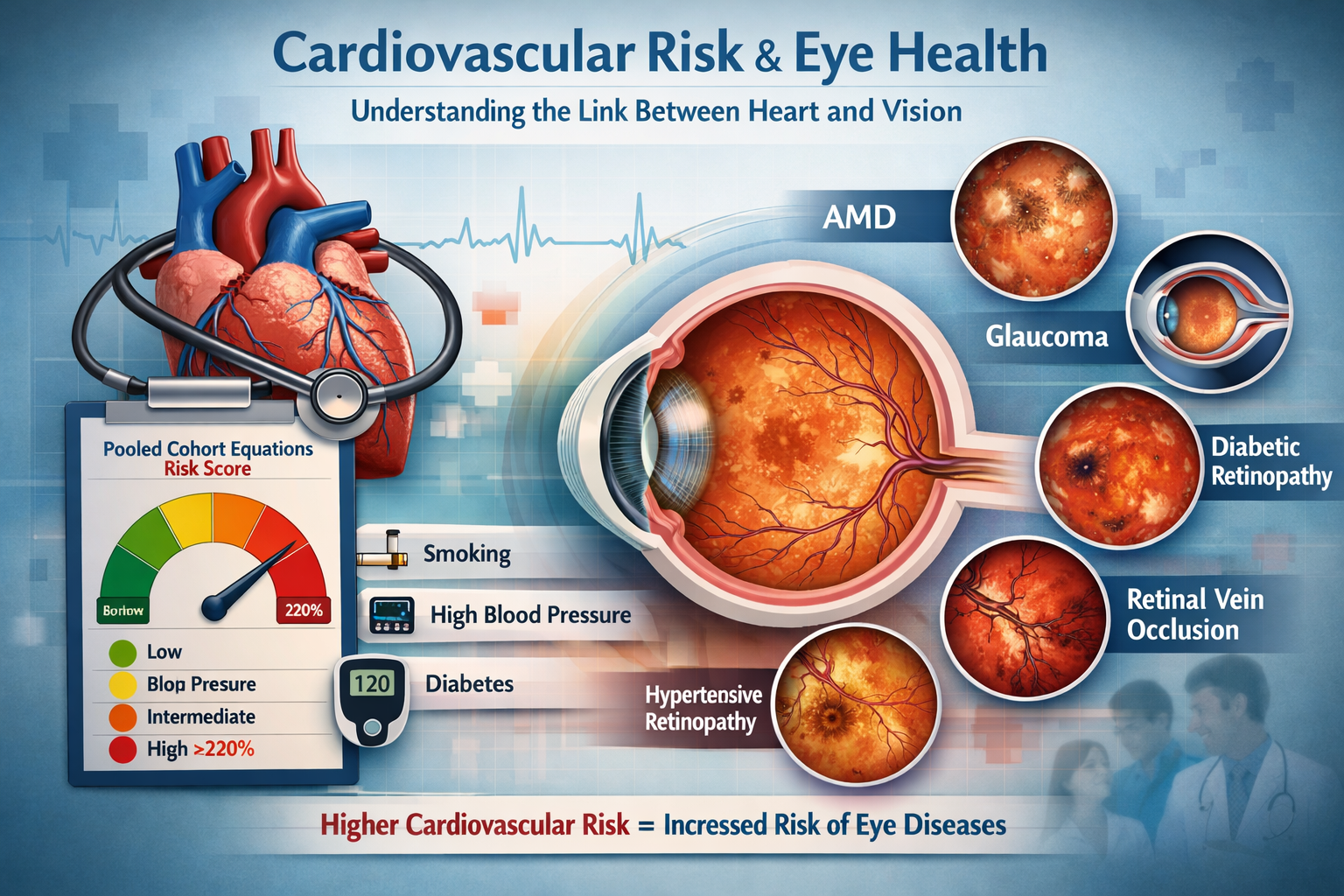
Cardiovascular Risk Scores and Eye Health: Understanding the Link Between Heart and Vision
Eye health is often considered separately from cardiovascular health, but emerging research suggests that the two are closely connected. A recent prospective cohort study explored how cardiovascular risk, measured through the Pooled Cohort Equations (PCE) risk score, correlates with the incidence of several major ocular diseases. This study provides valuable insights for both primary care providers and ophthalmologists, highlighting the potential for cardiovascular risk metrics to inform eye care strategies.
What Are the Pooled Cohort Equations?
The Pooled Cohort Equations were developed to estimate the 10-year risk of atherosclerotic cardiovascular disease (ASCVD). This composite risk score uses factors such as age, sex, cholesterol levels, blood pressure, smoking status, and diabetes to predict the likelihood of future cardiovascular events. Clinicians frequently use PCE in primary care to guide preventive strategies, including lifestyle modification and medication management.
While the PCE score was designed for cardiovascular risk assessment, researchers hypothesized that it might also predict the risk of developing eye diseases that share common vascular and metabolic pathways.
The Study Design
The study utilized data from the All of Us (AoU) Research Program, which collects electronic health records from a diverse cohort of U.S. adults. The researchers included 35,909 participants aged 40 to 79 years who had complete PCE-related variables recorded between 2009 and 2015. Participants with pre-existing cardiovascular disease or any of the five target ocular diseases—age-related macular degeneration (AMD), glaucoma, diabetic retinopathy (DR), retinal vein occlusion (RVO), or hypertensive retinopathy (HTR)—were excluded to ensure a clean baseline.
Each participant's PCE score was calculated and categorized into four groups:
- Low risk: <5%
- Borderline risk: 5–7.4%
- Intermediate risk: 7.5–19.9%
- High risk: ≥20%
The study then tracked the incidence of ocular diseases over time, using Kaplan-Meier curves and Cox proportional hazards regression models. Researchers adjusted for race, body mass index, chronic kidney disease, and education to avoid over-adjusting the cardiovascular score itself.
Key Findings
The study revealed strong associations between higher PCE risk scores and future ocular disease. The results were striking:
- Participants in the high-risk PCE category had significantly higher chances of developing AMD, DR, glaucoma, RVO, and HTR compared to the low-risk group.
- Hazard ratios for the high-risk group were 6.22 for AMD, 5.93 for DR, 2.33 for glaucoma, 3.38 for RVO, and 4.47 for HTR. These findings were statistically significant with p-values less than 0.001.
- Adjusted concordance indices indicated moderate to high predictive accuracy: AMD (0.72), DR (0.751), HTR (0.768), glaucoma (0.625), and RVO (0.654).
- Sensitivity analyses confirmed the robustness of the associations across different follow-up durations of five, six, and seven years.
Interestingly, while age largely explained the relationship between PCE scores and AMD, associations with DR and HTR remained significant even after adjusting for individual PCE components. This suggests that cardiovascular risk influences some eye diseases independently of age.
Implications for Clinical Practice
These findings have important implications for healthcare providers:
- Early Identification of High-Risk Patients: By using PCE scores already calculated in primary care, clinicians can identify patients who are at higher risk for ocular diseases and refer them for timely ophthalmologic evaluations.
- Integration of Eye and Cardiovascular Care: The study supports the idea that eye health and cardiovascular health are interconnected. Shared risk factors such as hypertension, diabetes, and smoking contribute to both vascular complications and ocular disease.
- Targeted Preventive Strategies: High-risk patients could benefit from more aggressive lifestyle interventions, strict blood pressure and glucose control, and closer eye monitoring.
- Resource Allocation: Eye care resources are often limited. Risk stratification using PCE scores may help prioritize patients who need early intervention, potentially preventing severe vision loss.
Understanding the Ocular Diseases
To appreciate the significance of these findings, it helps to understand the ocular diseases studied:
- Age-related macular degeneration (AMD): A leading cause of vision loss in older adults, AMD affects the macula, the part of the retina responsible for sharp central vision. Risk factors include age, smoking, and cardiovascular disease.
- Diabetic retinopathy (DR): This complication of diabetes damages retinal blood vessels and can lead to blindness if untreated. Cardiovascular risk factors like hypertension and high cholesterol exacerbate its progression.
- Glaucoma: A group of diseases characterized by optic nerve damage, often associated with elevated intraocular pressure. Vascular health influences glaucoma progression, and systemic cardiovascular issues can worsen optic nerve damage.
- Retinal vein occlusion (RVO): A blockage of the veins carrying blood away from the retina, RVO can cause sudden vision loss. Risk factors include hypertension, diabetes, and hyperlipidemia.
- Hypertensive retinopathy (HTR): Chronic high blood pressure can damage retinal vessels, leading to vision impairment.
Why Cardiovascular Risk Matters for Eye Health
The eye and the cardiovascular system share several physiological pathways:
- Vascular Health: Healthy blood vessels are essential for retinal perfusion. Cardiovascular risk factors compromise endothelial function, leading to microvascular damage in the retina.
- Inflammation and Oxidative Stress: Chronic inflammation and oxidative stress, common in cardiovascular disease, contribute to retinal degeneration and vascular injury.
- Metabolic Dysregulation: Diabetes, dyslipidemia, and obesity not only affect the heart but also increase susceptibility to DR and other retinal complications.
By recognizing these overlapping mechanisms, clinicians can adopt a more holistic approach to patient care.
Future Directions
The study raises several questions and potential avenues for research:
- Integration of PCE in Ophthalmology: Could PCE scoring become a routine part of ophthalmology risk assessment? Prospective trials may evaluate whether using PCE to guide screening improves outcomes.
- Disease-Specific Predictive Models: While PCE shows predictive value, combining it with eye-specific factors such as intraocular pressure, retinal imaging, or genetic markers might improve accuracy.
- Health Disparities: The study adjusted for race and education, but broader research is needed to understand how social determinants of health affect both cardiovascular and eye disease risk.
- Interventional Studies: Future research could investigate whether aggressive cardiovascular risk reduction decreases the incidence or progression of ocular diseases.
Limitations
It is important to note the study’s limitations:
- The cohort was restricted to U.S. adults aged 40 to 79 years, which may limit generalizability to younger populations or other countries.
- The observational design cannot establish causality. High PCE scores may be associated with ocular disease risk, but interventions targeting PCE alone may not prevent all cases.
- Some factors, such as medication adherence or lifestyle changes during follow-up, were not fully captured in the electronic health record.
Despite these limitations, the study provides compelling evidence that cardiovascular risk assessment tools can serve a dual purpose in predicting eye disease.
Practical Takeaways
For patients and clinicians, the key takeaways are:
- Know Your Cardiovascular Risk: Calculating PCE scores helps identify patients at risk for both heart disease and eye disease.
- Regular Eye Exams Are Critical: High-risk individuals should undergo timely screening for AMD, DR, glaucoma, RVO, and HTR.
- Lifestyle Modification Matters: Controlling blood pressure, cholesterol, and blood sugar, and avoiding smoking, benefits both cardiovascular and ocular health.
- Interdisciplinary Care Is Beneficial: Collaboration between primary care physicians, cardiologists, and ophthalmologists can optimize patient outcomes.
Conclusion
The link between cardiovascular health and eye disease is stronger than previously recognized. This prospective cohort study demonstrates that the Pooled Cohort Equations, commonly used to estimate heart disease risk, can also predict future incidence of AMD, DR, glaucoma, RVO, and HTR. Using this information, healthcare providers can identify high-risk patients, implement preventive strategies, and integrate cardiovascular and ocular care.
As research continues, the hope is that tools like the PCE score will enable proactive interventions, preserving both vision and cardiovascular health in at-risk populations. Patients who are aware of their cardiovascular risk factors should discuss their eye health with their healthcare providers, ensuring that both heart and vision receive appropriate attention.
Source: Sun D, Tseng VL, Yu F, Coleman AL. Cardiovascular Risk and Eye Health: A Prospective Cohort Study of the Pooled Cohort Equations and Ocular Disease Incidence. Ophthalmology. 2025 Dec 29.
Disclaimer: This article is intended for educational purposes only and should not replace professional medical advice. Always consult a qualified healthcare provider for personalized guidance regarding cardiovascular or eye health.