
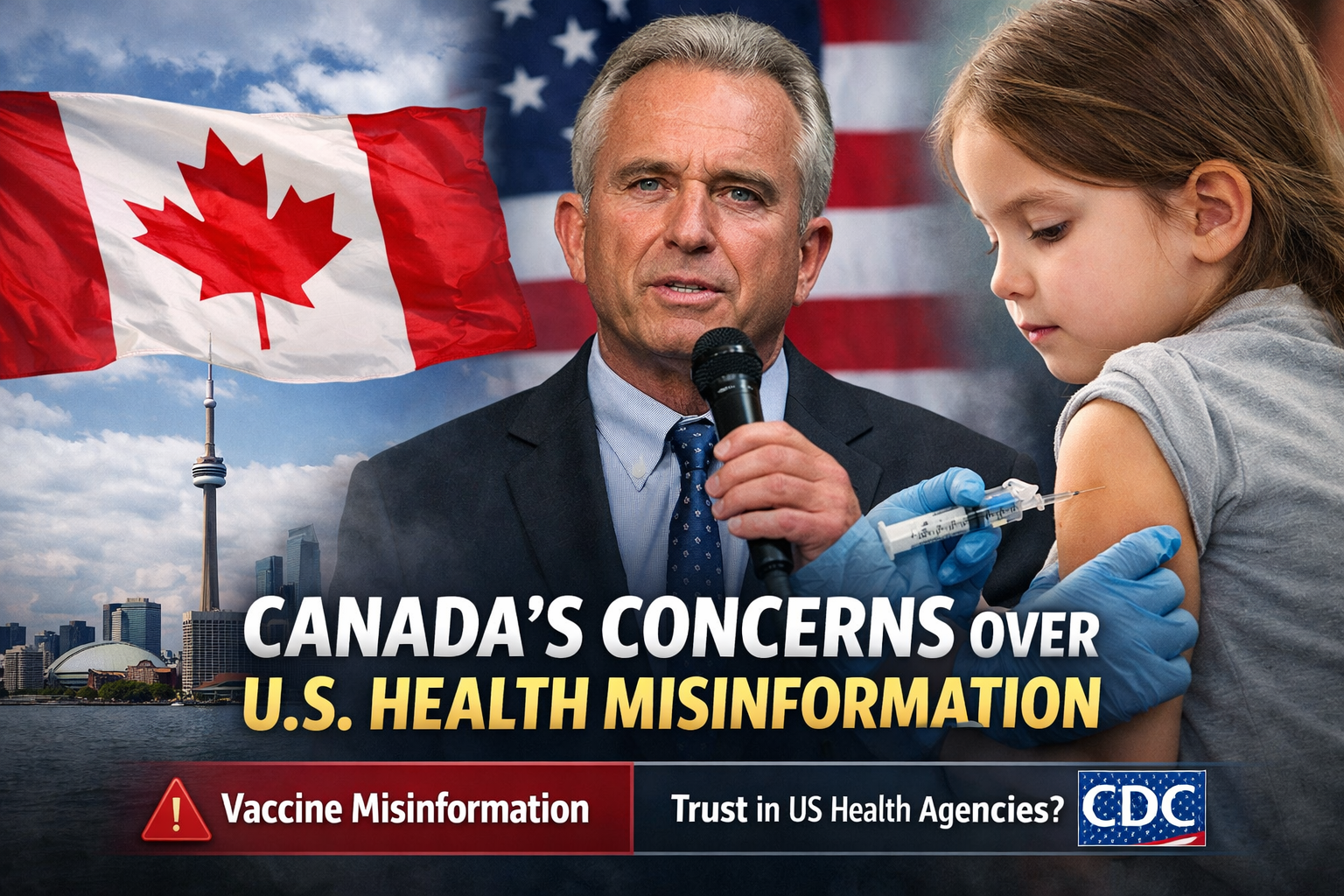
Canada Questions US Health Credibility as Vaccine Misinformation Raises Public Concern
Introduction
Public confidence in health institutions plays a decisive role in disease prevention, vaccination uptake, and overall social stability. When that confidence weakens, the consequences can ripple through communities and across borders. In recent months, Canadian public health officials and medical experts have raised serious concerns about the reliability of health information originating from the United States. These concerns stem from policy decisions, messaging shifts, and controversial leadership choices within US health agencies.
Canada’s warning is not theoretical. It comes at a time when the country is grappling with rising vaccine hesitancy, widespread misinformation, and the loss of its measles elimination status. As misinformation increasingly crosses borders through digital platforms, Canadian officials argue that shifts in US health guidance risk undermining public trust at home.
This article examines why Canada is distancing itself from US health institutions, how vaccine misinformation is influencing Canadian attitudes, what the data shows about declining confidence, and why experts believe the problem extends beyond foreign influence.
A Breakdown in Cross Border Health Trust
For decades, Canadian public health authorities have relied on close cooperation with US institutions such as the Centers for Disease Control and Prevention. These agencies were widely regarded as global leaders in epidemiology, disease surveillance, and vaccine guidance. That trust has weakened significantly.
Canada’s federal health minister, Marjorie Michel, stated publicly that US health and science institutions can no longer be considered dependable sources of accurate information. Her comments reflect growing concern among policymakers that recent US health decisions conflict with established scientific consensus.
The shift is particularly alarming because US health agencies continue to hold global influence. Their recommendations shape international media narratives, public debate, and online discourse. Canadian officials warn that when these institutions promote uncertainty rather than clarity, the effects are felt well beyond US borders.
Vaccine Policy Changes Spark Alarm
Much of the concern centers on actions taken under US Health Secretary Robert F Kennedy Jr, who has long been associated with anti vaccine rhetoric. In late 2025, a panel appointed by Kennedy voted to remove a longstanding recommendation that all newborns be vaccinated against hepatitis B. The decision marked a significant departure from decades of public health policy.
Around the same time, the US Centers for Disease Control and Prevention updated its website to state that studies have not ruled out a link between infant vaccines and autism. This claim directly contradicts extensive scientific evidence and has been widely criticized by public health experts.
Canadian immunologists warn that such statements lend credibility to misinformation that has already been thoroughly debunked. Even when framed cautiously, these messages can reinforce fear and uncertainty among parents who lack consistent access to trusted healthcare providers.
Data Shows Rising Vaccine Hesitancy in Canada
Canada’s concern is supported by data. According to a national childhood immunization survey conducted by the Public Health Agency of Canada, 2.1 percent of Canadian children aged two had received no vaccinations in 2021, compared to 1.7 percent in 2019. While the increase appears modest, experts emphasize that even small declines can compromise herd immunity.
A Leger Healthcare survey conducted in December 2025 revealed additional troubling trends:
- 74 percent of Canadians report confidence in vaccines
- 26 percent express some level of hesitancy
- 17 percent of vaccine hesitant respondents said they rely on US government health websites for information
These findings highlight how US health messaging can directly influence Canadian public opinion.
Parents who refuse or delay vaccines most commonly cite safety concerns, distrust in government, and misinformation encountered online. Public health experts note that misinformation is no longer fringe. It has become embedded in mainstream digital spaces.
Measles Outbreak Underscores the Consequences
The implications of declining vaccine confidence became painfully clear in 2025. Canada reported more than 5,000 measles cases nationwide, leading to the loss of its measles elimination status. Ontario accounted for the majority of cases, making it the measles epicenter of the western hemisphere during that period.
The World Health Organization defines measles elimination as the absence of continuous transmission for at least 12 months. Losing this status signals systemic weaknesses in immunization coverage and public trust.
Physicians and epidemiologists point to multiple contributing factors, including reduced access to family doctors, delayed childhood vaccinations during the Covid pandemic, and widespread misinformation. The resurgence of a disease once considered under control demonstrates how quickly public health gains can be reversed.
The Role of Digital Information Gaps
Canada faces unique challenges in addressing misinformation due to changes in how news circulates online. Restrictions on news sharing across major social media platforms have limited the visibility of credible journalism and public health messaging.
When authoritative information becomes harder to access, misinformation spreads more easily. Health experts warn that social media algorithms often amplify emotionally charged content, regardless of accuracy. This environment allows misleading claims to circulate widely, especially when they appear to originate from official sources.
Dawn Bowdish, an immunologist at McMaster University, has emphasized that public health communication depends not only on scientific accuracy but also on reach and trust. When reliable voices are drowned out, even well designed vaccination campaigns lose effectiveness.
Can Canada Fill the Leadership Gap
Some experts believe the situation presents an opportunity for Canada to strengthen its own public health leadership. Kumanan Wilson, a physician and professor at the University of Ottawa, argues that Canada should invest more heavily in independent health surveillance systems and international collaboration beyond the United States.
By developing robust data infrastructure and partnering with health agencies worldwide, Canada could reduce its dependence on US institutions while contributing valuable insights to global health efforts. Such an approach would also help counter misinformation by providing clear, evidence based guidance rooted in Canadian data.
However, building this capacity requires sustained funding, political commitment, and public engagement. Without those elements, misinformation will continue to fill gaps in understanding.
A Homegrown Trust Problem
Not all experts agree that US influence is the primary driver of vaccine hesitancy in Canada. Michel Grignon, a health economist at McMaster University, argues that the roots of distrust are largely domestic.
Grignon points to decades of erosion in social safety nets, growing inequality, and declining institutional trust. The Covid pandemic intensified these issues, leaving many Canadians feeling marginalized and skeptical of authority. He notes that the 2022 protests against pandemic restrictions reflected a broader collapse of social cohesion.
From this perspective, foreign misinformation exploits vulnerabilities that already exist. Addressing vaccine hesitancy, Grignon argues, requires rebuilding trust in public institutions, improving access to care, and strengthening social support systems.
Rebuilding Vaccine Confidence
Restoring confidence in vaccines will require a multifaceted strategy. Public health experts emphasize the importance of:
- Improving access to primary care and family physicians
- Investing in transparent and empathetic public health communication
- Countering misinformation with clear, consistent messaging
- Engaging communities directly rather than relying solely on top down messaging
Trust is not rebuilt through mandates alone. It grows through dialogue, accountability, and visible commitment to public well being.
Canadian officials must also navigate a delicate balance. Publicly distancing from US health institutions may protect domestic trust, but it also risks politicizing health discourse further. Clear communication grounded in evidence will be critical.
Conclusion
Canada’s decision to question the credibility of US health institutions marks a significant shift in North American public health dynamics. Vaccine misinformation, amplified by controversial policy decisions and digital information gaps, poses a tangible threat to public confidence and disease prevention efforts.
At the same time, the crisis exposes deeper challenges within Canada itself. Declining trust, access barriers, and social fragmentation all contribute to vaccine hesitancy. Addressing these issues will require more than pointing outward.
The future of public health depends on trust. Whether Canada can rebuild and sustain that trust will shape its ability to protect communities against preventable diseases in the years ahead.
Sources
- The Guardian, January 4, 2026
- Public Health Agency of Canada
- Leger Healthcare Vaccine Confidence Survey
- World Health Organization
Disclaimer
This article is for informational purposes only and does not constitute medical or public health advice. Readers should consult qualified healthcare professionals and official government sources for guidance on vaccinations and health related decisions.