
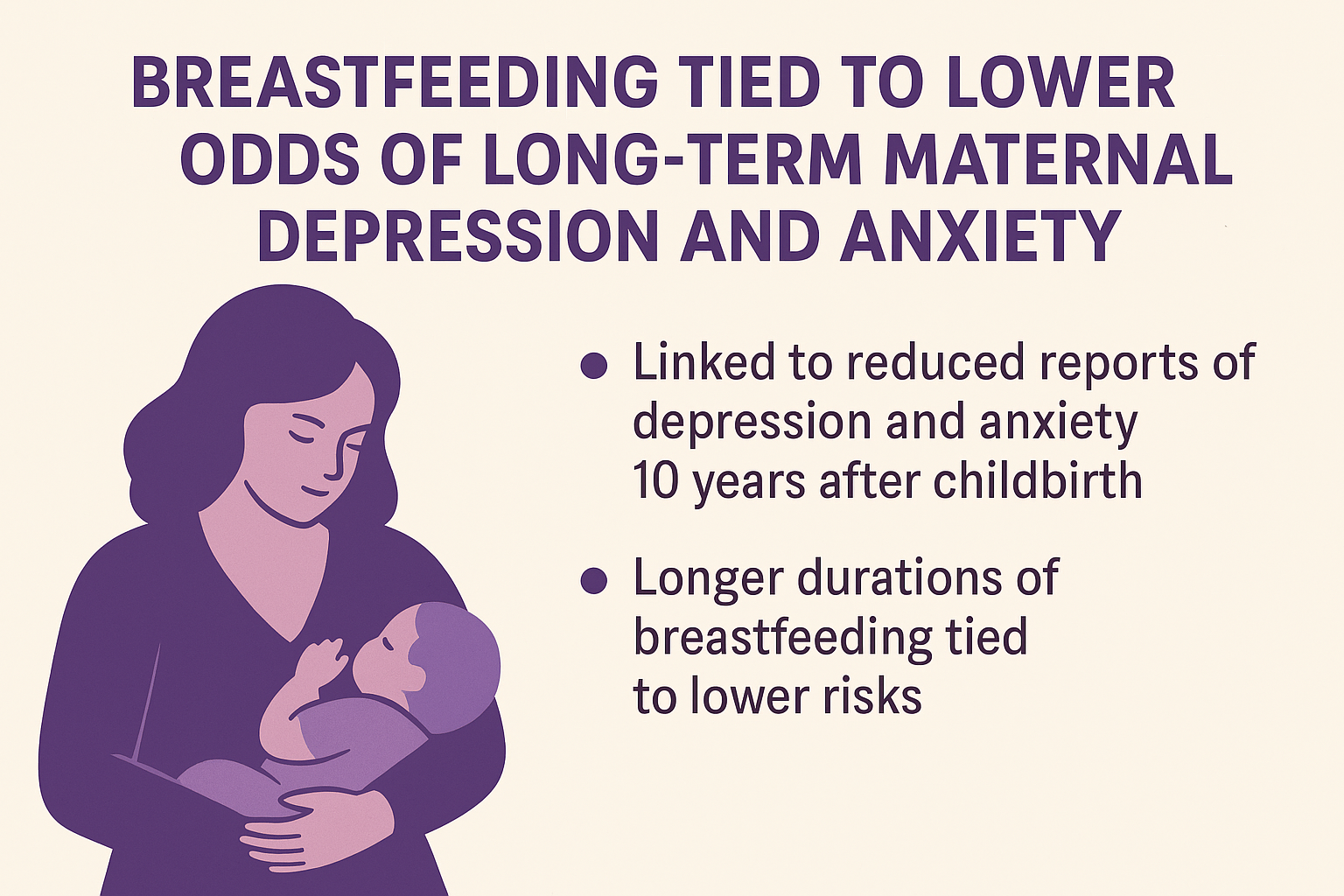
Breastfeeding Tied to Lower Odds of Long‑Term Maternal Depression and Anxiety: Insights from a Decade‑Long Irish Cohort
Breastfeeding may be associated with lower long‑term risk of maternal depression and anxiety. A 10‑year study from Ireland reports protective associations for any, exclusive, and cumulative breastfeeding duration. Learn what was found, why it matters, and what it means for families and policymakers. [bmjopen.bmj.com]
A 10‑year prospective study from Dublin followed 168 multiparous women and found that mothers who breastfed were less likely to report depression or anxiety both at the 10‑year follow‑up and across the entire study period. Longer exclusive breastfeeding and a cumulative breastfeeding history of at least 12 months were also linked with fewer reports of depression and anxiety. The findings are observational, so they show association rather than proof of cause. [bmjopen.bmj.com]
Why this study matters now
Maternal mental health challenges are common in the first year after birth. What has been less clear is whether choices and experiences in the early postpartum period are linked with emotional well‑being years later. The new BMJ Open paper fills an important gap by examining whether breastfeeding behaviors are associated with depression and anxiety up to a decade after pregnancy among women of later reproductive age. [bmjopen.bmj.com]
Study at a glance
Design and setting
Prospective longitudinal cohort research conducted in a tertiary maternity hospital in Dublin, part of the ROLO Longitudinal Cohort. Researchers collected lifetime breastfeeding history at the 10‑year visit and assessed self‑reported depression or anxiety at each study time point. [bmjopen.bmj.com]
Who participated
The analysis included 168 parous women who had data on lifetime breastfeeding and mental health at the 10‑year follow‑up. Average age at study end was 42.4 years. Nearly three quarters reported having breastfed at some point. [bmjopen.bmj.com]
What was measured
Four breastfeeding exposures were examined
- ever breastfed
- lifetime weeks of exclusive breastfeeding
- lifetime weeks of any breastfeeding
- cumulative lifetime breastfeeding of at least 12 months versus less than 12 months.
Outcomes were self‑reported physician diagnosis of depression or anxiety and use of antidepressant medication at the 10‑year time point and at any time during follow‑up. [bmjopen.bmj.com]
Key statistics reported
- 13.1 percent reported depression or anxiety at 10 years.
- 20.8 percent reported depression or anxiety at any time during the study.
- Ever breastfeeding was linked with lower odds of depression and anxiety at 10 years with an adjusted odds ratio of 0.34.
- Across the whole study period, ever breastfeeding, longer exclusive breastfeeding, and breastfeeding for 12 months or more were each associated with reduced odds of depression or anxiety. Each additional week of exclusive breastfeeding corresponded to a 2 percent lower likelihood. [bmjopen.bmj.com]
Independent institutional summaries also highlight these headline findings for a general audience.
What the results suggest
1) Ever breastfeeding and mental health
Mothers who reported any breastfeeding at all had lower odds of reporting depression or anxiety at the 10‑year assessment. This remained significant after adjusting for baseline differences and alcohol intake, suggesting the association is not explained only by those factors. [bmjopen.bmj.com]
2) Duration matters
Exclusive breastfeeding duration stood out. Each week of exclusive breastfeeding was associated with a small but measurable reduction in the odds of depression or anxiety across the decade of follow‑up. Cumulative breastfeeding of 12 months or more also aligned with fewer reports of depression and anxiety. [bmjopen.bmj.com]
3) The signal is consistent with prior knowledge
Previous research shows that breastfeeding is related to lower risk of postnatal depression in the first year after birth, especially when breastfeeding is exclusive. The new study echoes that pattern years later, broadening the time horizon under consideration. [bmjopen.bmj.com]
Important caveats
- Observational design
The authors are clear that the study cannot prove cause. Associations can be influenced by confounding and selection effects. For example, women with prior depression may be less likely to initiate or continue breastfeeding, which complicates interpretation. [bmjopen.bmj.com] - Sample size and representation
The cohort was relatively small and relatively homogeneous in ethnicity and education. That limits generalizability to more diverse populations or to first‑time mothers. [bmjopen.bmj.com] - Measurement approach
Depression and anxiety were captured through self‑report and medication lists rather than standardized diagnostic interviews at every time point. Recall bias and under‑reporting are possible, although maternal recall of breastfeeding duration has been shown to be reasonably accurate many years later. [bmjopen.bmj.com] - Temporal spacing
Follow‑ups were at several discrete time points over 10 years, not continuous monitoring, which may miss fluctuations between visits. [bmjopen.bmj.com]
Independent recaps by MedicalXpress and Irish Medical Times underscore these caveats and emphasize that the results should be read as signals for further research rather than proof of a causal effect.
Possible mechanisms behind the association
Although this study did not test mechanisms, it sits within a larger body of work that links lactation physiology and caregiving patterns with mood regulation:
- Oxytocin and bonding
Lactation stimulates oxytocin release, which is linked to reduced anxiety and enhanced mother‑infant bonding. Lower oxytocin in pregnancy has been associated with higher postpartum depressive symptoms, which could ripple forward in time. [bmjopen.bmj.com] - Stress axis modulation
Lactation may help stabilize hypothalamic pituitary adrenal axis activity, which could support resilience to stress. [bmjopen.bmj.com] - Behavioral and social pathways
Breastfeeding can embed daily routines, skin‑to‑skin contact, and social support interactions, all of which have potential mental health benefits. Conversely, pain or difficulties with breastfeeding can increase stress and might counteract benefits unless skilled support is available. The authors note bidirectional links between mood and breastfeeding success. [bmjopen.bmj.com]
What this means for parents and clinicians
Personalized, non‑judgmental support
The findings strengthen the case for offering high‑quality breastfeeding support as part of perinatal care, while honoring parental choice and circumstances. For families where breastfeeding is not possible or not desired, compassionate, evidence‑based mental health screening and support remain essential. The study does not imply that not breastfeeding causes depression or anxiety. Rather, it suggests breastfeeding may confer some protective association for some women. [bmjopen.bmj.com]
Screening and early intervention
Because pre‑existing depression or anxiety may reduce breastfeeding duration, proactive screening during pregnancy and in the early postpartum period can help identify those who would benefit from targeted support with feeding and mental health. [bmjopen.bmj.com]
Policy and systems implications
Investments in lactation services, parental leave, workplace accommodations, and equitable access to perinatal mental health care may deliver long‑term benefits for families and health systems. The BMJ Open paper and institutional summaries emphasize the potential for population‑level savings when breastfeeding support is improved. [bmjopen.bmj.com]
Practical tips for families considering breastfeeding
- Build your support team early
Engage with midwives, lactation consultants, peer support groups, and partners during pregnancy to set realistic plans and troubleshoot early. [bmjopen.bmj.com] - Focus on comfort and latch
Early attention to positioning, latch, and pain prevention can make continuation more achievable. Seek help promptly if feeding is painful or baby is not transferring milk well. [bmjopen.bmj.com] - Combine feeding goals with mental health goals
Add simple well‑being check‑ins to your routine. If symptoms of depression or anxiety arise, ask for help as soon as possible. Feeding choices should always be aligned with maternal health. [bmjopen.bmj.com] - Remember that every week counts
The study found a week‑by‑week association for exclusive breastfeeding and lower reported depression or anxiety across the decade. Any amount of breastfeeding may offer benefits, and mixed or partial breastfeeding can still be meaningful. [bmjopen.bmj.com]
Frequently asked questions
Does breastfeeding prevent depression and anxiety?
No. This research is observational. It shows associations, not proof that breastfeeding prevents mood disorders. Many factors shape mental health, including prior history, social support, sleep, trauma, and biology. [bmjopen.bmj.com]
What if I cannot or choose not to breastfeed?
You are not destined to experience poorer mental health. Effective treatments and supports exist. Feeding decisions should prioritize the health of both baby and parent. [bmjopen.bmj.com]
How long do I need to breastfeed to see a benefit?
There is no single threshold. The study reported that any breastfeeding was associated with lower odds at 10 years, and that each additional week of exclusive breastfeeding corresponded to a small reduction in reported depression or anxiety across the decade. Cumulative breastfeeding of 12 months or more was also associated with reduced odds across the study period. [bmjopen.bmj.com]
Is this relevant outside Ireland or among first‑time mothers?
Caution is warranted. The sample was relatively homogeneous and included multiparous women. More diverse and larger studies are needed to test generalizability. [bmjopen.bmj.com]
For researchers and policymakers
- Future research
Larger, diverse cohorts with validated diagnostic measures and more frequent follow‑ups could clarify pathways and moderators. Interventional trials that enhance breastfeeding support and track long‑term maternal mental health would be especially informative. [bmjopen.bmj.com] - Implementation science
Evaluations of comprehensive breastfeeding initiatives that include mental health components can quantify long‑term outcomes and economic impacts that institutional summaries already hint at.
Key takeaways for SEO readers
- A 10‑year Irish cohort study found that mothers who breastfed had lower odds of reporting depression or anxiety, both at 10 years and across the study period. Longer exclusive breastfeeding and a total of 12 months or more of breastfeeding were also linked with fewer reports. Association does not equal causation. [bmjopen.bmj.com]
- Mechanisms may include oxytocin‑related bonding, stress‑axis effects, and behavioral or social pathways. [bmjopen.bmj.com]
- The study supports offering robust, equitable breastfeeding support with integrated mental health screening, but it does not prescribe a single feeding choice for all families. [bmjopen.bmj.com]
How this study fits into the broader evidence
Systematic reviews have documented lower odds of postnatal depression among breastfeeding mothers, with stronger signals for exclusive breastfeeding. The new data extend the conversation into the longer term for women in their thirties and forties. Independent summaries from MedicalXpress and the Irish Medical Times further contextualize the results for non‑specialist audiences. [bmjopen.bmj.com]
Suggested internal links and keywords for on‑page SEO
Primary keywords
breastfeeding and maternal mental health, breastfeeding depression anxiety, long term effects of breastfeeding, exclusive breastfeeding benefits, ROLO longitudinal cohort study
Secondary keywords
postnatal depression, oxytocin and mood, perinatal mental health support, breastfeeding duration, lactation and stress response
Internal link ideas
- A practical guide to getting breastfeeding started in the first week
- Signs of postpartum depression and when to seek help
- Workplace policies that support breastfeeding continuity
How to talk about these findings with sensitivity
Responsible communication avoids implying that any single choice will prevent or cause depression or anxiety. Emphasize that the new study suggests potential long‑term benefits of breastfeeding for some women while also underscoring that healthy babies and healthy parents thrive in many feeding contexts. The right approach is the one that supports both infant nutrition and parental well‑being. [bmjopen.bmj.com]
Source
Primary study: McNestry C, O’Reilly SL, Twomey PJ, et al. Breastfeeding and later depression and anxiety in mothers in Ireland: a 10‑year prospective observational study. BMJ Open. 2026. Open access under CC BY 4.0. DOI: 10.1136/bmjopen‑2024‑097323. Available at BMJ Open. [bmjopen.bmj.com]
Disclaimer
This article provides general information and commentary for educational purposes only. It does not constitute medical advice. If you or someone you care for is experiencing symptoms of depression or anxiety, please contact a qualified health professional or your local support services. If you have questions about infant feeding or mental health treatment, consult your clinician who can offer personalized guidance based on your health history.