Atrial Septal Defect: Causes, Symptoms, Diagnosis, and Treatment
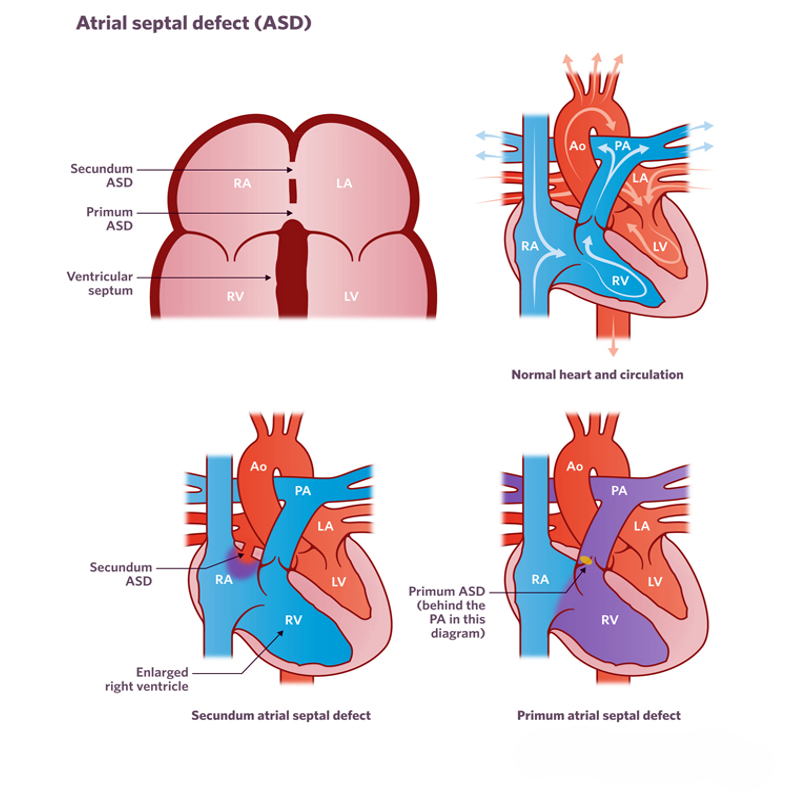
Atrial Septal Defect (ASD) is a congenital heart condition in which infants are born with a hole in the wall between the upper heart chambers. The wall that divides the upper heart chambers is called the atrial septum.
What are the types of ASD?
- Secundum: It is the most common type in which the hole is in the middle of the atrial septum.
- Primum: This type of ASD affects the lower part of the atrial septum and maybe present with other heart problems present at birth.
- Sinus Venosus: A rare type of ASD with the defect in the upper part of the atrial septum and often present with other heart structure changes present at birth.
- Coronary sinus: The coronary sinus is part of the vein system of the heart. In this rare type of ASD, part of the wall between the coronary sinus and the left upper heart chamber is missing. [1]
What causes ASD?
ASDs occur as singular defects but are associated with Mendelian inheritance, aneuploidy, transcription errors, mutations, and maternal exposures. ASDs are noted in patients with syndromes such as Down, Treacher-Collins, thrombocytopenia-absent radii, Turner, and Noonan. These conditions occur as a result of Mendelian inheritance.
Maternal exposure to rubella, substance abuse such as smoking cigarettes, cocaine and alcohol may also predispose the unborn foetus to developing an ASD.
What are the complications of ASD?
Small ASDs usually close spontaneously in childhood. Large defects that do not close on their own may require percutaneous or surgical intervention to prevent further complications, such as stroke, dysrhythmias, and pulmonary hypertension. [2]
What are the symptoms of ASD?
Sometimes a small ASD may go unnoticed for years, especially when there are no other heart defects present at birth. More severe cases of ASD may present with following symptoms:
- A rapid, pounding or fluttering heartbeat
- Difficulty breathing
- Frequent respiratory infections or a slow growth rate in children
- Shortness of breath when physically active
- Swollen legs and feet [3]
How is ASD diagnosed?
In addition to symptom history and physical examination, following tests can help diagnose ASD:
- Electrocardiogram (EKG): It can reveal blood flow abnormalities in coronary arteries and abnormal electrical activity in the heart.
- Chest X-ray: Can reveal enlarged heart chambers and if an atrial septal defect affected the blood vessels in your lungs.
- Transthoracic Echocardiogram (TTE): It shows how the left-to-right shunting of blood affects your heart and details related to pulmonary hypertension.
- Transoesophageal echocardiogram (TEE): This test shows the size, shape and location of an atrial septal defect. It can also check your heart valves.
- Intracardiac echocardiogram (ICE): The doctor sends a tiny camera to the heart via a vein to see the size and shape of the ASD and the direction of blood flow across it.
- In rare cases, a Cardiac CT or MRI may be required to get a clearer picture of other congenital conditions present with ASD.
What is the treatment for ASD?
Symptoms caused by a small ASD may be temporarily managed with medications, however medicines can`t close the hole. Providers may recommend an ASD closure if an atrial septal defect is causing issues and hasn’t closed by age 2 or 3.
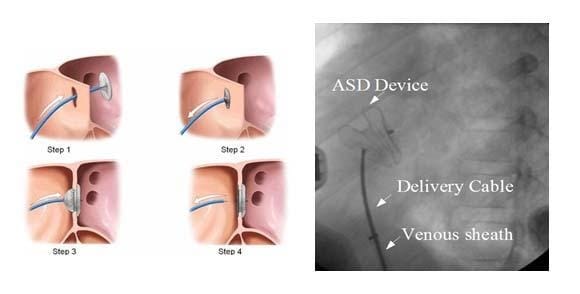
It is often recommended to get the ASD repaired early on, to prevent serious complications in the future, even for adults. Complications indicative of surgical repair include:
- The right side of your heart is bigger than normal
- There`s a significant flow of blood through the atrial septal defect
ASD closure can be performed either by percutaneous (nonsurgical) repair or by way of surgical repair through chest wall. [4]