
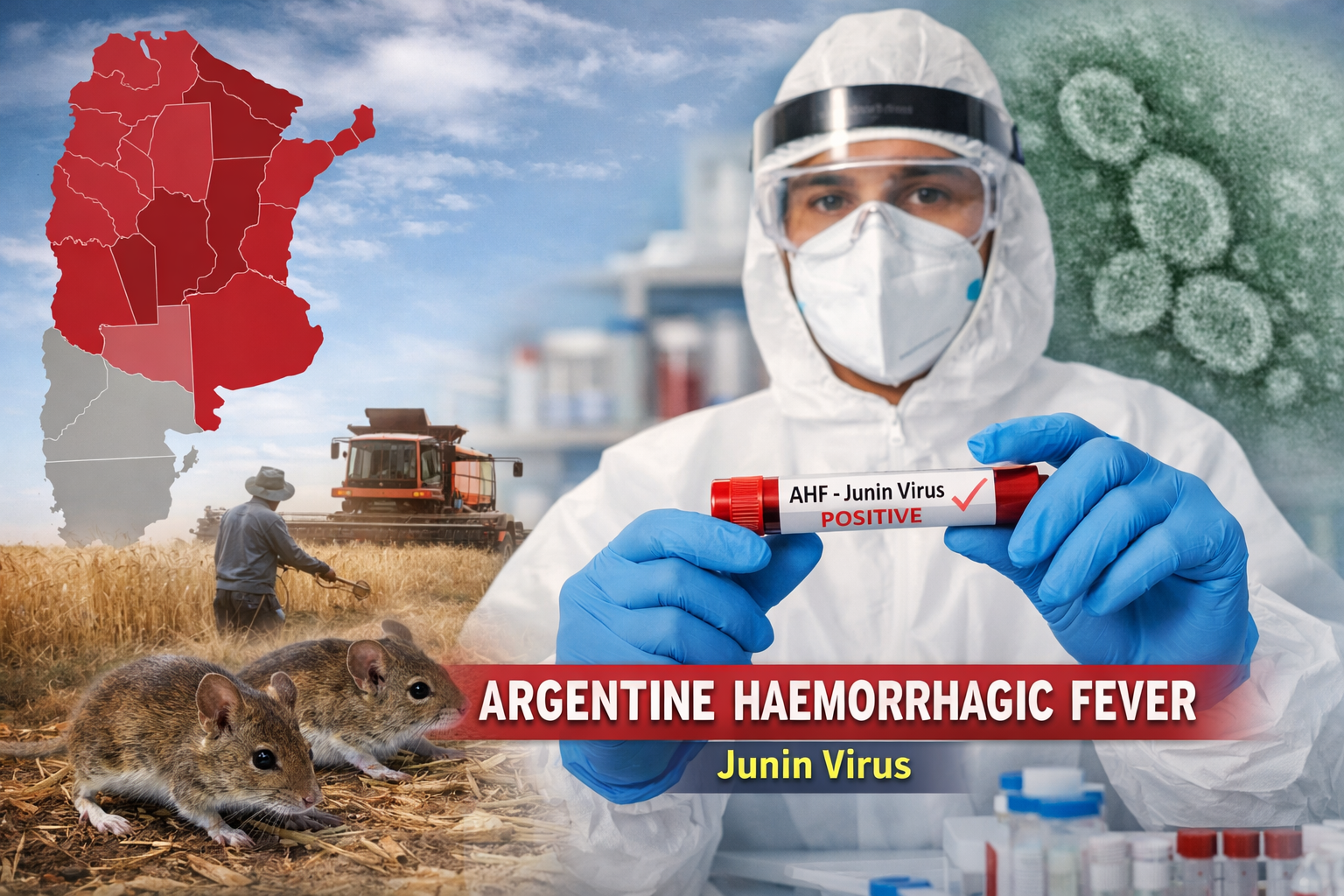
Argentine Haemorrhagic Fever in Argentina: Understanding the January 2026 Case and Its Public Health Significance
On 16 January 2026, media outlets in Argentina reported a confirmed case of Argentine haemorrhagic fever in Casilda Municipality, located in Santa Fe Province. The case was caused by the Junin virus, the pathogen responsible for Argentine haemorrhagic fever, often abbreviated as AHF. Local health authorities responded swiftly by initiating epidemiological investigations and implementing control measures aimed at limiting further transmission.
While Argentine haemorrhagic fever is not a new disease globally, the confirmation of a case outside the typical seasonal peak has drawn attention from public health professionals and the wider community. Understanding the disease, its transmission, and the context of this reported case is essential for assessing risk and reinforcing preparedness, both within Argentina and internationally.
What Is Argentine Haemorrhagic Fever?
Argentine haemorrhagic fever is a viral zoonotic disease caused by the Junin virus, a member of the Arenaviridae family. The disease was first identified in the 1950s in Argentina and has since been recognized as an endemic illness in specific regions of the country. AHF is classified as a viral haemorrhagic fever, a group of illnesses that can cause severe multisystem disease and, in some cases, life threatening complications.
The Junin virus primarily affects rural populations, particularly agricultural workers, due to its close association with rodent reservoirs found in farming environments. Without appropriate medical care, Argentine haemorrhagic fever can have a high case fatality rate, although outcomes have improved significantly with early diagnosis and treatment.
Geographic Distribution and Endemic Areas
Argentine haemorrhagic fever is endemic in central Argentina, particularly in the provinces of Buenos Aires, Cordoba, Santa Fe, and La Pampa. These regions collectively form what is often referred to as the AHF endemic zone. The virus persists in nature through its rodent hosts, which are widely distributed across these agricultural areas.
Santa Fe Province, where the January 2026 case was reported, is a known endemic region. Casilda Municipality lies within an area characterized by intensive farming activity, which increases the likelihood of human contact with infected rodents or contaminated environments.
Reservoirs and Natural Hosts
The primary reservoir of the Junin virus is the drylands vesper mouse, scientifically known as Calomys musculinus. These rodents can carry the virus without showing signs of illness and shed it through urine, feces, and saliva. Human infection occurs when people inhale aerosolized particles contaminated with the virus or come into direct contact with infected materials.
Rodent populations tend to increase during certain times of the year, particularly when food is abundant following agricultural cycles. This ecological dynamic plays a key role in shaping the seasonal pattern of Argentine haemorrhagic fever.
Transmission to Humans
Human transmission of Argentine haemorrhagic fever occurs mainly through environmental exposure rather than direct person to person spread. Common routes of infection include inhalation of dust contaminated with rodent excreta, handling of contaminated agricultural products, and contact with surfaces where infected rodents have been present.
Limited person to person transmission has been reported in rare circumstances, typically in healthcare settings involving close contact with bodily fluids. However, this is not considered a primary driver of outbreaks. As a result, standard infection prevention and control measures are generally effective in preventing secondary cases in clinical environments.
Seasonal Patterns and Agricultural Links
Most cases of Argentine haemorrhagic fever are reported during the harvest season in Argentina, which usually spans from April to July. During this period, agricultural activities intensify, increasing human exposure to dust, grain, and rodent habitats. The seasonal surge in cases has been well documented over decades of surveillance.
The reporting of a confirmed case in January, which falls outside the typical peak season, does not necessarily indicate a change in disease behavior. Sporadic cases can occur year round, particularly in endemic regions. However, off season cases often prompt closer epidemiological scrutiny to rule out unusual exposure patterns or localized increases in rodent populations.
Clinical Features and Disease Progression
Argentine haemorrhagic fever typically begins with nonspecific symptoms, which can make early diagnosis challenging. Initial signs often include fever, fatigue, headache, muscle aches, and loss of appetite. Gastrointestinal symptoms such as nausea and abdominal pain may also occur.
As the disease progresses, patients may develop more severe manifestations, including bleeding from the gums or nose, low blood pressure, neurological symptoms such as tremors or confusion, and in some cases shock. Without treatment, the disease can be fatal, with historical fatality rates reaching up to 30 percent.
Diagnosis and Treatment
Early diagnosis is critical for improving outcomes in Argentine haemorrhagic fever. Laboratory confirmation is usually achieved through molecular testing or serological assays performed in specialized reference laboratories due to the need for high biosafety standards.
The most effective treatment for AHF is the administration of immune plasma obtained from recovered patients. When given early in the course of the disease, this therapy significantly reduces mortality. Supportive care, including fluid management and monitoring for complications, is also essential.
Public Health Response to the January 2026 Case
Following the confirmation of the case in Casilda Municipality on 16 January 2026, local health authorities in Santa Fe Province initiated epidemiological investigations. These measures typically include identifying and monitoring close contacts, assessing potential exposure sites, and reinforcing rodent control and environmental hygiene efforts.
Public health messaging is also a critical component of the response. Authorities often advise residents in affected areas on preventive measures such as proper food storage, reducing rodent habitats around homes and farms, and using protective equipment during agricultural work.
Vaccination and Prevention Strategies
Argentina has developed a live attenuated vaccine known as Candid 1, which has been used successfully in high risk populations within endemic regions. The vaccine has significantly reduced the incidence of Argentine haemorrhagic fever among vaccinated agricultural workers.
Preventive strategies also emphasize environmental management, including rodent control programs and safe agricultural practices. Education campaigns targeting rural communities play an important role in reducing exposure risk.
International Perspective and Risk to the United Kingdom
There have been no known cases of Argentine haemorrhagic fever reported in the United Kingdom to date. The risk of importation remains very low due to the disease’s limited geographic distribution and the absence of sustained human to human transmission.
Nevertheless, UK health authorities maintain guidance for the assessment and management of viral haemorrhagic fevers. Travelers returning from endemic areas who develop symptoms consistent with AHF are advised to seek medical care promptly and inform healthcare providers of their travel history.
Clinical Guidance and Preparedness
In the United Kingdom and other non endemic countries, clinicians rely on established viral haemorrhagic fever algorithms to assess potential cases. These frameworks help determine risk based on travel history, exposure, and clinical presentation, and guide appropriate infection control measures.
Resources such as the Advisory Committee on Dangerous Pathogens guidance and the National Travel Health Network and Centre country information pages support clinicians and public health professionals in managing potential cases safely and effectively.
Looking Ahead
The confirmation of an Argentine haemorrhagic fever case in January 2026 serves as a reminder of the ongoing presence of endemic zoonotic diseases and the importance of sustained surveillance. While the situation does not currently suggest an increased public health threat beyond the affected area, vigilance remains essential.
Continued investment in vaccination programs, rodent control, public education, and laboratory capacity will be key to maintaining control over Argentine haemorrhagic fever. Collaboration between local, national, and international health authorities also plays a vital role in ensuring timely information sharing and effective response.
Sources
World Health Organization. Viral haemorrhagic fevers overview and fact sheets.
Pan American Health Organization. Argentine haemorrhagic fever epidemiology and control.
UK Health Security Agency. Advisory Committee on Dangerous Pathogens guidance on viral haemorrhagic fevers.
NaTHNaC. Country information page for Argentina.
Argentine Ministry of Health. Argentine haemorrhagic fever surveillance and vaccination information.
Disclaimer
This blog article is intended for informational and educational purposes only. It does not constitute medical advice, diagnosis, or treatment. Readers should seek guidance from qualified healthcare professionals or public health authorities for medical concerns or disease management. Information is based on publicly available data as of January 2026 and may be subject to change as new evidence emerges.