
Anthropic Launches Claude for Healthcare and Life Sciences to Rival OpenAI
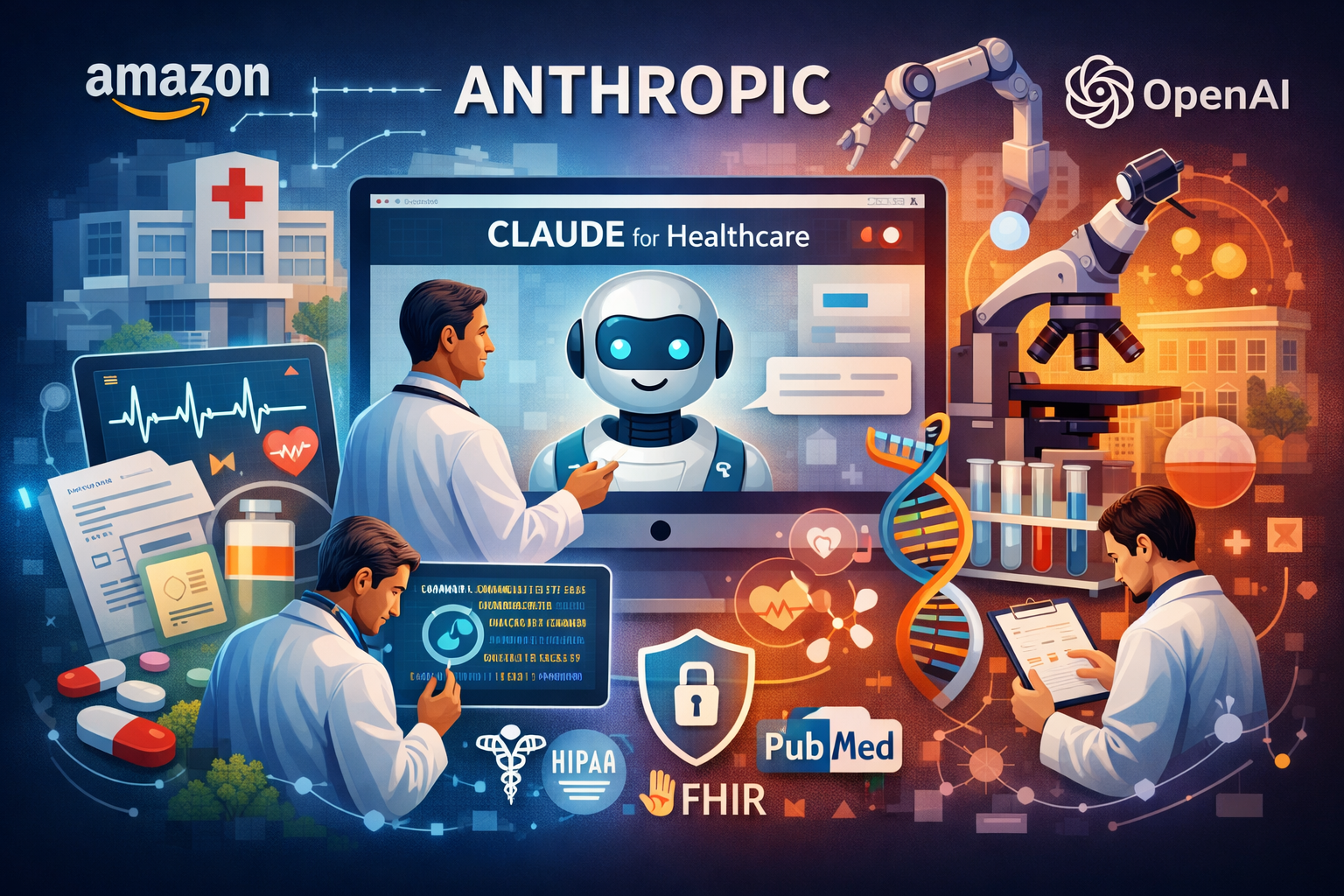
In a bold move that could reshape the future of artificial intelligence in medicine and biotechnology, Amazon‑backed Anthropic has introduced Claude for Healthcare, a new suite of AI tools designed specifically for hospitals, insurers, clinicians, researchers, and patients. The new product suite expands Claude’s capabilities beyond general AI tasks into high‑stakes clinical and scientific environments, putting Anthropic directly in competition with rivals like OpenAI, which recently unveiled its own medical AI offering. The launch underscores a growing trend in the artificial intelligence industry where healthcare and life sciences are viewed as one of the most compelling markets for large language models (LLMs).
What Is Claude for Healthcare and Why It Matters
Claude for Healthcare is a HIPAA‑ready AI platform that allows healthcare organisations and providers to use generative AI for medical and administrative workflows while maintaining compliance with patient privacy regulations. Health data in the United States is protected under the Health Insurance Portability and Accountability Act, and any AI product that accesses or processes sensitive patient information must operate within strict rules. Anthropic has designed Claude for Healthcare to be compliant with those requirements, supporting real medical use cases without introducing new privacy risks.
In addition to enterprise offerings for hospitals and clinics, the product includes features that help patients engage with their medical records in more meaningful ways. Users can integrate personal health data from platforms like Apple Health, Function Health, and Android Health Connect directly into Claude, enabling personalised insights and support for preparing for clinical visits. Claude can summarise medical history, explain lab results, help identify patterns in health data, and answer questions in plain language grounded in the user’s own health records. Data privacy rights are retained by users and Anthropic states that personal health data will not be used for ongoing model training.
Bigger Picture: AI in Healthcare
The healthcare industry is often seen as one of the most complex and data‑intensive sectors, with enormous potential for efficiency improvements through AI. Traditional clinical workflows involve time‑consuming tasks such as prior authorisations, claims processing, medical coding, and coordination across providers. Long hours of administrative work can take clinicians away from patient care, reducing productivity and increasing burnout.
AI tools like Claude for Healthcare aim to reduce some of this burden by automating or supporting complex tasks. For example, Claude can access trusted medical databases such as the Centers for Medicare & Medicaid Services (CMS) Coverage Database, the International Classification of Diseases ICD‑10 code system for diagnoses and procedures, and the National Provider Identifier Registry to verify clinicians and facilities. By pulling critical information together in a single place, Claude can generate summaries, assist with medical coding, and support prior authorisation decisions, improving efficiency in real clinical environments.
These capabilities matter because US healthcare workflows involve constant exchange of complex data between payers, providers, and patients. Claude’s integrations make information easier to access and interpret, helping clinicians focus on care rather than paperwork. AI assistance can reduce administrative overhead and allow healthcare systems to use technology in ways that can lead to better outcomes.
How Claude for Healthcare Compares to Other AI Healthcare Tools
Anthropic’s entry into healthcare comes at a moment when other AI companies are also prioritising medical applications. Recently, OpenAI unveiled ChatGPT Health, a specialised offering designed to help clinicians and patients with health‑related questions and documentation, and secure access to health records. Both Anthropic and OpenAI are racing to bring their generative AI platforms into regulated medical environments, where customer demand is high and the potential impact is significant.
OpenAI’s approach for ChatGPT Health focuses on helping clinicians with documentation tasks, evidence synthesis, and operational workflows like prior authorisations. Claude for Healthcare overlaps with some of these use cases, but also emphasises enterprise readiness through HIPAA compliance, native database integrations, and tools designed for complex clinical and administrative tasks. It also includes connectors that work with modern healthcare data exchange standards like FHIR (Fast Healthcare Interoperability Resources), which allows seamless sharing of patient information across platforms and systems.
The competition between Anthropic and OpenAI will likely intensify as both companies refine their healthcare AI products and expand adoption among providers, pharmaceutical companies, and insurers. Organisations are increasingly evaluating not just AI accuracy but also privacy, security, and ease of integration with existing systems. In this environment, strong compliance frameworks and direct access to medical data sources are key differentiators among competing solutions.
Life Sciences Expansion: Claude for Clinical Trials and Research Support
Anthropic is not stopping at healthcare delivery. The company is also expanding Claude’s role in life sciences, where AI is poised to accelerate scientific discovery and streamline drug development. Clinical trials remain one of the most time‑intensive and expensive parts of bringing new therapies to market. AI can help design protocols, support site recruitment, assist with regulatory submissions, and monitor trial progress by analysing data and generating insights.
To support these workflows, Anthropic has developed connectors that link Claude with life sciences platforms like Medidata, a leading clinical trial data provider, and ClinicalTrials.gov, the official US registry of ongoing clinical research studies. Claude’s integration with research repositories such as bioRxiv and medRxiv allows it to access the latest preprint research, giving scientists timely insight into emerging discoveries before formal publication. Other connectors include tools like Open Targets, which supports identification of drug targets, and established scientific resources like Benchling and PubMed.
By integrating with these systems, Claude becomes a valuable partner for researchers working at different points in the scientific process. AI‑driven tools can help automate drafting of clinical trial protocols, compare scientific approaches, identify regulatory considerations, and assist teams in preparing submissions that meet agency requirements. These tasks often require meticulous attention to detail and extensive domain knowledge. Claude’s ability to summarise, generate drafts, and interpret complex information can save significant time for scientists and regulatory professionals. (Anthropic)
Partnerships and Enterprise Adoption
The healthcare and life sciences rollout builds on Anthropic’s existing partnerships and collaborations with major organisations. Early adopters and collaborators include healthcare systems such as Banner Health, research and pharmaceutical companies like Sanofi, Novo Nordisk and pharmaceutical technology vendors like Veeva Systems. Some implementations are aimed at large enterprises looking to apply AI at scale for clinical and administrative use cases.
In parallel, Claude’s integrations into cloud platforms such as Amazon Web Services (AWS) Bedrock and Microsoft Foundry allow enterprises to deploy the AI in environments they already trust. AWS’s investment and deepening collaboration with Anthropic have made cloud infrastructure a key part of Claude’s deployment strategy, while partnerships with systems integrators help organisations adopt AI tools that match their needs. (About Amazon)
Partnerships with consumer health platforms like HealthEx enable patient users to connect their personal medical records with Claude using secure credentials. This empowers individuals to use generative AI to understand their health outside of clinical visits, prepare meaningful questions, and get clear explanations of complex medical information. Privacy protections are central to these offerings, with user control over what data is shared and clear opt‑in mechanisms.
Challenges and Ethical Considerations
The deployment of AI in healthcare and life sciences comes with unique challenges. Accuracy, reliability and regulatory compliance cannot be taken for granted when dealing with sensitive patient data and life‑critical decisions. There are concerns among clinicians and privacy advocates about how AI systems process and store personal health information, especially when consumer access is broadened. Anthropic has stated that medical records integrated with Claude will not be used for training future versions of the model, a claim that addresses some privacy worries but still invites scrutiny and demand for independent audits.
Another challenge is mitigating AI hallucinations, where models produce confident but incorrect answers. In healthcare, even small errors can have major consequences, which is why robust safety, testing, and human oversight remain essential. Claude’s design includes improved capabilities to acknowledge uncertainty and recommend human verification when needed. These safety features are part of Anthropic’s broader approach to responsible AI, drawing on evaluations and enhancements made to the underlying model family. (Anthropic)
What This Means for the Future
Anthropic’s launch of Claude for Healthcare and expanded life sciences tools marks a significant milestone in the adoption of generative AI in regulated industries. The product suite brings together advanced language models, direct access to medical and scientific data sources, and enterprise‑grade privacy frameworks. As healthcare systems, insurers, and research organisations seek ways to improve efficiency and accelerate discovery, tools like Claude are positioned to play a transformative role.
Competition with OpenAI and others will likely push innovation further, benefiting patients, clinicians, and researchers alike. As AI continues to evolve, it will be critical for developers, regulators, and healthcare professionals to work together to ensure these tools deliver value safely and ethically. With Claude now part of the healthcare and life sciences landscape, the future of AI‑assisted medicine looks more tangible than ever.