
Airline Drinking Water Safety in 2026: Why Passengers Should Think Twice Before Ordering Coffee or Tea
Air travel is often associated with convenience, speed, and comfort. However, a new 2026 airline water safety study raises serious concerns about something most passengers rarely question: the safety of drinking water on airplanes. From coffee and tea to handwashing water in airplane bathrooms, onboard water systems may not always meet federal safety standards.
According to recent findings published via HealthDay and reviewed by Drugs.com, airline drinking water quality varies significantly across carriers. The study reveals that several major and regional airlines continue to fall short of compliance with regulations designed to protect public health. For travelers, this information is especially important as millions of people fly every day and routinely consume beverages prepared with onboard water.
This article breaks down the key findings of the 2026 airline water study, explains why airline water safety matters, highlights which airlines performed best and worst, and offers practical tips for passengers who want to reduce health risks while flying.
Overview of the 2026 Airline Water Safety Study
The study was conducted by the Center for Food as Medicine and Longevity, an organization focused on public health and safety. Researchers analyzed airline water testing data collected over a three year period, from October 1, 2022, through September 30, 2025.
A total of 21 airlines were evaluated, including 10 major airlines and 11 regional carriers operating within the United States. Each airline received a Water Safety Score ranging from 0.00 to 5.00. Higher scores reflected stronger compliance with safety standards and better overall water quality.
Airlines that earned a score of 3.5 or higher received a Grade A or B, indicating relatively safe onboard drinking water. Scores below that threshold suggested ongoing safety concerns and regulatory issues.
Why Airline Drinking Water Safety Matters
Most passengers assume that water served on airplanes is safe. Unfortunately, the reality is more complicated. Aircraft water systems are complex and vulnerable to contamination due to several factors, including infrequent cleaning, inconsistent testing, and exposure to multiple water sources.
Airplane water tanks are filled from a variety of locations, including domestic and international airports. The quality of water can be affected by hoses, trucks, storage tanks, and ground handling equipment. If any part of this chain is contaminated, bacteria can enter the aircraft water system.
The presence of coliform bacteria is particularly concerning. While coliform bacteria are not always harmful on their own, they serve as an indicator that disease causing organisms may also be present. In some cases, water samples also tested positive for E. coli, which can lead to gastrointestinal illness and more serious infections.
For passengers with weakened immune systems, older adults, children, and pregnant individuals, contaminated water poses an even greater risk.
Federal Rules Governing Aircraft Drinking Water
The Aircraft Drinking Water Rule, also known as ADWR, has been in effect since 2011. This regulation requires airlines to provide safe drinking water for passengers and crew.
Under the rule, airlines must:
- Regularly test aircraft water systems for coliform bacteria
- Monitor for potential E. coli contamination
- Disinfect and flush onboard water tanks multiple times per year
- Issue public notices when violations occur
- Take corrective actions such as retesting or shutting down affected systems
Despite these requirements, enforcement has been inconsistent. According to the study, civil penalties for airline water safety violations remain extremely rare.
How Airlines Were Scored
Researchers evaluated airlines using five weighted factors designed to reflect real world water safety performance. These included:
- Number of violations per aircraft
- Maximum Contaminant Level violations for E. coli
- Percentage of coliform positive test results
- Issuance of public notices
- Frequency of water system disinfection and flushing
Across all airlines studied, 35,674 water sample locations were tested for coliform bacteria. Out of these samples, 949 tested positive, representing approximately 2.7 percent.
The most damaging factor for airline scores was the presence of E. coli. A total of 32 E. coli violations were identified across the 21 airlines included in the study.
Airlines With the Safest Drinking Water in 2026
Some airlines performed well and demonstrated strong compliance with federal safety standards.
Top Performing Major Airlines
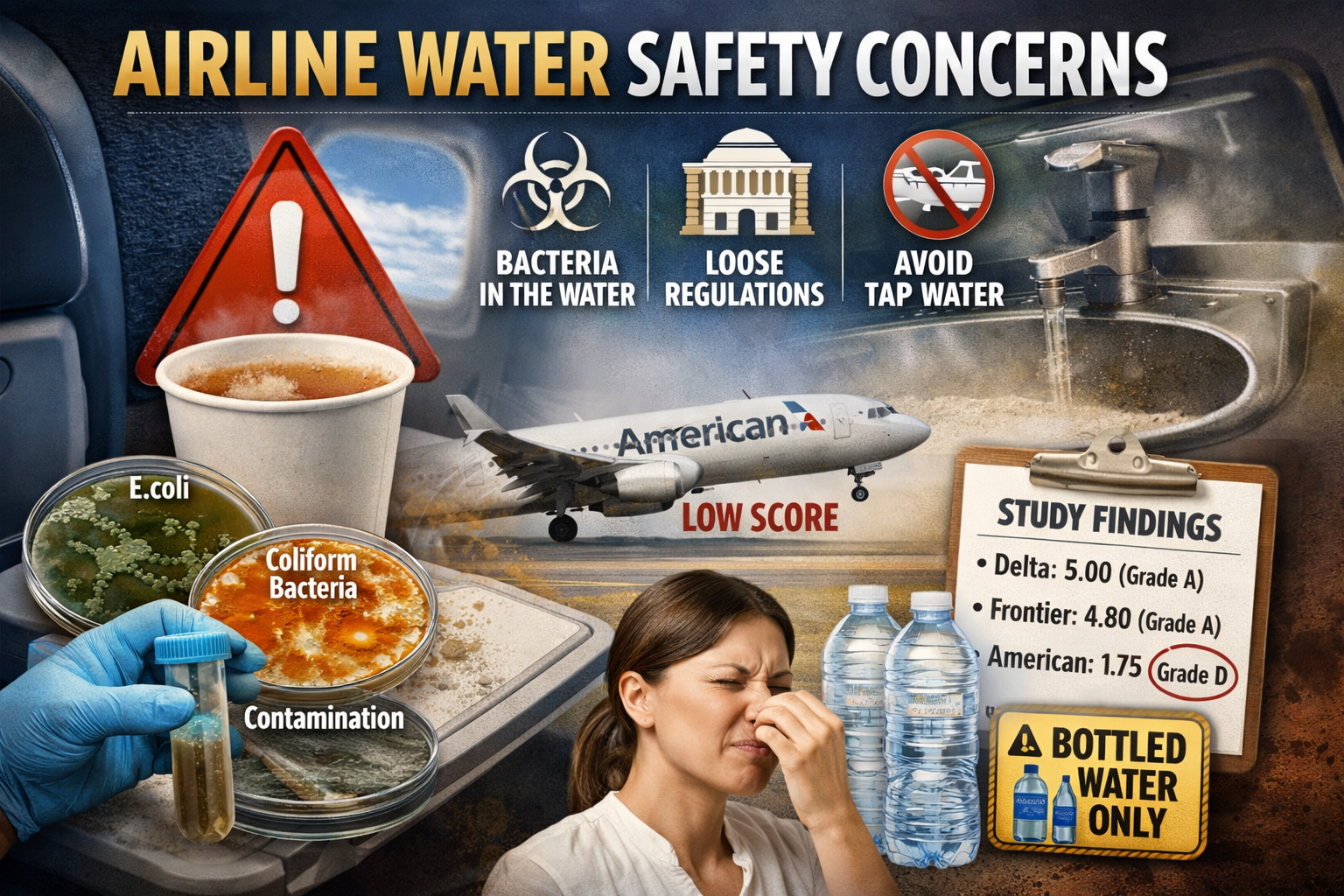
- Delta Air Lines earned a perfect score of 5.00 and received a Grade A, ranking first overall.
- Frontier Airlines followed closely with a score of 4.80 and also received a Grade A.
- Alaska Airlines ranked third among major carriers with a score of 3.85, earning a Grade B.
These airlines showed consistent testing, fewer violations, and better maintenance of onboard water systems.
Best Regional Airline
- GoJet Airlines stood out among regional carriers, earning a score of 3.85 and a Grade B.
Researchers noted that GoJet was the only regional airline that demonstrated relatively strong water safety practices compared to its peers.
Airlines With the Lowest Water Safety Scores
Unfortunately, several airlines scored poorly, highlighting persistent safety issues.
Lowest Scoring Major Airlines
- American Airlines ranked lowest among major carriers with a score of 1.75, earning a Grade D.
- JetBlue also scored poorly, placing near the bottom among major airlines.
Lowest Scoring Regional Airlines
- Mesa Airlines received the lowest score overall at 1.35, earning a Grade F.
- CommuteAir recorded a coliform positive rate of 33.33 percent, one of the highest in the study.
Researchers emphasized that nearly all regional airlines need to significantly improve their onboard water safety practices.
Regulatory Oversight and the EPA Criticism
The study issued a notable criticism toward the U.S. Environmental Protection Agency. The EPA shares responsibility for enforcing aircraft drinking water safety standards alongside other federal agencies.
The report awarded the EPA a symbolic "Shame on You" designation due to the lack of meaningful enforcement actions. Despite repeated violations, penalties against airlines are rare, reducing incentives for compliance.
Public health advocates argue that stronger enforcement and transparency are necessary to protect travelers and airline staff.
Health Risks Associated With Contaminated Airline Water
Drinking or using contaminated water can expose passengers to harmful bacteria. Potential health effects include:
- Diarrhea and stomach cramps
- Nausea and vomiting
- Fever
- Infections caused by E. coli or other pathogens
While healthy adults may recover quickly, vulnerable populations face higher risks. Even using contaminated water for brushing teeth or washing hands can increase exposure.
Practical Safety Tips for Airline Passengers
Until airline water systems show consistent improvement, experts recommend taking precautions while flying.
The Center for Food as Medicine and Longevity offers the following guidance:
- Never drink water onboard unless it comes from a sealed bottle
- Avoid coffee, tea, and other beverages made with airplane tap water
- Do not use airplane sink water for brushing teeth
- Use alcohol based hand sanitizer with at least 60 percent alcohol instead of washing hands with airplane sink water when possible
These steps can significantly reduce the risk of exposure to contaminated water during air travel.
What This Means for Frequent Flyers
For business travelers and frequent flyers, repeated exposure to unsafe water increases cumulative risk. Choosing airlines with higher water safety scores may help reduce concerns. Staying informed about airline safety practices empowers travelers to make healthier choices.
As air travel continues to rebound globally, public pressure may play a key role in improving airline water standards. Transparency, stronger enforcement, and consumer awareness are essential to driving change.
Final Thoughts
The 2026 airline water safety study reveals an issue that often goes unnoticed by the traveling public. While some airlines demonstrate strong commitment to safe drinking water, others continue to lag behind federal standards.
Until regulatory enforcement improves and airlines invest more consistently in water system maintenance, passengers are advised to remain cautious. Something as simple as skipping onboard coffee or carrying hand sanitizer can make a meaningful difference in protecting personal health.
Sources
- Center for Food as Medicine and Longevity, News Release, January 2, 2026
Disclaimer
This article is for informational and educational purposes only. Statistical data in medical and public health reports reflect general trends and do not apply to every individual or situation. Personal health risks may vary based on individual factors. This content is not intended as medical advice, diagnosis, or treatment. Always consult a qualified healthcare professional for personalized medical guidance.