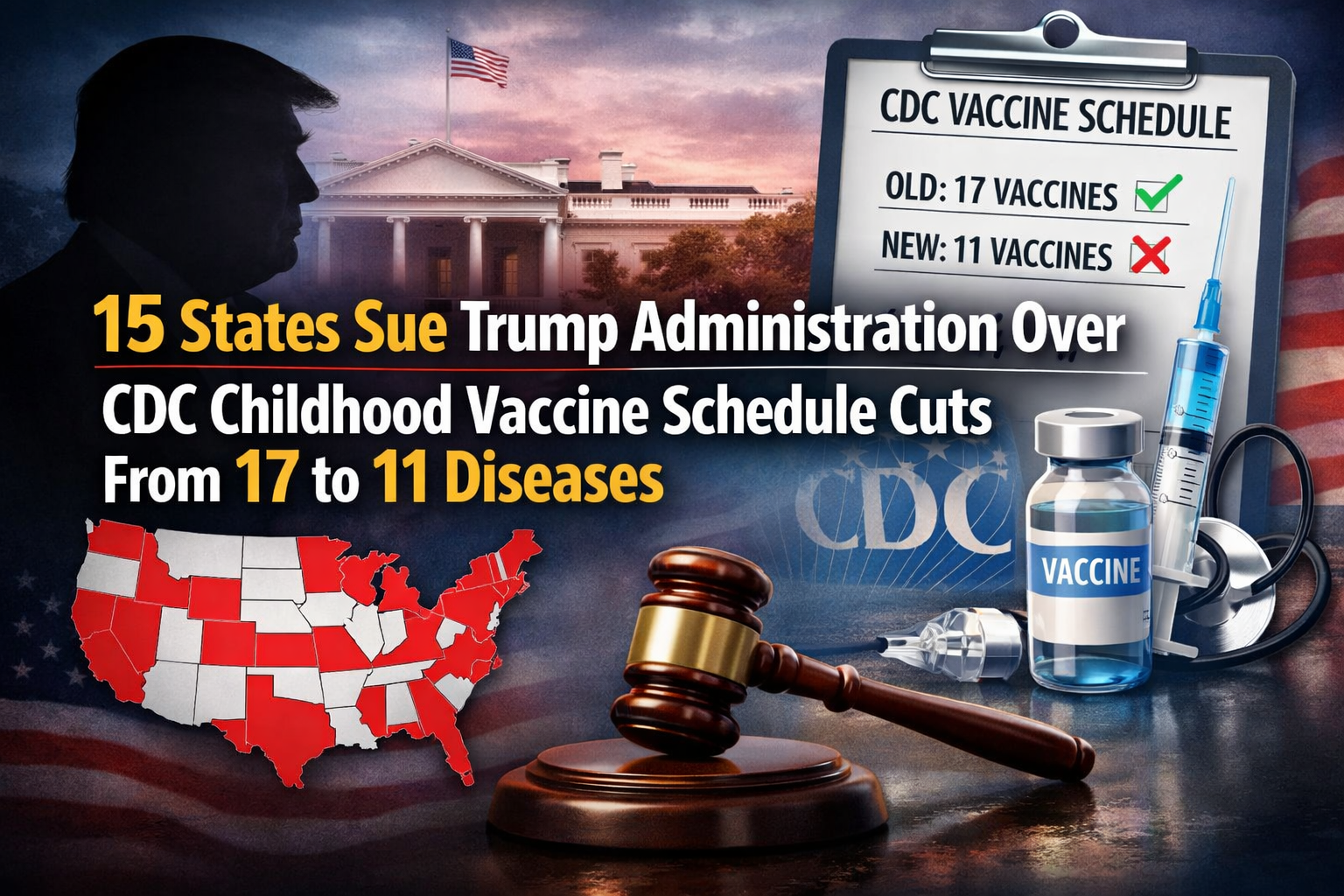
In February 2026, a coalition of Democrat led states filed a high profile lawsuit against the Trump administration over sweeping changes to the federal childhood vaccine schedule. The legal battle has drawn national attention and renewed debate about vaccine policy, scientific oversight, and the role of federal health agencies.
The lawsuit targets recent decisions by the U.S. Department of Health and Human Services and the U.S. Centers for Disease Control and Prevention that reduced the number of diseases covered under the routine childhood immunization schedule from 17 to 11. State leaders argue that the changes were made without proper scientific review and could put children at increased risk of preventable diseases.
This article explores the background of the case, the legal arguments on both sides, the potential impact on families and schools, and what this means for the future of vaccine policy in the United States.
In January 2026, federal health officials announced a revised childhood immunization schedule. The updated guidance significantly reduced the number of routinely recommended vaccines for children.
Previously, the federal schedule included protections against 17 diseases. The revised version now includes 11. Critics say the rollback removes long standing safeguards against serious and sometimes life threatening illnesses.
The lawsuit was filed by 14 state attorneys general along with the governor of Pennsylvania. The states involved include Arizona, California, Colorado, Connecticut, Delaware, Maine, Maryland, Michigan, Minnesota, New Jersey, New Mexico, Oregon, Rhode Island, and Wisconsin.
The defendants named in the suit include:
State officials argue that the revised schedule was not supported by credible scientific evidence and did not follow established federal review procedures.
A central issue in the lawsuit is the restructuring of the federal vaccine advisory panel known as the Advisory Committee on Immunization Practices, commonly referred to as ACIP.
For decades, ACIP has played a critical role in shaping vaccine recommendations in the United States. The committee evaluates scientific data on vaccine safety, effectiveness, and timing. Its recommendations influence:
In June 2025, Secretary Kennedy removed all 17 previous ACIP members and appointed new members who reportedly share skepticism about vaccine mandates and certain immunization practices.
Following the leadership changes, ACIP revised several long standing recommendations. Among the most notable was the rollback of routine hepatitis B vaccination for newborns. Hepatitis B is a highly contagious virus that can lead to chronic liver disease and liver cancer.
Plaintiffs argue that bypassing established scientific processes undermines public health protections and creates confusion for healthcare providers and families.
Another point of contention involves comparisons to vaccine policies in Denmark. According to court filings, the revised U.S. schedule closely mirrors Denmark’s approach, which includes fewer routine childhood vaccinations.
Critics argue that simply adopting Denmark’s vaccine schedule without adopting its national healthcare infrastructure does not account for key differences between the two countries, such as:
State attorneys general contend that public health policies must reflect domestic conditions rather than replicating foreign frameworks without comprehensive evaluation.
The coalition of states claims that:
California Attorney General Rob Bonta stated that vaccines have historically saved lives and reduced public health expenditures. Other state officials echoed concerns that weakening federal guidance may strain already limited healthcare resources.
An HHS spokesperson dismissed the lawsuit, describing it as politically motivated. Federal officials maintain that the health secretary has statutory authority to determine the CDC immunization schedule and appoint advisory committee members.
Under federal law, the Secretary of Health and Human Services does have broad discretion over public health policy decisions. The legal question may center on whether procedural requirements were met and whether the decision was arbitrary or capricious under administrative law standards.
This lawsuit is not the only legal challenge involving vaccine policy in 2026. In July 2025, six major medical organizations, including the American Academy of Pediatrics, filed a separate lawsuit.
That case challenges the decision to stop recommending COVID 19 vaccines for healthy children and pregnant women. The plaintiffs argue that the administration bypassed the typical evidence based review process.
More than 100 public health experts and organizations have filed briefs supporting that lawsuit. A federal judge in Massachusetts heard arguments earlier this month and is expected to issue a ruling soon.
Together, these cases represent one of the most significant federal state clashes over vaccine policy in modern U.S. history.
If the revised schedule remains in place, the long term public health effects remain uncertain. Historically, routine childhood vaccination programs have been credited with dramatically reducing diseases such as:
Public health experts warn that even modest declines in vaccination rates can lead to outbreaks, particularly in communities with lower immunization coverage.
School systems could also face challenges. Many states tie school vaccine requirements to CDC recommendations. A reduced federal schedule may prompt states to develop their own standards, potentially creating a patchwork of policies nationwide.
Healthcare providers may also encounter confusion regarding insurance reimbursement, since many coverage decisions rely on ACIP guidance.
The vaccine schedule dispute reflects broader political tensions surrounding public health authority, federal oversight, and parental choice.
Supporters of the revised schedule argue that reducing mandated vaccines increases parental autonomy and reduces unnecessary medical interventions.
Opponents counter that vaccine policy must be grounded in scientific consensus and public health data rather than political ideology.
The outcome of this case could influence:
Given the prominence of the figures involved and the scope of the changes, the court’s decision could have lasting consequences for U.S. healthcare policy.
The lawsuit will proceed through federal court, where judges will evaluate whether the administration followed required administrative procedures and whether the revised schedule meets legal standards.
Possible outcomes include:
Until a ruling is issued, uncertainty may continue for state health departments, pediatricians, insurers, and families.
For parents, vaccine policy changes can feel confusing and politically charged. Regardless of legal outcomes, pediatricians remain a primary source of individualized medical advice.
Routine childhood vaccinations have historically been recommended based on large scale clinical trials and long term epidemiological data. However, vaccine decisions can vary depending on a child’s health status, family medical history, and regional disease patterns.
Parents should consult licensed healthcare providers to make informed decisions tailored to their child’s needs.
The lawsuit filed by 15 Democrat led states marks a significant moment in the ongoing national debate over vaccine policy. At stake is not only the content of the childhood immunization schedule but also the integrity of the scientific review process that has guided U.S. public health decisions for decades.
As legal proceedings unfold, families, healthcare professionals, and policymakers will be watching closely. The court’s ruling may redefine how vaccine recommendations are developed and implemented across the country.
In a time of heightened political division, the case underscores the importance of transparent, evidence based decision making in protecting public health.
The New York Times, February 24, 2026.
This article is for informational and educational purposes only. It does not constitute medical or legal advice. Vaccine recommendations and healthcare decisions should always be made in consultation with a qualified healthcare professional. Statistical and policy information reflects general trends and may not apply to individual circumstances.

Most Accurate Healthcare AI designed for everything from admin workflows to clinical decision support.